







Araghchi: Regional security cannot be achieved without Iran
Iranian Foreign Minister Abbas Araghchi said regional security cannot be achieved by sidelining or excluding Iran, stressing that recent events have underscored the need for cooperation and respect for the interests of all countries in the region.
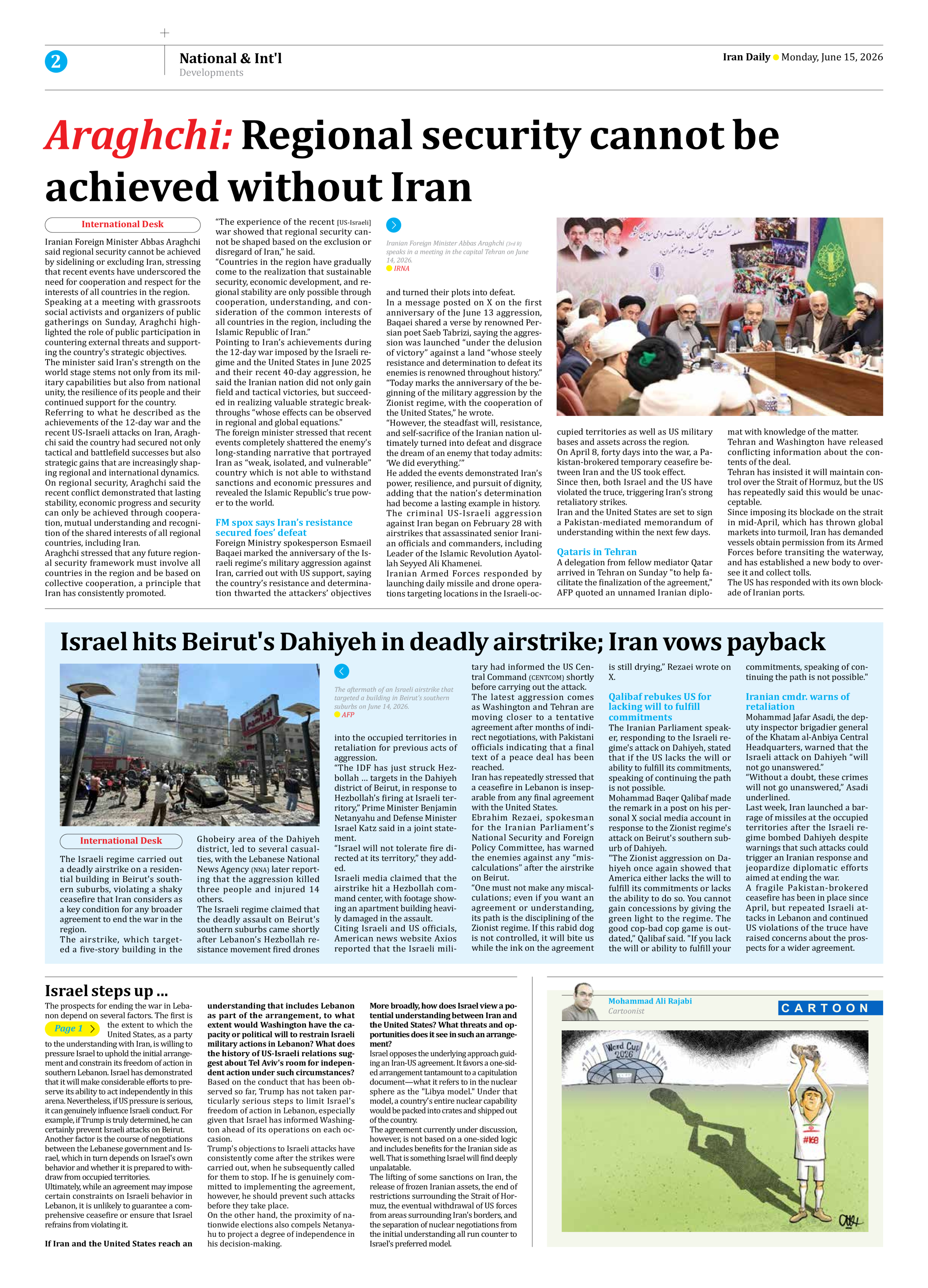
Speaking at a meeting with grassroots social activists and organizers of public gatherings on Sunday, Araghchi highlighted the role of public participation in countering external threats and supporting the country's strategic objectives.
The minister said Iran's strength on the world stage stems not only from its military capabilities but also from national unity, the resilience of its people and their continued support for the country.
Referring to what he described as the achievements of the 12-day war and the recent US-Israeli attacks on Iran, Araghchi said the country had secured not only tactical and battlefield successes but also strategic gains that are increasingly shaping regional and international dynamics.
On regional security, Araghchi said the recent conflict demonstrated that lasting stability, economic progress and security can only be achieved through cooperation, mutual understanding and recognition of the shared interests of all regional countries, including Iran.
Araghchi stressed that any future regional security framework must involve all countries in the region and be based on collective cooperation, a principle that Iran has consistently promoted.
“The experience of the recent [US-Israeli] war showed that regional security cannot be shaped based on the exclusion or disregard of Iran,” he said.
“Countries in the region have gradually come to the realization that sustainable security, economic development, and regional stability are only possible through cooperation, understanding, and consideration of the common interests of all countries in the region, including the Islamic Republic of Iran.”
Pointing to Iran’s achievements during the 12-day war imposed by the Israeli regime and the United States in June 2025 and their recent 40-day aggression, he said the Iranian nation did not only gain field and tactical victories, but succeeded in realizing valuable strategic breakthroughs “whose effects can be observed in regional and global equations."
The foreign minister stressed that recent events completely shattered the enemy’s long-standing narrative that portrayed Iran as “weak, isolated, and vulnerable” country which is not able to withstand sanctions and economic pressures and revealed the Islamic Republic’s true power to the world.
FM spox says Iran’s resistance secured foes’ defeat
Foreign Ministry spokesperson Esmaeil Baqaei marked the anniversary of the Israeli regime’s military aggression against Iran, carried out with US support, saying the country’s resistance and determination thwarted the attackers’ objectives and turned their plots into defeat.
In a message posted on X on the first anniversary of the June 13 aggression, Baqaei shared a verse by renowned Persian poet Saeb Tabrizi, saying the aggression was launched “under the delusion of victory” against a land “whose steely resistance and determination to defeat its enemies is renowned throughout history.”
“Today marks the anniversary of the beginning of the military aggression by the Zionist regime, with the cooperation of the United States,” he wrote.
“However, the steadfast will, resistance, and self-sacrifice of the Iranian nation ultimately turned into defeat and disgrace the dream of an enemy that today admits: ‘We did everything.’”
He added the events demonstrated Iran’s power, resilience, and pursuit of dignity, adding that the nation’s determination had become a lasting example in history.
The criminal US-Israeli aggression against Iran began on February 28 with airstrikes that assassinated senior Iranian officials and commanders, including Leader of the Islamic Revolution Ayatollah Seyyed Ali Khamenei.
Iranian Armed Forces responded by launching daily missile and drone operations targeting locations in the Israeli-occupied territories as well as US military bases and assets across the region.
On April 8, forty days into the war, a Pakistan-brokered temporary ceasefire between Iran and the US took effect.
Since then, both Israel and the US have violated the truce, triggering Iran’s strong retaliatory strikes.
Iran and the United States are set to sign a Pakistan-mediated memorandum of understanding within the next few days.
Qataris in Tehran
A delegation from fellow mediator Qatar arrived in Tehran on Sunday "to help facilitate the finalization of the agreement," AFP quoted an unnamed Iranian diplomat with knowledge of the matter.
Tehran and Washington have released conflicting information about the contents of the deal.
Tehran has insisted it will maintain control over the Strait of Hormuz, but the US has repeatedly said this would be unacceptable.
Since imposing its blockade on the strait in mid-April, which has thrown global markets into turmoil, Iran has demanded vessels obtain permission from its Armed Forces before transiting the waterway, and has established a new body to oversee it and collect tolls.
The US has responded with its own blockade of Iranian ports.