







Minister urges BRICS action to safeguard global food security
Iran's agriculture minister said on Saturday that global food security must not be undermined by unilateral measures and disruptions to supply chains, calling on BRICS members to play a more effective role against emerging food security challenges.
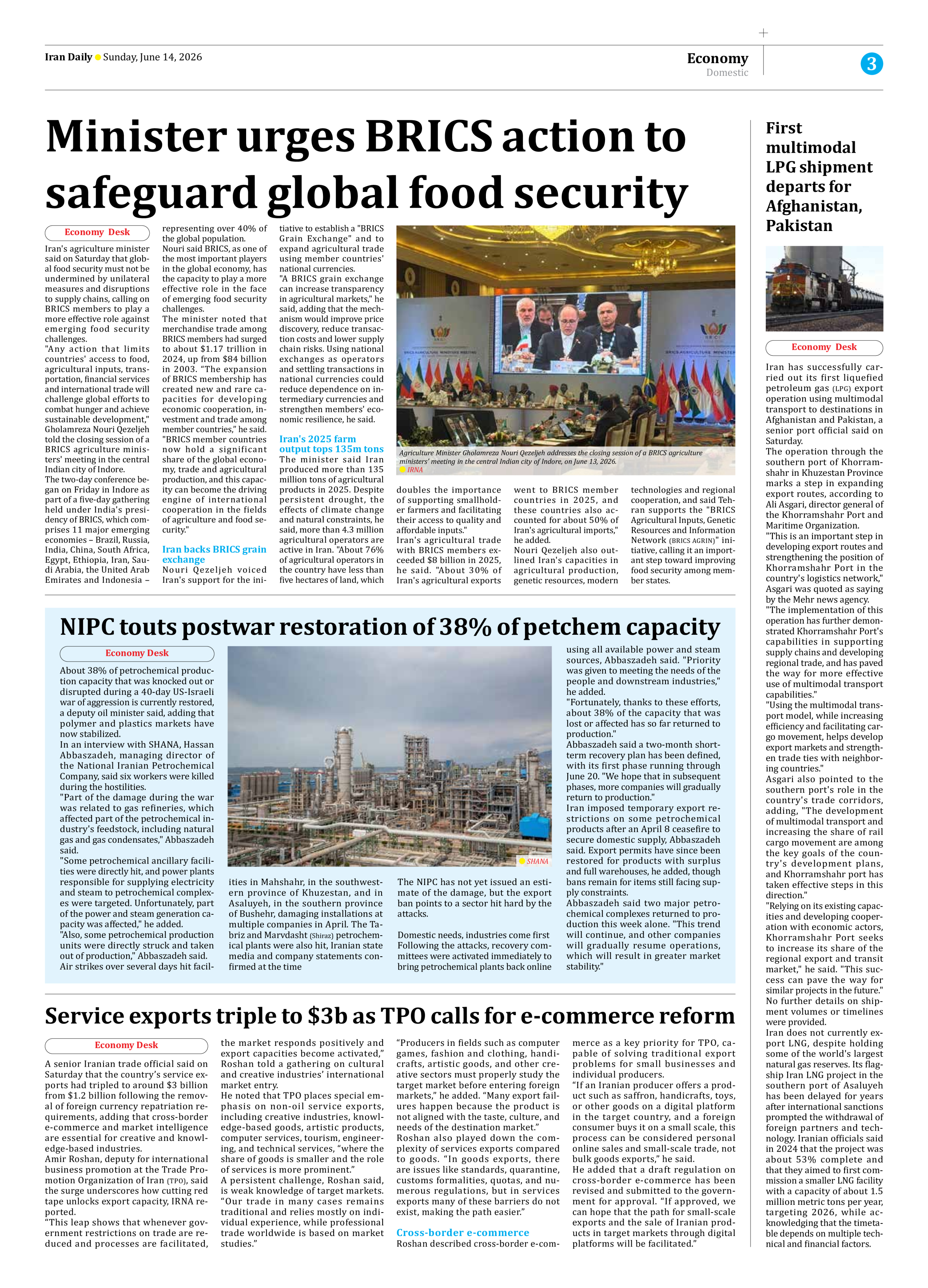
"Any action that limits countries' access to food, agricultural inputs, transportation, financial services and international trade will challenge global efforts to combat hunger and achieve sustainable development," Gholamreza Nouri Qezeljeh told the closing session of a BRICS agriculture ministers' meeting in the central Indian city of Indore.
The two-day conference began on Friday in Indore as part of a five-day gathering held under India's presidency of BRICS, which comprises 11 major emerging economies – Brazil, Russia, India, China, South Africa, Egypt, Ethiopia, Iran, Saudi Arabia, the United Arab Emirates and Indonesia – representing over 40% of the global population.
Nouri said BRICS, as one of the most important players in the global economy, has the capacity to play a more effective role in the face of emerging food security challenges.
The minister noted that merchandise trade among BRICS members had surged to about $1.17 trillion in 2024, up from $84 billion in 2003. “The expansion of BRICS membership has created new and rare capacities for developing economic cooperation, investment and trade among member countries,” he said.
"BRICS member countries now hold a significant share of the global economy, trade and agricultural production, and this capacity can become the driving engine of international cooperation in the fields of agriculture and food security."
Iran backs BRICS grain exchange
Nouri Qezeljeh voiced Iran's support for the initiative to establish a "BRICS Grain Exchange" and to expand agricultural trade using member countries' national currencies.
"A BRICS grain exchange can increase transparency in agricultural markets," he said, adding that the mechanism would improve price discovery, reduce transaction costs and lower supply chain risks. Using national exchanges as operators and settling transactions in national currencies could reduce dependence on intermediary currencies and strengthen members' economic resilience, he said.
Iran's 2025 farm output tops 135m tons
The minister said Iran produced more than 135 million tons of agricultural products in 2025. Despite persistent drought, the effects of climate change and natural constraints, he said, more than 4.3 million agricultural operators are active in Iran. "About 76% of agricultural operators in the country have less than five hectares of land, which doubles the importance of supporting smallholder farmers and facilitating their access to quality and affordable inputs."
Iran's agricultural trade with BRICS members exceeded $8 billion in 2025, he said. "About 30% of Iran's agricultural exports went to BRICS member countries in 2025, and these countries also accounted for about 50% of Iran's agricultural imports," he added.
Nouri Qezeljeh also outlined Iran's capacities in agricultural production, genetic resources, modern technologies and regional cooperation, and said Tehran supports the "BRICS Agricultural Inputs, Genetic Resources and Information Network (BRICS AGRIN)" initiative, calling it an important step toward improving food security among member states.