







Hands keeping Abpakhsh’s mat weaving tradition alive
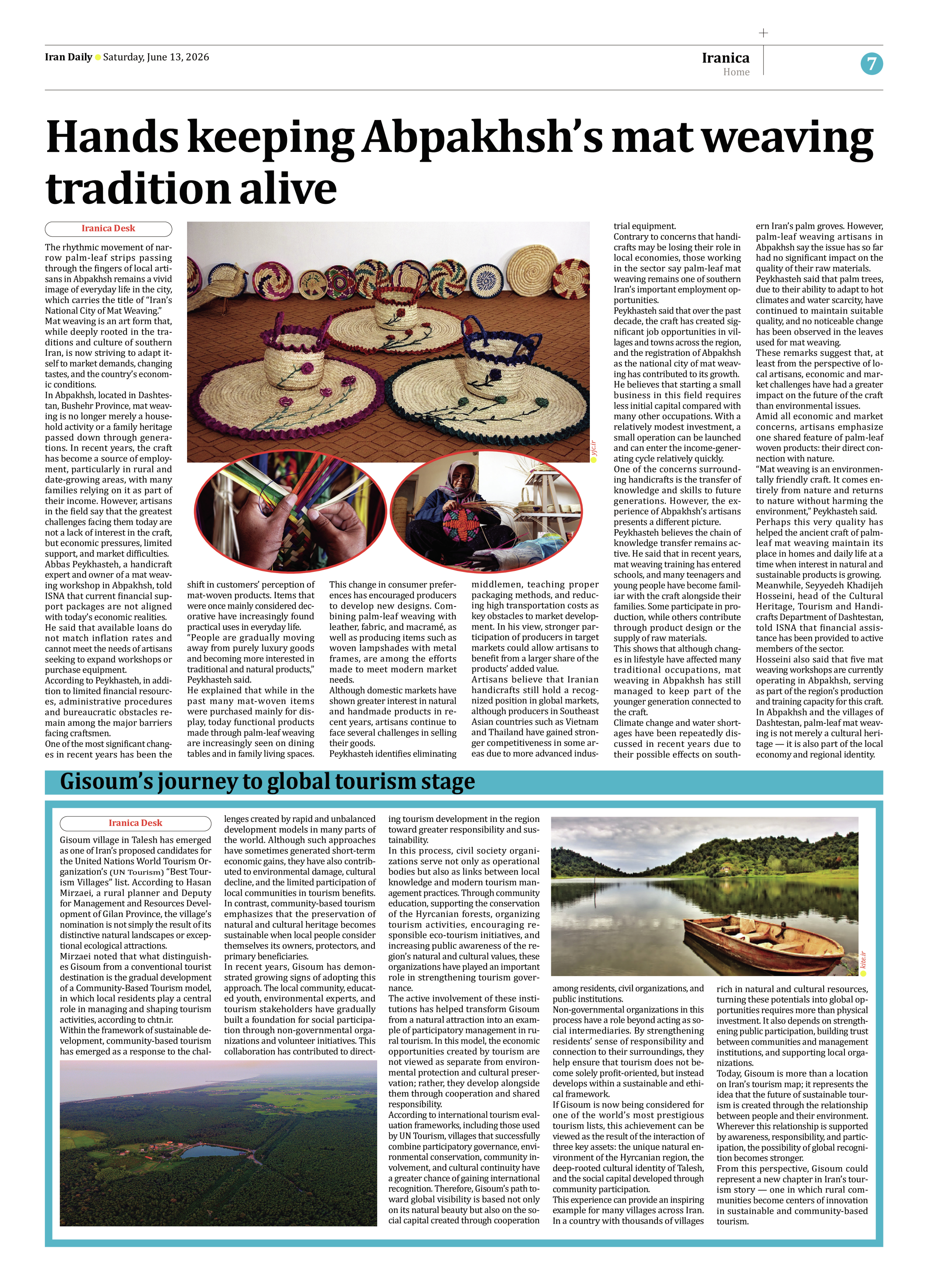
The rhythmic movement of narrow palm-leaf strips passing through the fingers of local artisans in Abpakhsh remains a vivid image of everyday life in the city, which carries the title of “Iran’s National City of Mat Weaving.”
Mat weaving is an art form that, while deeply rooted in the traditions and culture of southern Iran, is now striving to adapt itself to market demands, changing tastes, and the country’s economic conditions.
In Abpakhsh, located in Dashtestan, Bushehr Province, mat weaving is no longer merely a household activity or a family heritage passed down through generations. In recent years, the craft has become a source of employment, particularly in rural and date-growing areas, with many families relying on it as part of their income. However, artisans in the field say that the greatest challenges facing them today are not a lack of interest in the craft, but economic pressures, limited support, and market difficulties.
Abbas Peykhasteh, a handicraft expert and owner of a mat weaving workshop in Abpakhsh, told ISNA that current financial support packages are not aligned with today’s economic realities.
He said that available loans do not match inflation rates and cannot meet the needs of artisans seeking to expand workshops or purchase equipment.
According to Peykhasteh, in addition to limited financial resources, administrative procedures and bureaucratic obstacles remain among the major barriers facing craftsmen.
One of the most significant changes in recent years has been the shift in customers’ perception of mat-woven products. Items that were once mainly considered decorative have increasingly found practical uses in everyday life.
“People are gradually moving away from purely luxury goods and becoming more interested in traditional and natural products,” Peykhasteh said.
He explained that while in the past many mat-woven items were purchased mainly for display, today functional products made through palm-leaf weaving are increasingly seen on dining tables and in family living spaces.
This change in consumer preferences has encouraged producers to develop new designs. Combining palm-leaf weaving with leather, fabric, and macramé, as well as producing items such as woven lampshades with metal frames, are among the efforts made to meet modern market needs.
Although domestic markets have shown greater interest in natural and handmade products in recent years, artisans continue to face several challenges in selling their goods.
Peykhasteh identifies eliminating middlemen, teaching proper packaging methods, and reducing high transportation costs as key obstacles to market development. In his view, stronger participation of producers in target markets could allow artisans to benefit from a larger share of the products’ added value.
Artisans believe that Iranian handicrafts still hold a recognized position in global markets, although producers in Southeast Asian countries such as Vietnam and Thailand have gained stronger competitiveness in some areas due to more advanced industrial equipment.
Contrary to concerns that handicrafts may be losing their role in local economies, those working in the sector say palm-leaf mat weaving remains one of southern Iran’s important employment opportunities.
Peykhasteh said that over the past decade, the craft has created significant job opportunities in villages and towns across the region, and the registration of Abpakhsh as the national city of mat weaving has contributed to its growth.
He believes that starting a small business in this field requires less initial capital compared with many other occupations. With a relatively modest investment, a small operation can be launched and can enter the income-generating cycle relatively quickly.
One of the concerns surrounding handicrafts is the transfer of knowledge and skills to future generations. However, the experience of Abpakhsh’s artisans presents a different picture.
Peykhasteh believes the chain of knowledge transfer remains active. He said that in recent years, mat weaving training has entered schools, and many teenagers and young people have become familiar with the craft alongside their families. Some participate in production, while others contribute through product design or the supply of raw materials.
This shows that although changes in lifestyle have affected many traditional occupations, mat weaving in Abpakhsh has still managed to keep part of the younger generation connected to the craft.
Climate change and water shortages have been repeatedly discussed in recent years due to their possible effects on southern Iran’s palm groves. However, palm-leaf weaving artisans in Abpakhsh say the issue has so far had no significant impact on the quality of their raw materials.
Peykhasteh said that palm trees, due to their ability to adapt to hot climates and water scarcity, have continued to maintain suitable quality, and no noticeable change has been observed in the leaves used for mat weaving.
These remarks suggest that, at least from the perspective of local artisans, economic and market challenges have had a greater impact on the future of the craft than environmental issues.
Amid all economic and market concerns, artisans emphasize one shared feature of palm-leaf woven products: their direct connection with nature.
“Mat weaving is an environmentally friendly craft. It comes entirely from nature and returns to nature without harming the environment,” Peykhasteh said.
Perhaps this very quality has helped the ancient craft of palm-leaf mat weaving maintain its place in homes and daily life at a time when interest in natural and sustainable products is growing.
Meanwhile, Seyyedeh Khadijeh Hosseini, head of the Cultural Heritage, Tourism and Handicrafts Department of Dashtestan, told ISNA that financial assistance has been provided to active members of the sector.
Hosseini also said that five mat weaving workshops are currently operating in Abpakhsh, serving as part of the region’s production and training capacity for this craft.
In Abpakhsh and the villages of Dashtestan, palm-leaf mat weaving is not merely a cultural heritage — it is also part of the local economy and regional identity.