





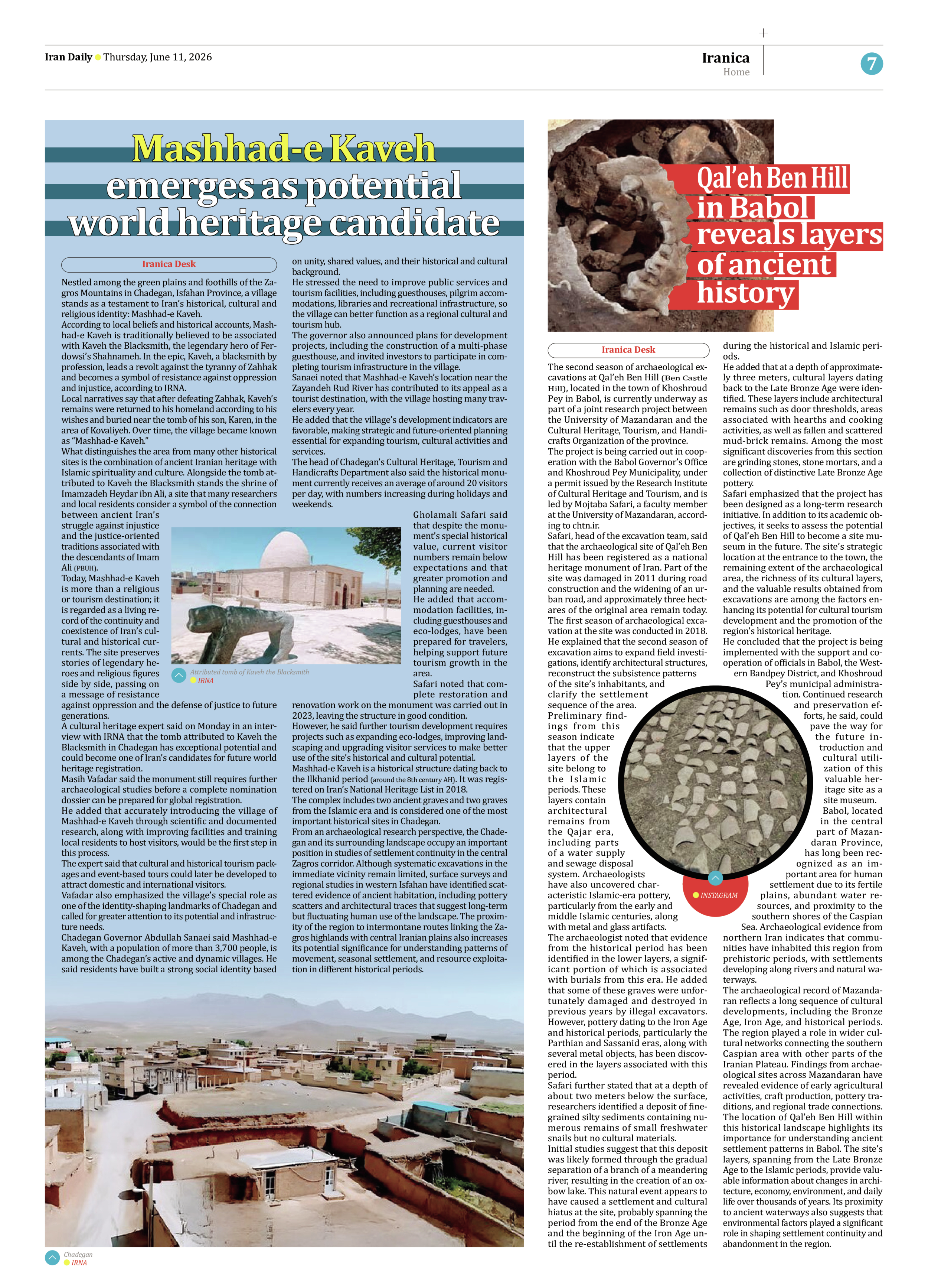


Qal’eh Ben Hill in Babol reveals layers of ancient history
The second season of archaeological excavations at Qal’eh Ben Hill (Ben Castle Hill), located in the town of Khoshroud Pey in Babol, is currently underway as part of a joint research project between the University of Mazandaran and the Cultural Heritage, Tourism, and Handicrafts Organization of the province.
The project is being carried out in cooperation with the Babol Governor’s Office and Khoshroud Pey Municipality, under a permit issued by the Research Institute of Cultural Heritage and Tourism, and is led by Mojtaba Safari, a faculty member at the University of Mazandaran, according to chtn.ir.
Safari, head of the excavation team, said that the archaeological site of Qal’eh Ben Hill has been registered as a national heritage monument of Iran. Part of the site was damaged in 2011 during road construction and the widening of an urban road, and approximately three hectares of the original area remain today. The first season of archaeological excavation at the site was conducted in 2018.
He explained that the second season of excavation aims to expand field investigations, identify architectural structures, reconstruct the subsistence patterns of the site’s inhabitants, and clarify the settlement sequence of the area. Preliminary findings from this season indicate that the upper layers of the site belong to the Islamic periods. These layers contain architectural remains from the Qajar era, including parts of a water supply and sewage disposal system. Archaeologists have also uncovered characteristic Islamic-era pottery, particularly from the early and middle Islamic centuries, along with metal and glass artifacts.
The archaeologist noted that evidence from the historical period has been identified in the lower layers, a significant portion of which is associated with burials from this era. He added that some of these graves were unfortunately damaged and destroyed in previous years by illegal excavators. However, pottery dating to the Iron Age and historical periods, particularly the Parthian and Sassanid eras, along with several metal objects, has been discovered in the layers associated with this period.
Safari further stated that at a depth of about two meters below the surface, researchers identified a deposit of fine-grained silty sediments containing numerous remains of small freshwater snails but no cultural materials.
Initial studies suggest that this deposit was likely formed through the gradual separation of a branch of a meandering river, resulting in the creation of an oxbow lake. This natural event appears to have caused a settlement and cultural hiatus at the site, probably spanning the period from the end of the Bronze Age and the beginning of the Iron Age until the re-establishment of settlements during the historical and Islamic periods.
He added that at a depth of approximately three meters, cultural layers dating back to the Late Bronze Age were identified. These layers include architectural remains such as door thresholds, areas associated with hearths and cooking activities, as well as fallen and scattered mud-brick remains. Among the most significant discoveries from this section are grinding stones, stone mortars, and a collection of distinctive Late Bronze Age pottery.
Safari emphasized that the project has been designed as a long-term research initiative. In addition to its academic objectives, it seeks to assess the potential of Qal’eh Ben Hill to become a site museum in the future. The site’s strategic location at the entrance to the town, the remaining extent of the archaeological area, the richness of its cultural layers, and the valuable results obtained from excavations are among the factors enhancing its potential for cultural tourism development and the promotion of the region’s historical heritage.
He concluded that the project is being implemented with the support and cooperation of officials in Babol, the Western Bandpey District, and Khoshroud Pey’s municipal administration. Continued research and preservation efforts, he said, could pave the way for the future introduction and cultural utilization of this valuable heritage site as a site museum.
Babol, located in the central part of Mazandaran Province, has long been recognized as an important area for human settlement due to its fertile plains, abundant water resources, and proximity to the southern shores of the Caspian Sea. Archaeological evidence from northern Iran indicates that communities have inhabited this region from prehistoric periods, with settlements developing along rivers and natural waterways.
The archaeological record of Mazandaran reflects a long sequence of cultural developments, including the Bronze Age, Iron Age, and historical periods. The region played a role in wider cultural networks connecting the southern Caspian area with other parts of the Iranian Plateau. Findings from archaeological sites across Mazandaran have revealed evidence of early agricultural activities, craft production, pottery traditions, and regional trade connections.
The location of Qal’eh Ben Hill within this historical landscape highlights its importance for understanding ancient settlement patterns in Babol. The site’s layers, spanning from the Late Bronze Age to the Islamic periods, provide valuable information about changes in architecture, economy, environment, and daily life over thousands of years. Its proximity to ancient waterways also suggests that environmental factors played a significant role in shaping settlement continuity and abandonment in the region.