







Mashhad-e Kaveh emerges as potential world heritage candidate
Nestled among the green plains and foothills of the Zagros Mountains in Chadegan, Isfahan Province, a village stands as a testament to Iran’s historical, cultural and religious identity: Mashhad-e Kaveh.
According to local beliefs and historical accounts, Mashhad-e Kaveh is traditionally believed to be associated with Kaveh the Blacksmith, the legendary hero of Ferdowsi’s Shahnameh. In the epic, Kaveh, a blacksmith by profession, leads a revolt against the tyranny of Zahhak and becomes a symbol of resistance against oppression and injustice, according to IRNA.
Local narratives say that after defeating Zahhak, Kaveh’s remains were returned to his homeland according to his wishes and buried near the tomb of his son, Karen, in the area of Kovaliyeh. Over time, the village became known as “Mashhad-e Kaveh.”
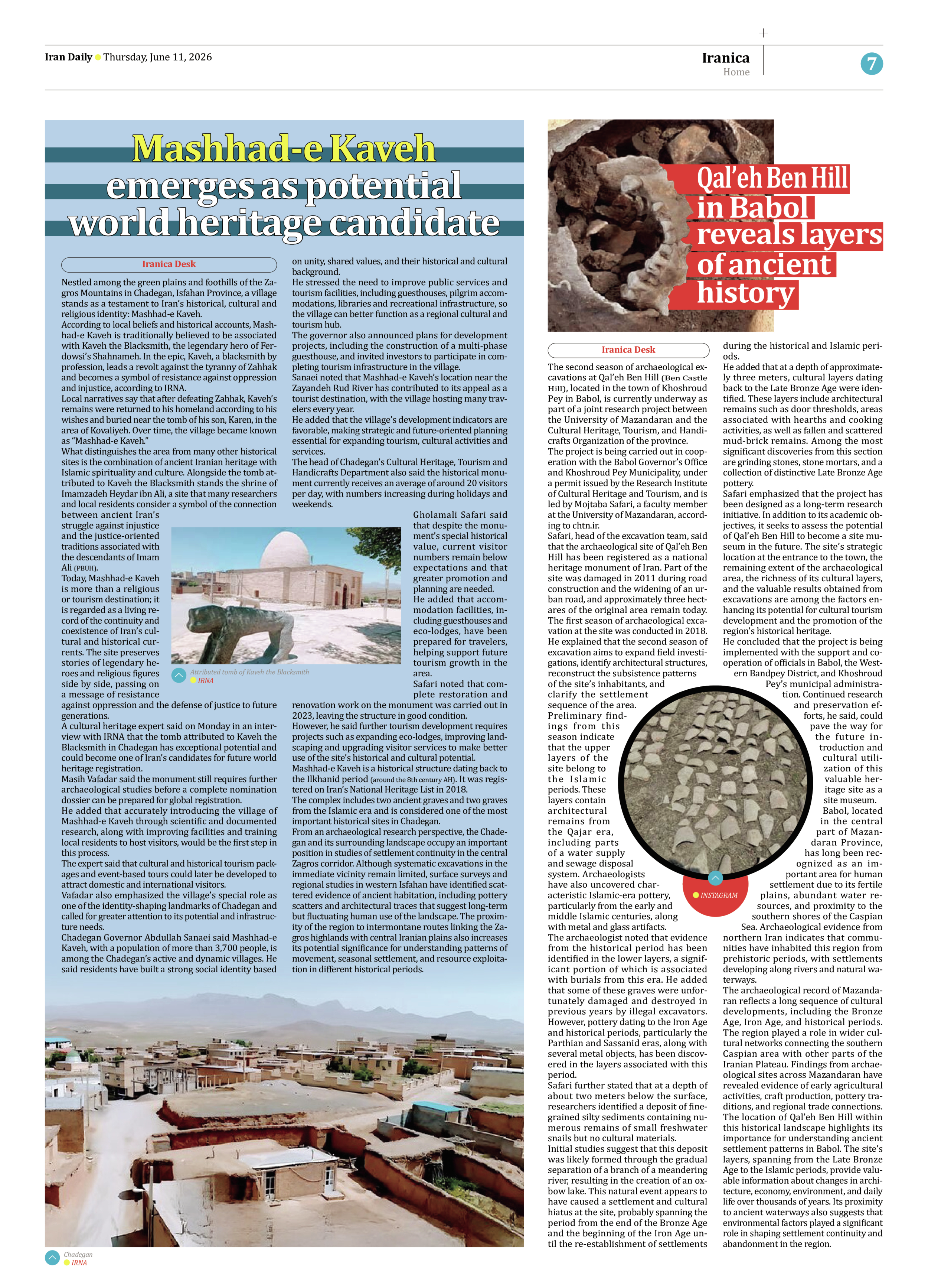
What distinguishes the area from many other historical sites is the combination of ancient Iranian heritage with Islamic spirituality and culture. Alongside the tomb attributed to Kaveh the Blacksmith stands the shrine of Imamzadeh Heydar ibn Ali, a site that many researchers and local residents consider a symbol of the connection between ancient Iran’s struggle against injustice and the justice-oriented traditions associated with the descendants of Imam Ali (PBUH).
Today, Mashhad-e Kaveh is more than a religious or tourism destination; it is regarded as a living record of the continuity and coexistence of Iran’s cultural and historical currents. The site preserves stories of legendary heroes and religious figures side by side, passing on a message of resistance against oppression and the defense of justice to future generations.
A cultural heritage expert said on Monday in an interview with IRNA that the tomb attributed to Kaveh the Blacksmith in Chadegan has exceptional potential and could become one of Iran’s candidates for future world heritage registration.
Masih Vafadar said the monument still requires further archaeological studies before a complete nomination dossier can be prepared for global registration.
He added that accurately introducing the village of Mashhad-e Kaveh through scientific and documented research, along with improving facilities and training local residents to host visitors, would be the first step in this process.
The expert said that cultural and historical tourism packages and event-based tours could later be developed to attract domestic and international visitors.
Vafadar also emphasized the village’s special role as one of the identity-shaping landmarks of Chadegan and called for greater attention to its potential and infrastructure needs.
Chadegan Governor Abdullah Sanaei said Mashhad-e Kaveh, with a population of more than 3,700 people, is among the Chadegan’s active and dynamic villages. He said residents have built a strong social identity based on unity, shared values, and their historical and cultural background.
He stressed the need to improve public services and tourism facilities, including guesthouses, pilgrim accommodations, libraries and recreational infrastructure, so the village can better function as a regional cultural and tourism hub.
The governor also announced plans for development projects, including the construction of a multi-phase guesthouse, and invited investors to participate in completing tourism infrastructure in the village.
Sanaei noted that Mashhad-e Kaveh’s location near the Zayandeh Rud River has contributed to its appeal as a tourist destination, with the village hosting many travelers every year.
He added that the village’s development indicators are favorable, making strategic and future-oriented planning essential for expanding tourism, cultural activities and services.
The head of Chadegan’s Cultural Heritage, Tourism and Handicrafts Department also said the historical monument currently receives an average of around 20 visitors per day, with numbers increasing during holidays and weekends.
Gholamali Safari said that despite the monument’s special historical value, current visitor numbers remain below expectations and that greater promotion and planning are needed.
He added that accommodation facilities, including guesthouses and eco-lodges, have been prepared for travelers, helping support future tourism growth in the area.
Safari noted that complete restoration and renovation work on the monument was carried out in 2023, leaving the structure in good condition.
However, he said further tourism development requires projects such as expanding eco-lodges, improving landscaping and upgrading visitor services to make better use of the site’s historical and cultural potential.
Mashhad-e Kaveh is a historical structure dating back to the Ilkhanid period (around the 8th century AH). It was registered on Iran’s National Heritage List in 2018.
The complex includes two ancient graves and two graves from the Islamic era and is considered one of the most important historical sites in Chadegan.
From an archaeological research perspective, the Chadegan and its surrounding landscape occupy an important position in studies of settlement continuity in the central Zagros corridor. Although systematic excavations in the immediate vicinity remain limited, surface surveys and regional studies in western Isfahan have identified scattered evidence of ancient habitation, including pottery scatters and architectural traces that suggest long-term but fluctuating human use of the landscape. The proximity of the region to intermontane routes linking the Zagros highlands with central Iranian plains also increases its potential significance for understanding patterns of movement, seasonal settlement, and resource exploitation in different historical periods.