







Yakh Morad Cave facing uncertain future
On a road cutting through the heart of the Alborz Mountains, somewhere between the endless bends of the Chalus Road and slopes that sometimes seemed to separate the sky from the earth, a narrow side road branched off toward Kohneh Deh village. The route was quieter than one might have expected for a destination leading to one of Iran’s most remarkable limestone caves. Yet this silence was exactly what had surrounded Yakh Morad Cave for decades.
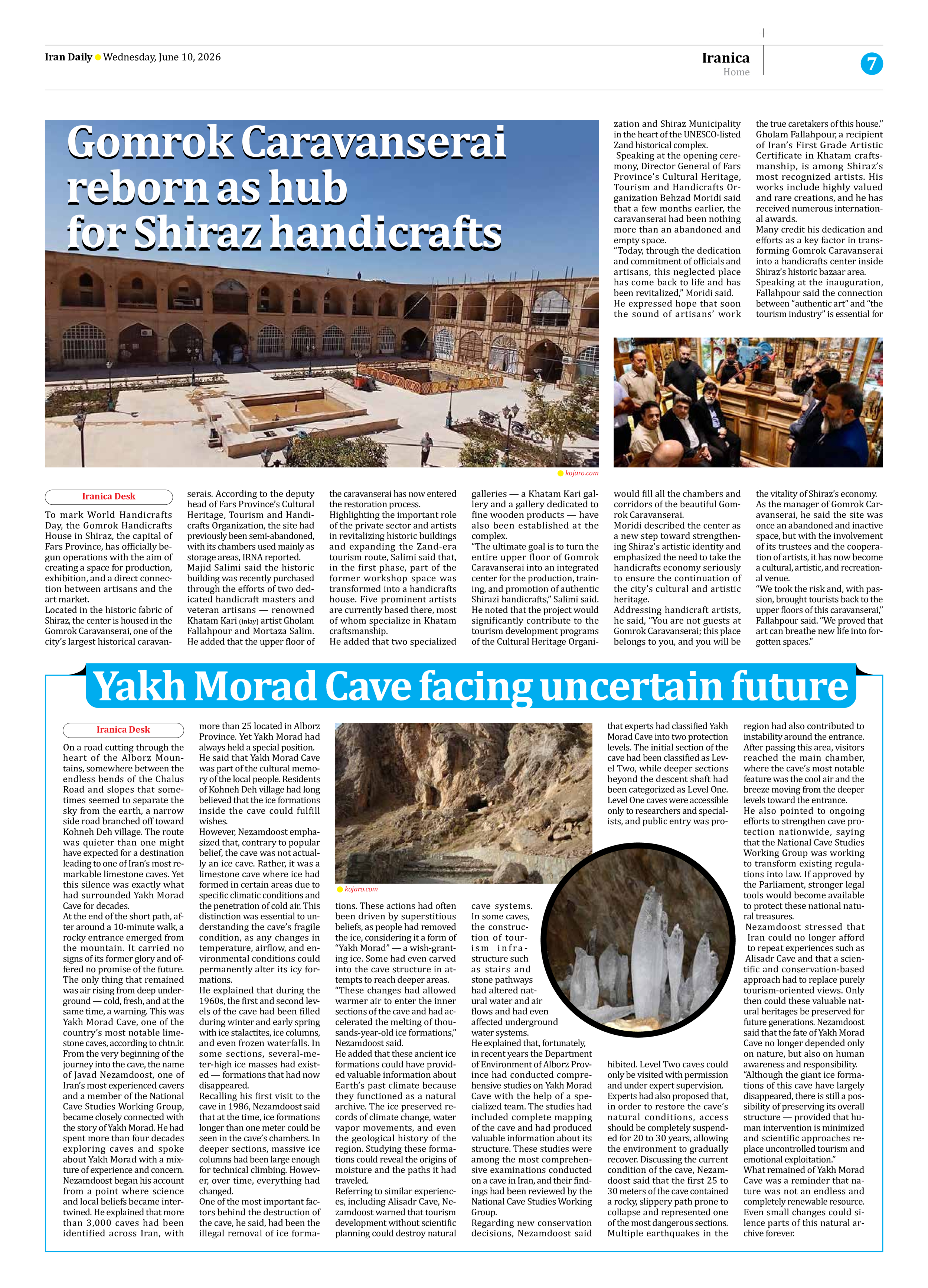
At the end of the short path, after around a 10-minute walk, a rocky entrance emerged from the mountain. It carried no signs of its former glory and offered no promise of the future. The only thing that remained was air rising from deep underground — cold, fresh, and at the same time, a warning. This was Yakh Morad Cave, one of the country’s most notable limestone caves, according to chtn.ir.
From the very beginning of the journey into the cave, the name of Javad Nezamdoost, one of Iran’s most experienced cavers and a member of the National Cave Studies Working Group, became closely connected with the story of Yakh Morad. He had spent more than four decades exploring caves and spoke about Yakh Morad with a mixture of experience and concern.
Nezamdoost began his account from a point where science and local beliefs became intertwined. He explained that more than 3,000 caves had been identified across Iran, with more than 25 located in Alborz Province. Yet Yakh Morad had always held a special position.
He said that Yakh Morad Cave was part of the cultural memory of the local people. Residents of Kohneh Deh village had long believed that the ice formations inside the cave could fulfill wishes.
However, Nezamdoost emphasized that, contrary to popular belief, the cave was not actually an ice cave. Rather, it was a limestone cave where ice had formed in certain areas due to specific climatic conditions and the penetration of cold air. This distinction was essential to understanding the cave’s fragile condition, as any changes in temperature, airflow, and environmental conditions could permanently alter its icy formations.
He explained that during the 1960s, the first and second levels of the cave had been filled during winter and early spring with ice stalactites, ice columns, and even frozen waterfalls. In some sections, several-meter-high ice masses had existed — formations that had now disappeared.
Recalling his first visit to the cave in 1986, Nezamdoost said that at the time, ice formations longer than one meter could be seen in the cave’s chambers. In deeper sections, massive ice columns had been large enough for technical climbing. However, over time, everything had changed.
One of the most important factors behind the destruction of the cave, he said, had been the illegal removal of ice formations. These actions had often been driven by superstitious beliefs, as people had removed the ice, considering it a form of “Yakh Morad” — a wish-granting ice. Some had even carved into the cave structure in attempts to reach deeper areas.
“These changes had allowed warmer air to enter the inner sections of the cave and had accelerated the melting of thousands-year-old ice formations,” Nezamdoost said.
He added that these ancient ice formations could have provided valuable information about Earth’s past climate because they functioned as a natural archive. The ice preserved records of climate change, water vapor movements, and even the geological history of the region. Studying these formations could reveal the origins of moisture and the paths it had traveled.
Referring to similar experiences, including Alisadr Cave, Nezamdoost warned that tourism development without scientific planning could destroy natural cave systems. In some caves, the construction of tourism infrastructure such as stairs and stone pathways had altered natural water and air flows and had even affected underground water systems.
He explained that, fortunately, in recent years the Department of Environment of Alborz Province had conducted comprehensive studies on Yakh Morad Cave with the help of a specialized team. The studies had included complete mapping of the cave and had produced valuable information about its structure. These studies were among the most comprehensive examinations conducted on a cave in Iran, and their findings had been reviewed by the National Cave Studies Working Group.
Regarding new conservation decisions, Nezamdoost said that experts had classified Yakh Morad Cave into two protection levels. The initial section of the cave had been classified as Level Two, while deeper sections beyond the descent shaft had been categorized as Level One. Level One caves were accessible only to researchers and specialists, and public entry was prohibited. Level Two caves could only be visited with permission and under expert supervision.
Experts had also proposed that, in order to restore the cave’s natural conditions, access should be completely suspended for 20 to 30 years, allowing the environment to gradually recover. Discussing the current condition of the cave, Nezamdoost said that the first 25 to 30 meters of the cave contained a rocky, slippery path prone to collapse and represented one of the most dangerous sections. Multiple earthquakes in the region had also contributed to instability around the entrance. After passing this area, visitors reached the main chamber, where the cave’s most notable feature was the cool air and the breeze moving from the deeper levels toward the entrance.
He also pointed to ongoing efforts to strengthen cave protection nationwide, saying that the National Cave Studies Working Group was working to transform existing regulations into law. If approved by the Parliament, stronger legal tools would become available to protect these national natural treasures.
Nezamdoost stressed that Iran could no longer afford to repeat experiences such as Alisadr Cave and that a scientific and conservation-based approach had to replace purely tourism-oriented views. Only then could these valuable natural heritages be preserved for future generations. Nezamdoost said that the fate of Yakh Morad Cave no longer depended only on nature, but also on human awareness and responsibility.
“Although the giant ice formations of this cave have largely disappeared, there is still a possibility of preserving its overall structure — provided that human intervention is minimized and scientific approaches replace uncontrolled tourism and emotional exploitation.”
What remained of Yakh Morad Cave was a reminder that nature was not an endless and completely renewable resource. Even small changes could silence parts of this natural archive forever.