





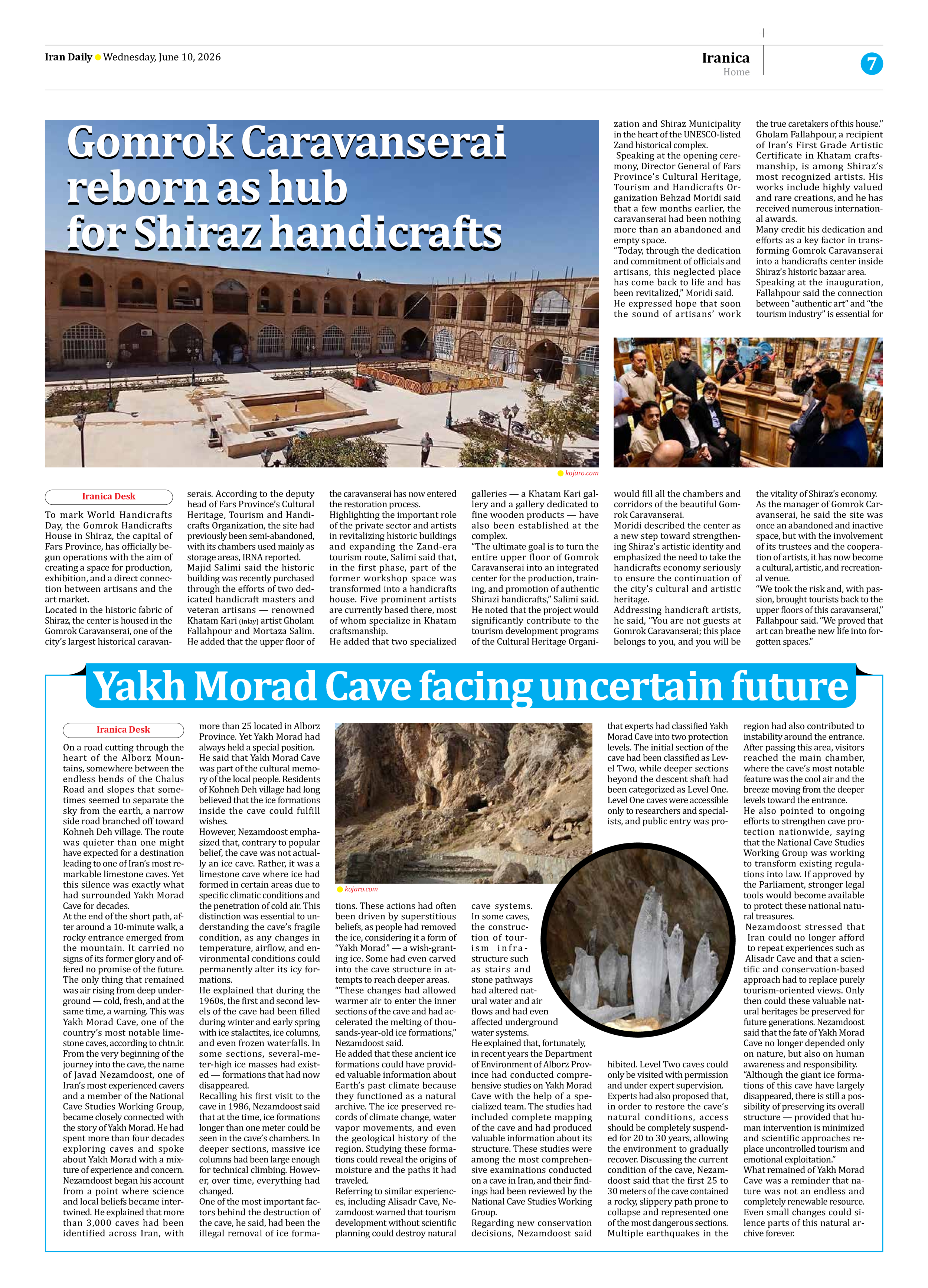


Gomrok Caravanserai reborn as hub for Shiraz handicrafts
To mark World Handicrafts Day, the Gomrok Handicrafts House in Shiraz, the capital of Fars Province, has officially begun operations with the aim of creating a space for production, exhibition, and a direct connection between artisans and the art market.
Located in the historic fabric of Shiraz, the center is housed in the Gomrok Caravanserai, one of the city’s largest historical caravanserais. According to the deputy head of Fars Province’s Cultural Heritage, Tourism and Handicrafts Organization, the site had previously been semi-abandoned, with its chambers used mainly as storage areas, IRNA reported.
Majid Salimi said the historic building was recently purchased through the efforts of two dedicated handicraft masters and veteran artisans — renowned Khatam Kari (inlay) artist Gholam Fallahpour and Mortaza Salim. He added that the upper floor of the caravanserai has now entered the restoration process.
Highlighting the important role of the private sector and artists in revitalizing historic buildings and expanding the Zand-era tourism route, Salimi said that, in the first phase, part of the former workshop space was transformed into a handicrafts house. Five prominent artists are currently based there, most of whom specialize in Khatam craftsmanship.
He added that two specialized galleries — a Khatam Kari gallery and a gallery dedicated to fine wooden products — have also been established at the complex.
“The ultimate goal is to turn the entire upper floor of Gomrok Caravanserai into an integrated center for the production, training, and promotion of authentic Shirazi handicrafts,” Salimi said.
He noted that the project would significantly contribute to the tourism development programs of the Cultural Heritage Organization and Shiraz Municipality in the heart of the UNESCO-listed Zand historical complex.
Speaking at the opening ceremony, Director General of Fars Province’s Cultural Heritage, Tourism and Handicrafts Organization Behzad Moridi said that a few months earlier, the caravanserai had been nothing more than an abandoned and empty space.
“Today, through the dedication and commitment of officials and artisans, this neglected place has come back to life and has been revitalized,” Moridi said.
He expressed hope that soon the sound of artisans’ work would fill all the chambers and corridors of the beautiful Gomrok Caravanserai.
Moridi described the center as a new step toward strengthening Shiraz’s artistic identity and emphasized the need to take the handicrafts economy seriously to ensure the continuation of the city’s cultural and artistic heritage.
Addressing handicraft artists, he said, “You are not guests at Gomrok Caravanserai; this place belongs to you, and you will be the true caretakers of this house.”
Gholam Fallahpour, a recipient of Iran’s First Grade Artistic Certificate in Khatam craftsmanship, is among Shiraz’s most recognized artists. His works include highly valued and rare creations, and he has received numerous international awards.
Many credit his dedication and efforts as a key factor in transforming Gomrok Caravanserai into a handicrafts center inside Shiraz’s historic bazaar area.
Speaking at the inauguration, Fallahpour said the connection between “authentic art” and “the tourism industry” is essential for the vitality of Shiraz’s economy.
As the manager of Gomrok Caravanserai, he said the site was once an abandoned and inactive space, but with the involvement of its trustees and the cooperation of artists, it has now become a cultural, artistic, and recreational venue.
“We took the risk and, with passion, brought tourists back to the upper floors of this caravanserai,” Fallahpour said. “We proved that art can breathe new life into forgotten spaces.”