







Reading Room
Pieces; new collection bringing poetry to life
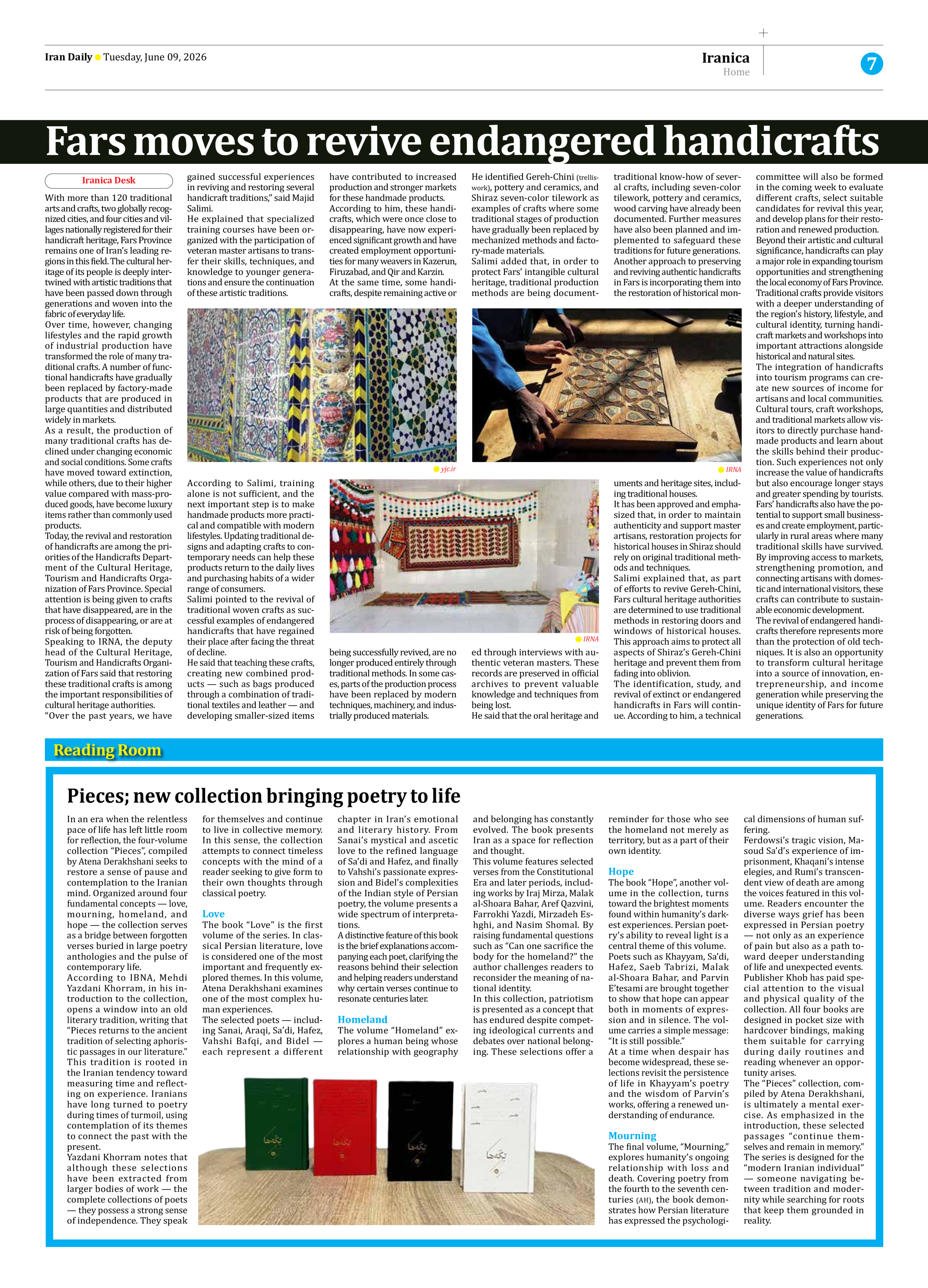
In an era when the relentless pace of life has left little room for reflection, the four-volume collection “Pieces”, compiled by Atena Derakhshani seeks to restore a sense of pause and contemplation to the Iranian mind. Organized around four fundamental concepts — love, mourning, homeland, and hope — the collection serves as a bridge between forgotten verses buried in large poetry anthologies and the pulse of contemporary life.
According to IBNA, Mehdi Yazdani Khorram, in his introduction to the collection, opens a window into an old literary tradition, writing that “Pieces returns to the ancient tradition of selecting aphoristic passages in our literature.” This tradition is rooted in the Iranian tendency toward measuring time and reflecting on experience. Iranians have long turned to poetry during times of turmoil, using contemplation of its themes to connect the past with the present.
Yazdani Khorram notes that although these selections have been extracted from larger bodies of work — the complete collections of poets — they possess a strong sense of independence. They speak for themselves and continue to live in collective memory. In this sense, the collection attempts to connect timeless concepts with the mind of a reader seeking to give form to their own thoughts through classical poetry.
Love
The book “Love” is the first volume of the series. In classical Persian literature, love is considered one of the most important and frequently explored themes. In this volume, Atena Derakhshani examines one of the most complex human experiences.
The selected poets — including Sanai, Araqi, Sa’di, Hafez, Vahshi Bafqi, and Bidel — each represent a different chapter in Iran’s emotional and literary history. From Sanai’s mystical and ascetic love to the refined language of Sa’di and Hafez, and finally to Vahshi’s passionate expression and Bidel’s complexities of the Indian style of Persian poetry, the volume presents a wide spectrum of interpretations.
A distinctive feature of this book is the brief explanations accompanying each poet, clarifying the reasons behind their selection and helping readers understand why certain verses continue to resonate centuries later.
Homeland
The volume “Homeland” explores a human being whose relationship with geography and belonging has constantly evolved. The book presents Iran as a space for reflection and thought.
This volume features selected verses from the Constitutional Era and later periods, including works by Iraj Mirza, Malak al-Shoara Bahar, Aref Qazvini, Farrokhi Yazdi, Mirzadeh Eshghi, and Nasim Shomal. By raising fundamental questions such as “Can one sacrifice the body for the homeland?” the author challenges readers to reconsider the meaning of national identity.
In this collection, patriotism is presented as a concept that has endured despite competing ideological currents and debates over national belonging. These selections offer a reminder for those who see the homeland not merely as territory, but as a part of their own identity.
Hope
The book “Hope”, another volume in the collection, turns toward the brightest moments found within humanity’s darkest experiences. Persian poetry’s ability to reveal light is a central theme of this volume.
Poets such as Khayyam, Sa’di, Hafez, Saeb Tabrizi, Malak al-Shoara Bahar, and Parvin E’tesami are brought together to show that hope can appear both in moments of expression and in silence. The volume carries a simple message: “It is still possible.”
At a time when despair has become widespread, these selections revisit the persistence of life in Khayyam’s poetry and the wisdom of Parvin’s works, offering a renewed understanding of endurance.
Mourning
The final volume, “Mourning,” explores humanity’s ongoing relationship with loss and death. Covering poetry from the fourth to the seventh centuries (AH), the book demonstrates how Persian literature has expressed the psychological dimensions of human suffering.
Ferdowsi’s tragic vision, Masoud Sa’d’s experience of imprisonment, Khaqani’s intense elegies, and Rumi’s transcendent view of death are among the voices featured in this volume. Readers encounter the diverse ways grief has been expressed in Persian poetry — not only as an experience of pain but also as a path toward deeper understanding of life and unexpected events.
Publisher Khob has paid special attention to the visual and physical quality of the collection. All four books are designed in pocket size with hardcover bindings, making them suitable for carrying during daily routines and reading whenever an opportunity arises.
The “Pieces” collection, compiled by Atena Derakhshani, is ultimately a mental exercise. As emphasized in the introduction, these selected passages “continue themselves and remain in memory.” The series is designed for the “modern Iranian individual” — someone navigating between tradition and modernity while searching for roots that keep them grounded in reality.