







Fars moves to revive endangered handicrafts
With more than 120 traditional arts and crafts, two globally recognized cities, and four cities and villages nationally registered for their handicraft heritage, Fars Province remains one of Iran’s leading regions in this field. The cultural heritage of its people is deeply intertwined with artistic traditions that have been passed down through generations and woven into the fabric of everyday life.
Over time, however, changing lifestyles and the rapid growth of industrial production have transformed the role of many traditional crafts. A number of functional handicrafts have gradually been replaced by factory-made products that are produced in large quantities and distributed widely in markets.
As a result, the production of many traditional crafts has declined under changing economic and social conditions. Some crafts have moved toward extinction, while others, due to their higher value compared with mass-produced goods, have become luxury items rather than commonly used products.
Today, the revival and restoration of handicrafts are among the priorities of the Handicrafts Department of the Cultural Heritage, Tourism and Handicrafts Organization of Fars Province. Special attention is being given to crafts that have disappeared, are in the process of disappearing, or are at risk of being forgotten.
Speaking to IRNA, the deputy head of the Cultural Heritage, Tourism and Handicrafts Organization of Fars said that restoring these traditional crafts is among the important responsibilities of cultural heritage authorities.
“Over the past years, we have gained successful experiences in reviving and restoring several handicraft traditions,” said Majid Salimi.
He explained that specialized training courses have been organized with the participation of veteran master artisans to transfer their skills, techniques, and knowledge to younger generations and ensure the continuation of these artistic traditions.
According to Salimi, training alone is not sufficient, and the next important step is to make handmade products more practical and compatible with modern lifestyles. Updating traditional designs and adapting crafts to contemporary needs can help these products return to the daily lives and purchasing habits of a wider range of consumers.
Salimi pointed to the revival of traditional woven crafts as successful examples of endangered handicrafts that have regained their place after facing the threat of decline.
He said that teaching these crafts, creating new combined products — such as bags produced through a combination of traditional textiles and leather — and developing smaller-sized items have contributed to increased production and stronger markets for these handmade products.
According to him, these handicrafts, which were once close to disappearing, have now experienced significant growth and have created employment opportunities for many weavers in Kazerun, Firuzabad, and Qir and Karzin.
At the same time, some handicrafts, despite remaining active or being successfully revived, are no longer produced entirely through traditional methods. In some cases, parts of the production process have been replaced by modern techniques, machinery, and industrially produced materials.
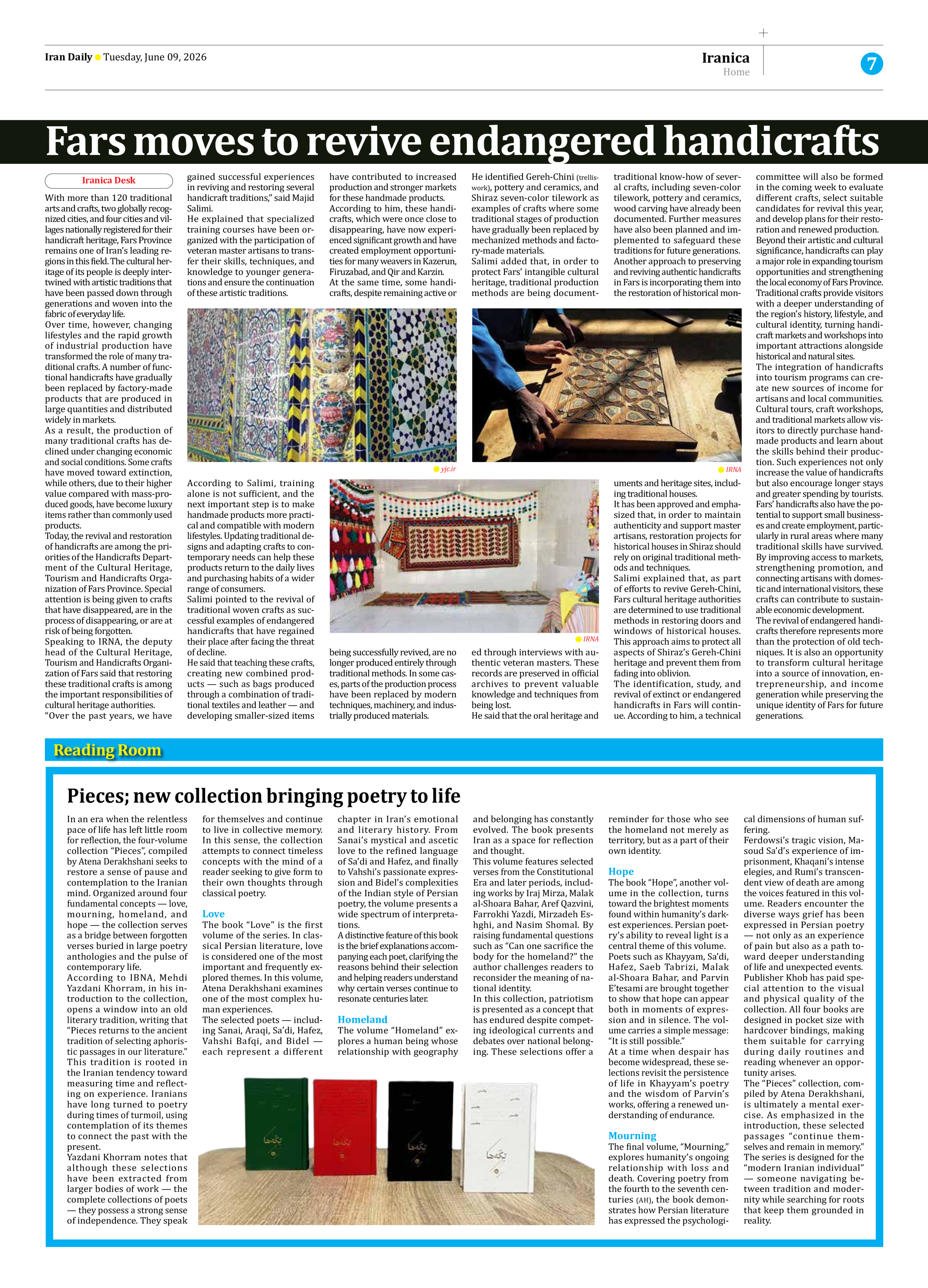
He identified Gereh-Chini (trelliswork), pottery and ceramics, and Shiraz seven-color tilework as examples of crafts where some traditional stages of production have gradually been replaced by mechanized methods and factory-made materials.
Salimi added that, in order to protect Fars’ intangible cultural heritage, traditional production methods are being documented through interviews with authentic veteran masters. These records are preserved in official archives to prevent valuable knowledge and techniques from being lost.
He said that the oral heritage and traditional know-how of several crafts, including seven-color tilework, pottery and ceramics, wood carving have already been documented. Further measures have also been planned and implemented to safeguard these traditions for future generations.
Another approach to preserving and reviving authentic handicrafts in Fars is incorporating them into the restoration of historical monuments and heritage sites, including traditional houses.
It has been approved and emphasized that, in order to maintain authenticity and support master artisans, restoration projects for historical houses in Shiraz should rely on original traditional methods and techniques.
Salimi explained that, as part of efforts to revive Gereh-Chini, Fars cultural heritage authorities are determined to use traditional methods in restoring doors and windows of historical houses. This approach aims to protect all aspects of Shiraz’s Gereh-Chini heritage and prevent them from fading into oblivion.
The identification, study, and revival of extinct or endangered handicrafts in Fars will continue. According to him, a technical committee will also be formed in the coming week to evaluate different crafts, select suitable candidates for revival this year, and develop plans for their restoration and renewed production.
Beyond their artistic and cultural significance, handicrafts can play a major role in expanding tourism opportunities and strengthening the local economy of Fars Province. Traditional crafts provide visitors with a deeper understanding of the region’s history, lifestyle, and cultural identity, turning handicraft markets and workshops into important attractions alongside historical and natural sites.
The integration of handicrafts into tourism programs can create new sources of income for artisans and local communities. Cultural tours, craft workshops, and traditional markets allow visitors to directly purchase handmade products and learn about the skills behind their production. Such experiences not only increase the value of handicrafts but also encourage longer stays and greater spending by tourists.
Fars’ handicrafts also have the potential to support small businesses and create employment, particularly in rural areas where many traditional skills have survived. By improving access to markets, strengthening promotion, and connecting artisans with domestic and international visitors, these crafts can contribute to sustainable economic development.
The revival of endangered handicrafts therefore represents more than the protection of old techniques. It is also an opportunity to transform cultural heritage into a source of innovation, entrepreneurship, and income generation while preserving the unique identity of Fars for future generations.