







Untapped potential of Zanjan’s protected areas
Today, tourism — particularly nature-based tourism, or ecotourism — plays a vital role in the economies of many countries. Unlike mass tourism, which often requires heavy investment in large-scale infrastructure such as luxury hotels, extensive road networks, and major transportation systems, ecotourism focuses on direct, affordable, and responsible experiences in natural environments.
Ecotourists are travelers who explore beautiful, diverse, and peaceful landscapes with limited facilities while respecting the environment. Countries with rich biodiversity have often been more successful in attracting these visitors and generating foreign revenue. Iran, due to its unique geographical location and wide range of climates, has significant potential to become an important ecotourism destination. However, achieving this goal requires accurate identification of natural resources, careful planning, sustainable management, and increased public awareness, according to chtn.ir.
The development of ecotourism not only creates employment and economic opportunities but also strengthens visitors’ sense of responsibility toward nature conservation. In essence, ecotourism represents a thoughtful and environmentally friendly approach to the use of natural resources, where conservation and development advance together.
Tourism in protected areas is one of the most important forms of sustainable engagement with nature. It aims to introduce people to environmental values, promote a culture of conservation, and generate income for local communities. When properly managed, this form of tourism can support biodiversity protection while creating opportunities for social and economic development around protected areas.
Protected areas, with their natural landscapes, valuable plant and animal species, and unique ecosystems, have considerable potential to attract visitors. One of the key factors behind successful tourism development in these areas is the participation of local communities. When local residents benefit from tourism, they have stronger motivation to protect their surrounding environment.
Tourism in protected areas can only succeed when it is built on conservation, education, community participation, and scientific management. Under such conditions, nature is preserved while responsible and sustainable tourism opportunities are created.
The development of ecotourism in Zanjan Province, supported by its diverse climates and rich ecosystems, represents a major opportunity for sustainable economic growth. With approximately 19 percent of its territory under national protection, Zanjan has significant potential to attract both domestic and international nature travelers.
Transforming these resources from “strict protection” into “responsible and sustainable use” could create meaningful employment opportunities and generate tourism revenue. Integrated management of protected areas such as Anguran and Sorkhabad, along with restricted hunting zones, provides a foundation for responsible tourism development.
The expansion of low-impact, environmentally compatible infrastructure — without damaging sensitive ecosystems — is essential for success in this field. Cooperation between local communities and government institutions is also necessary to raise awareness and encourage environmental responsibility.
As a green alternative to environmentally harmful activities, ecotourism has the potential to transform local economies and position Zanjan as a major tourism destination in western Iran. With long-term planning and targeted investment, the province’s natural assets can become a sustainable source of prosperity for local communities.
Covering an area of approximately 22,164 square kilometers, Zanjan Province holds a special place on Iran’s natural map due to its climatic diversity, significant elevation changes, and variety of plant and animal species.
Situated within Iran’s mountainous belt and benefiting from diverse ecosystems, Zanjan is considered one of the country’s important regions in terms of natural resources and biodiversity. Developing ecotourism in the province requires accurate identification, documentation, and sustainable management of these resources.
Anguran Protected Area
The Anguran Protected Area is a remarkable destination for wildlife enthusiasts, nature photographers, and adventure travelers. Located at the intersection of Zanjan, East Azarbaijan, West Azarbaijan, and Kurdestan provinces, Anguran offers visitors a combination of impressive mountain landscapes and rich biodiversity.
The area covers approximately 125,000 hectares, including 90,000 hectares of protected land and 35,000 hectares designated as a wildlife refuge.
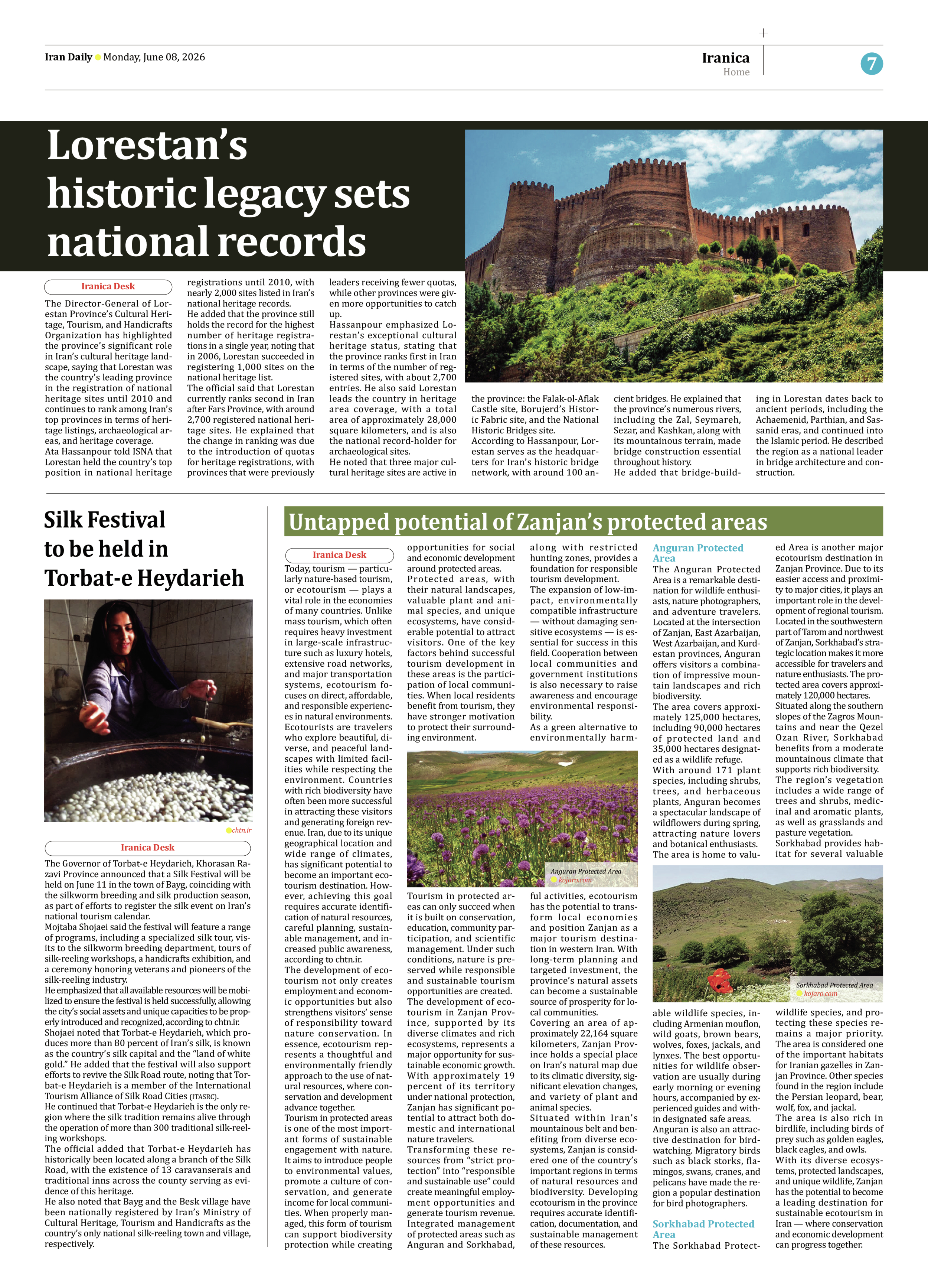
With around 171 plant species, including shrubs, trees, and herbaceous plants, Anguran becomes a spectacular landscape of wildflowers during spring, attracting nature lovers and botanical enthusiasts.
The area is home to valuable wildlife species, including Armenian mouflon, wild goats, brown bears, wolves, foxes, jackals, and lynxes. The best opportunities for wildlife observation are usually during early morning or evening hours, accompanied by experienced guides and within designated safe areas.
Anguran is also an attractive destination for birdwatching. Migratory birds such as black storks, flamingos, swans, cranes, and pelicans have made the region a popular destination for bird photographers.
Sorkhabad Protected Area
The Sorkhabad Protected Area is another major ecotourism destination in Zanjan Province. Due to its easier access and proximity to major cities, it plays an important role in the development of regional tourism.
Located in the southwestern part of Tarom and northwest of Zanjan, Sorkhabad’s strategic location makes it more accessible for travelers and nature enthusiasts. The protected area covers approximately 120,000 hectares.
Situated along the southern slopes of the Zagros Mountains and near the Qezel Ozan River, Sorkhabad benefits from a moderate mountainous climate that supports rich biodiversity.
The region’s vegetation includes a wide range of trees and shrubs, medicinal and aromatic plants, as well as grasslands and pasture vegetation.
Sorkhabad provides habitat for several valuable wildlife species, and protecting these species remains a major priority. The area is considered one of the important habitats for Iranian gazelles in Zanjan Province. Other species found in the region include the Persian leopard, bear, wolf, fox, and jackal.
The area is also rich in birdlife, including birds of prey such as golden eagles, black eagles, and owls.
With its diverse ecosystems, protected landscapes, and unique wildlife, Zanjan has the potential to become a leading destination for sustainable ecotourism in Iran — where conservation and economic development can progress together.