







Lorestan’s historic legacy sets national records
The Director-General of Lorestan Province’s Cultural Heritage, Tourism, and Handicrafts Organization has highlighted the province’s significant role in Iran’s cultural heritage landscape, saying that Lorestan was the country’s leading province in the registration of national heritage sites until 2010 and continues to rank among Iran’s top provinces in terms of heritage listings, archaeological areas, and heritage coverage.
Ata Hassanpour told ISNA that Lorestan held the country’s top position in national heritage registrations until 2010, with nearly 2,000 sites listed in Iran’s national heritage records.
He added that the province still holds the record for the highest number of heritage registrations in a single year, noting that in 2006, Lorestan succeeded in registering 1,000 sites on the national heritage list.
The official said that Lorestan currently ranks second in Iran after Fars Province, with around 2,700 registered national heritage sites. He explained that the change in ranking was due to the introduction of quotas for heritage registrations, with provinces that were previously leaders receiving fewer quotas, while other provinces were given more opportunities to catch up.
Hassanpour emphasized Lorestan’s exceptional cultural heritage status, stating that the province ranks first in Iran in terms of the number of registered sites, with about 2,700 entries. He also said Lorestan leads the country in heritage area coverage, with a total area of approximately 28,000 square kilometers, and is also the national record-holder for archaeological sites.
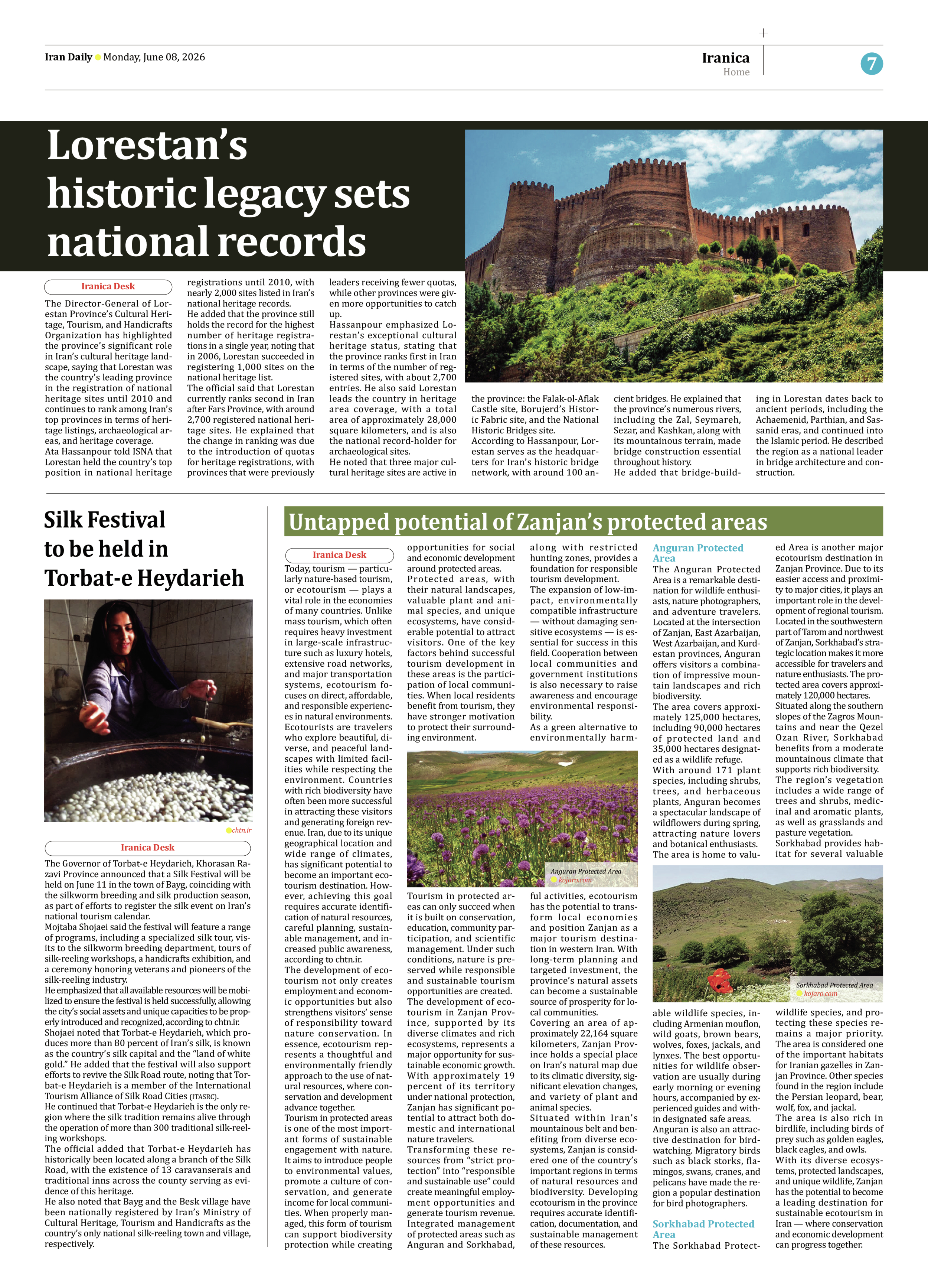
He noted that three major cultural heritage sites are active in the province: the Falak-ol-Aflak Castle site, Borujerd’s Historic Fabric site, and the National Historic Bridges site.
According to Hassanpour, Lorestan serves as the headquarters for Iran’s historic bridge network, with around 100 ancient bridges. He explained that the province’s numerous rivers, including the Zal, Seymareh, Sezar, and Kashkan, along with its mountainous terrain, made bridge construction essential throughout history.
He added that bridge-building in Lorestan dates back to ancient periods, including the Achaemenid, Parthian, and Sassanid eras, and continued into the Islamic period. He described the region as a national leader in bridge architecture and construction.