







Historic Riab village eyes international heritage status
In the southern reaches of Khorasan Razavi Province, near the city of Gonabad, the historic village of Riab stands as a living page from the history of Iran’s desert civilization. Here, the past continues to breathe through winding alleyways and earthen architecture, while contemporary life unfolds in harmony with centuries-old traditions.
Riab tells the story of a community that emerged in a challenging environment and sustained itself through patience, ingenuity, and a deep understanding of nature.
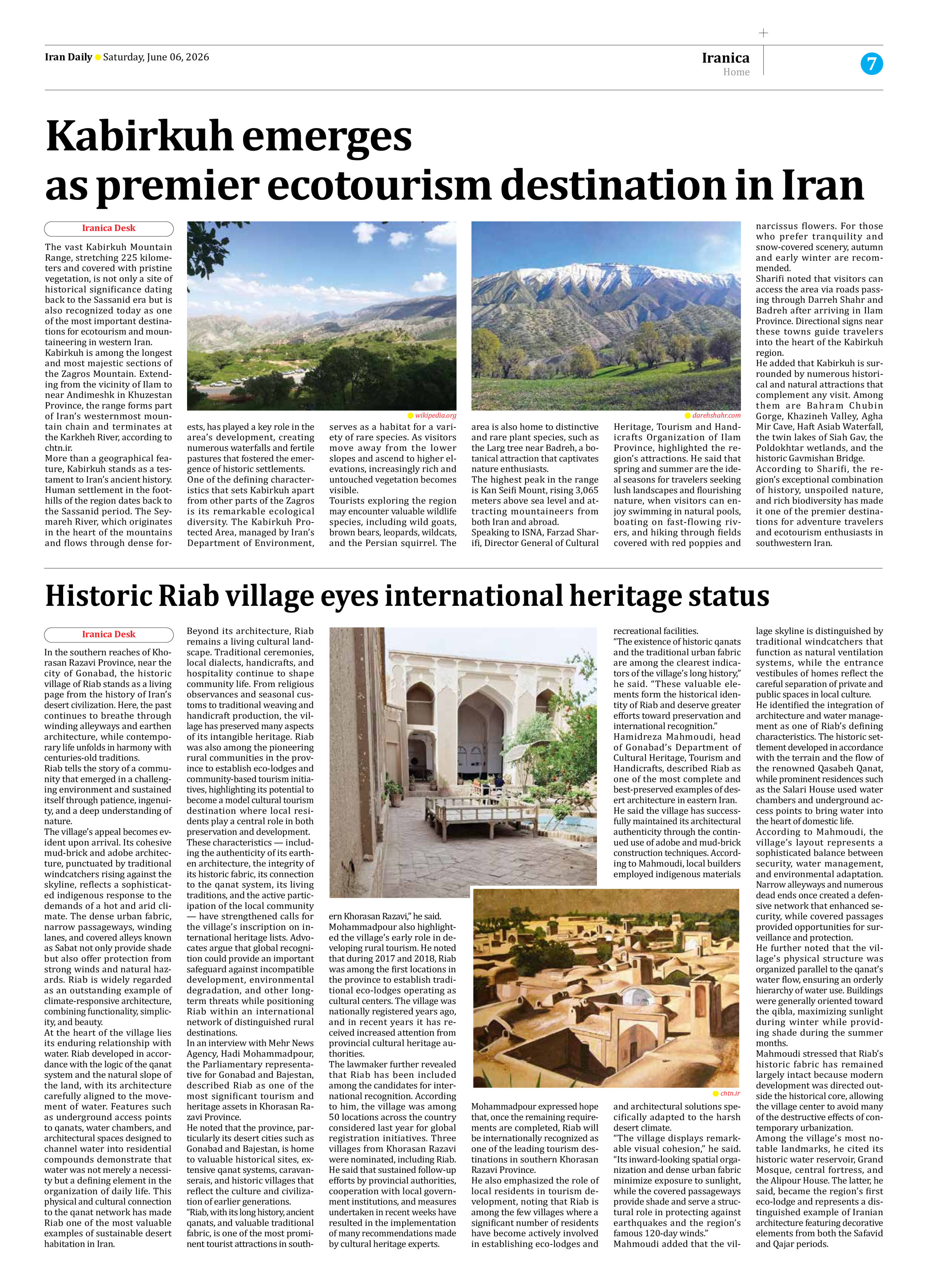
The village’s appeal becomes evident upon arrival. Its cohesive mud-brick and adobe architecture, punctuated by traditional windcatchers rising against the skyline, reflects a sophisticated indigenous response to the demands of a hot and arid climate. The dense urban fabric, narrow passageways, winding lanes, and covered alleys known as Sabat not only provide shade but also offer protection from strong winds and natural hazards. Riab is widely regarded as an outstanding example of climate-responsive architecture, combining functionality, simplicity, and beauty.
At the heart of the village lies its enduring relationship with water. Riab developed in accordance with the logic of the qanat system and the natural slope of the land, with its architecture carefully aligned to the movement of water. Features such as underground access points to qanats, water chambers, and architectural spaces designed to channel water into residential compounds demonstrate that water was not merely a necessity but a defining element in the organization of daily life. This physical and cultural connection to the qanat network has made Riab one of the most valuable examples of sustainable desert habitation in Iran.
Beyond its architecture, Riab remains a living cultural landscape. Traditional ceremonies, local dialects, handicrafts, and hospitality continue to shape community life. From religious observances and seasonal customs to traditional weaving and handicraft production, the village has preserved many aspects of its intangible heritage. Riab was also among the pioneering rural communities in the province to establish eco-lodges and community-based tourism initiatives, highlighting its potential to become a model cultural tourism destination where local residents play a central role in both preservation and development.
These characteristics — including the authenticity of its earthen architecture, the integrity of its historic fabric, its connection to the qanat system, its living traditions, and the active participation of the local community — have strengthened calls for the village’s inscription on international heritage lists. Advocates argue that global recognition could provide an important safeguard against incompatible development, environmental degradation, and other long-term threats while positioning Riab within an international network of distinguished rural destinations.
In an interview with Mehr News Agency, Hadi Mohammadpour, the Parliamentary representative for Gonabad and Bajestan, described Riab as one of the most significant tourism and heritage assets in Khorasan Razavi Province.
He noted that the province, particularly its desert cities such as Gonabad and Bajestan, is home to valuable historical sites, extensive qanat systems, caravanserais, and historic villages that reflect the culture and civilization of earlier generations.
“Riab, with its long history, ancient qanats, and valuable traditional fabric, is one of the most prominent tourist attractions in southern Khorasan Razavi,” he said.
Mohammadpour also highlighted the village’s early role in developing rural tourism. He noted that during 2017 and 2018, Riab was among the first locations in the province to establish traditional eco-lodges operating as cultural centers. The village was nationally registered years ago, and in recent years it has received increased attention from provincial cultural heritage authorities.
The lawmaker further revealed that Riab has been included among the candidates for international recognition. According to him, the village was among 50 locations across the country considered last year for global registration initiatives. Three villages from Khorasan Razavi were nominated, including Riab.
He said that sustained follow-up efforts by provincial authorities, cooperation with local government institutions, and measures undertaken in recent weeks have resulted in the implementation of many recommendations made by cultural heritage experts.
Mohammadpour expressed hope that, once the remaining requirements are completed, Riab will be internationally recognized as one of the leading tourism destinations in southern Khorasan Razavi Province.
He also emphasized the role of local residents in tourism development, noting that Riab is among the few villages where a significant number of residents have become actively involved in establishing eco-lodges and recreational facilities.
“The existence of historic qanats and the traditional urban fabric are among the clearest indicators of the village’s long history,” he said. “These valuable elements form the historical identity of Riab and deserve greater efforts toward preservation and international recognition.”
Hamidreza Mahmoudi, head of Gonabad’s Department of Cultural Heritage, Tourism and Handicrafts, described Riab as one of the most complete and best-preserved examples of desert architecture in eastern Iran.
He said the village has successfully maintained its architectural authenticity through the continued use of adobe and mud-brick construction techniques. According to Mahmoudi, local builders employed indigenous materials and architectural solutions specifically adapted to the harsh desert climate.
“The village displays remarkable visual cohesion,” he said. “Its inward-looking spatial organization and dense urban fabric minimize exposure to sunlight, while the covered passageways provide shade and serve a structural role in protecting against earthquakes and the region’s famous 120-day winds.”
Mahmoudi added that the village skyline is distinguished by traditional windcatchers that function as natural ventilation systems, while the entrance vestibules of homes reflect the careful separation of private and public spaces in local culture.
He identified the integration of architecture and water management as one of Riab’s defining characteristics. The historic settlement developed in accordance with the terrain and the flow of the renowned Qasabeh Qanat, while prominent residences such as the Salari House used water chambers and underground access points to bring water into the heart of domestic life.
According to Mahmoudi, the village’s layout represents a sophisticated balance between security, water management, and environmental adaptation. Narrow alleyways and numerous dead ends once created a defensive network that enhanced security, while covered passages provided opportunities for surveillance and protection.
He further noted that the village’s physical structure was organized parallel to the qanat’s water flow, ensuring an orderly hierarchy of water use. Buildings were generally oriented toward the qibla, maximizing sunlight during winter while providing shade during the summer months.
Mahmoudi stressed that Riab’s historic fabric has remained largely intact because modern development was directed outside the historical core, allowing the village center to avoid many of the destructive effects of contemporary urbanization.
Among the village’s most notable landmarks, he cited its historic water reservoir, Grand Mosque, central fortress, and the Alipour House. The latter, he said, became the region’s first eco-lodge and represents a distinguished example of Iranian architecture featuring decorative elements from both the Safavid and Qajar periods.