







Kabirkuh emerges as premier ecotourism destination in Iran
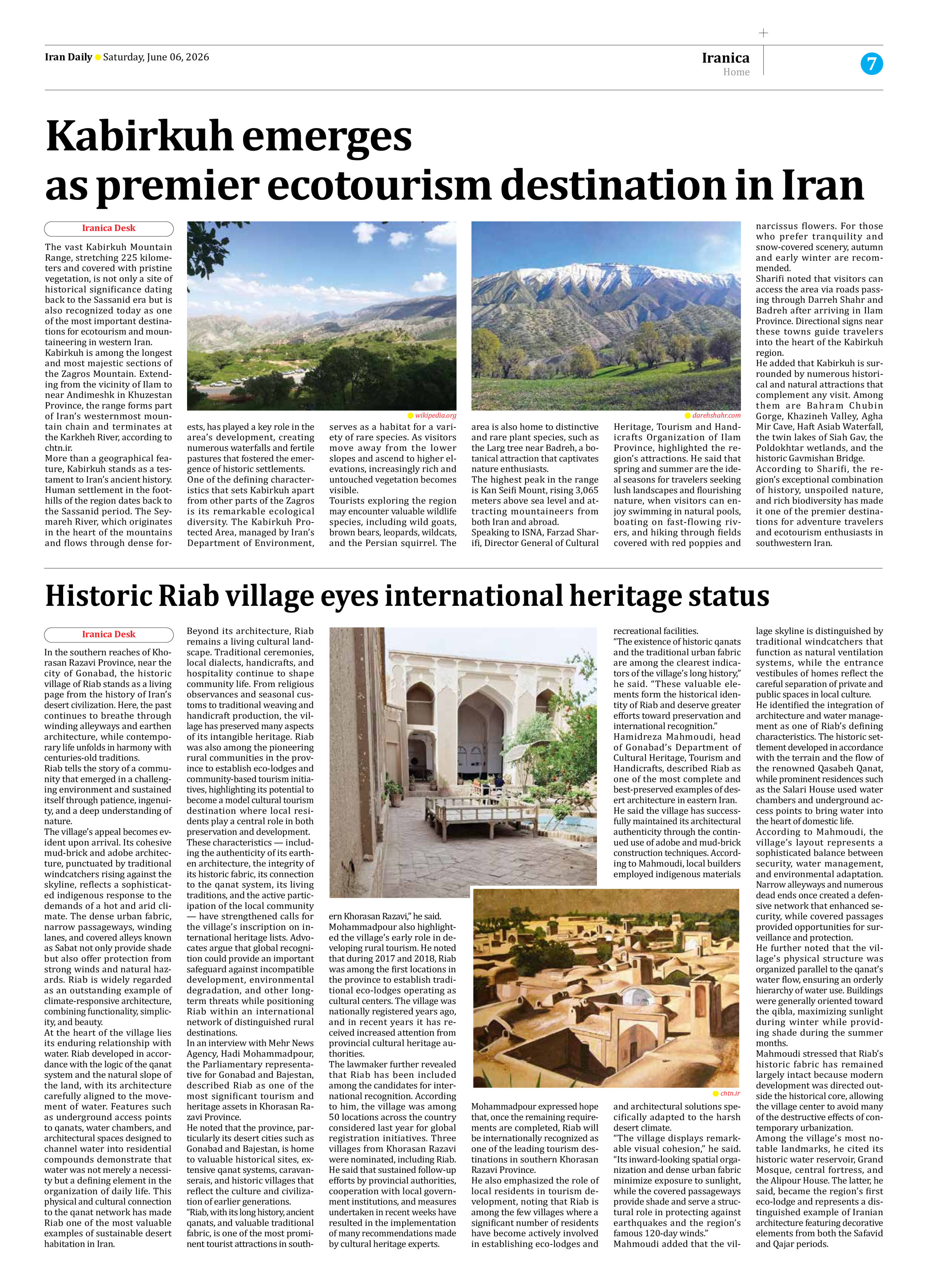
The vast Kabirkuh Mountain Range, stretching 225 kilometers and covered with pristine vegetation, is not only a site of historical significance dating back to the Sassanid era but is also recognized today as one of the most important destinations for ecotourism and mountaineering in western Iran.
Kabirkuh is among the longest and most majestic sections of the Zagros Mountain. Extending from the vicinity of Ilam to near Andimeshk in Khuzestan Province, the range forms part of Iran’s westernmost mountain chain and terminates at the Karkheh River, according to chtn.ir.
More than a geographical feature, Kabirkuh stands as a testament to Iran’s ancient history. Human settlement in the foothills of the region dates back to the Sassanid period. The Seymareh River, which originates in the heart of the mountains and flows through dense forests, has played a key role in the area’s development, creating numerous waterfalls and fertile pastures that fostered the emergence of historic settlements.
One of the defining characteristics that sets Kabirkuh apart from other parts of the Zagros is its remarkable ecological diversity. The Kabirkuh Protected Area, managed by Iran’s Department of Environment, serves as a habitat for a variety of rare species. As visitors move away from the lower slopes and ascend to higher elevations, increasingly rich and untouched vegetation becomes visible.
Tourists exploring the region may encounter valuable wildlife species, including wild goats, brown bears, leopards, wildcats, and the Persian squirrel. The area is also home to distinctive and rare plant species, such as the Larg tree near Badreh, a botanical attraction that captivates nature enthusiasts.
The highest peak in the range is Kan Seifi Mount, rising 3,065 meters above sea level and attracting mountaineers from both Iran and abroad.
Speaking to ISNA, Farzad Sharifi, Director General of Cultural Heritage, Tourism and Handicrafts Organization of Ilam Province, highlighted the region’s attractions. He said that spring and summer are the ideal seasons for travelers seeking lush landscapes and flourishing nature, when visitors can enjoy swimming in natural pools, boating on fast-flowing rivers, and hiking through fields covered with red poppies and narcissus flowers. For those who prefer tranquility and snow-covered scenery, autumn and early winter are recommended.
Sharifi noted that visitors can access the area via roads passing through Darreh Shahr and Badreh after arriving in Ilam Province. Directional signs near these towns guide travelers into the heart of the Kabirkuh region.
He added that Kabirkuh is surrounded by numerous historical and natural attractions that complement any visit. Among them are Bahram Chubin Gorge, Khazineh Valley, Agha Mir Cave, Haft Asiab Waterfall, the twin lakes of Siah Gav, the Poldokhtar wetlands, and the historic Gavmishan Bridge.
According to Sharifi, the region’s exceptional combination of history, unspoiled nature, and rich biodiversity has made it one of the premier destinations for adventure travelers and ecotourism enthusiasts in southwestern Iran.