







Copy in clipboard...
Hezbollah says will not accept ‘partial ceasefire’ with Israel
Iran threatens to freeze US talks if Israeli strikes in Lebanon persist
Hezbollah will not accept a "partial ceasefire" with Israel, a senior official from the Lebanese resistance group said Tuesday, refusing to halt retaliatory attacks against northern occupied territories in exchange for Israel sparing Beirut's southern suburbs.
"We will not accept a partial ceasefire," Mahmud Qomati told AFP in a written statement, adding, "The Zionist enemy should know that any aggression against the suburbs could lead to a deeper and stronger response" from the group.
On Monday, US President Donald Trump announced a deal which Lebanese officials later said involved Israel refraining from attacking Beirut's southern suburbs in return for Hezbollah not attacking Israeli positions.
Following the development, Iranian Parliament Speaker Mohammad Baqer Qalibaf on Tuesday warned that if Israel’s attacks continue in Lebanon, the Islamic Republic will not only suspend peace talks with the United States but will also stand against the Israeli regime. Qalibaf made the remarks in a phone conversation with his Lebanese counterpart Nabih Berri amid Israel’s deepest incursion into Lebanon in 26 years.
Qalibaf described the bond between Iran and Lebanon as unbreakable, stressing that any ceasefire agreement between Tehran and Washington must include a halt to Israeli attacks on all fronts, particularly Lebanon.
“Over the past 48 hours, we have seriously pursued a halt to Israeli attacks. If the crimes continue, we will not only suspend the talks but also stand against the Zionist regime,” he warned.
Berri, for his part, thanked the Islamic Republic for its efforts to stop Israeli atrocities.
A halt to Israel’s attacks on Lebanon has been one of Iran’s key conditions in the ceasefire deal between Iran and the US, which has been in place since early April to give a chance to diplomacy to end a US-Israeli aggression against Iran, which began on February 28.
The Israeli regime not only failed to stop its aggression against Lebanon but it intensified its attacks and occupied more Lebanon’s territories during its recent incursion.
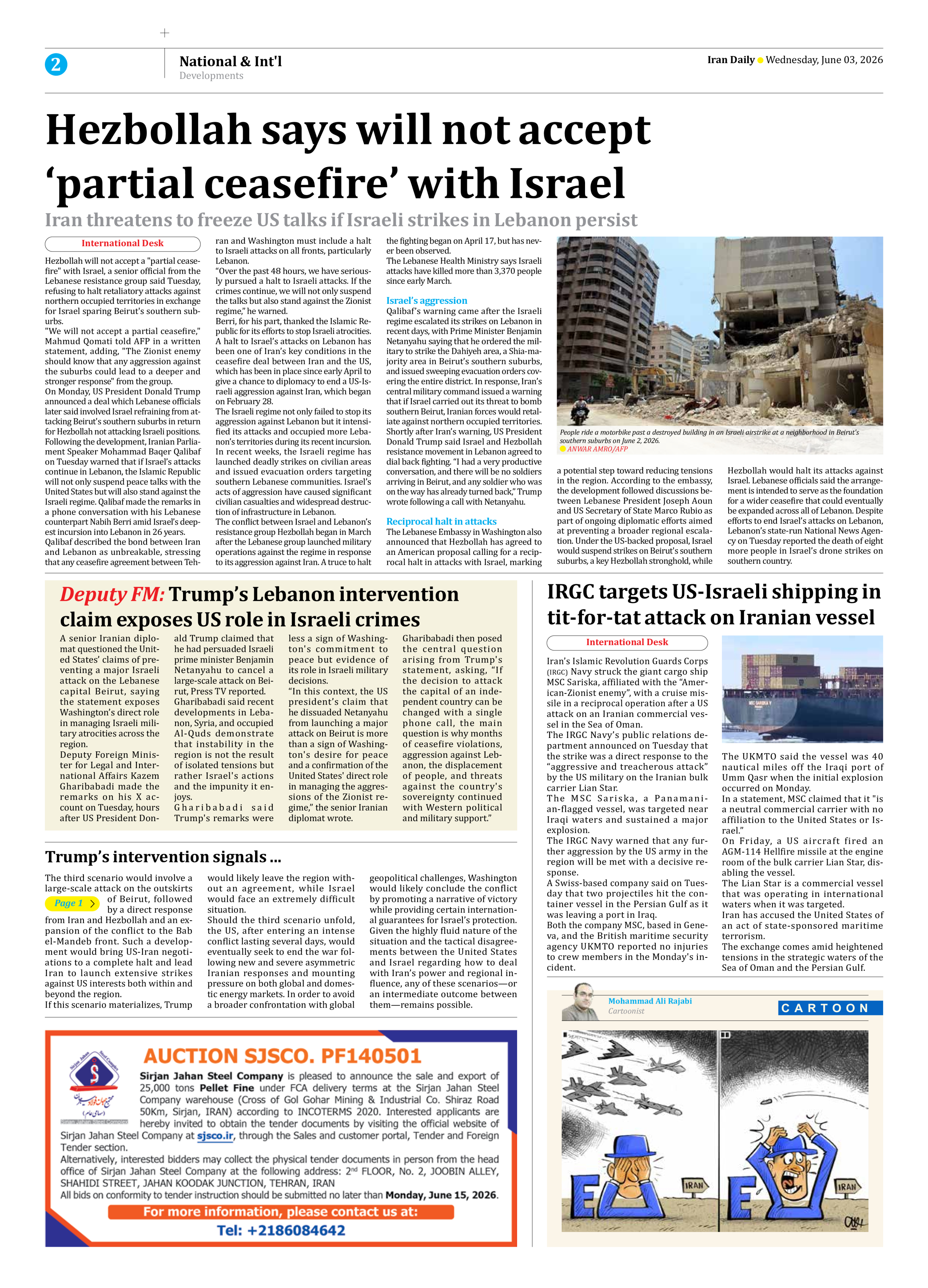
In recent weeks, the Israeli regime has launched deadly strikes on civilian areas and issued evacuation orders targeting southern Lebanese communities. Israel’s acts of aggression have caused significant civilian casualties and widespread destruction of infrastructure in Lebanon.
The conflict between Israel and Lebanon’s resistance group Hezbollah began in March after the Lebanese group launched military operations against the regime in response to its aggression against Iran. A truce to halt the fighting began on April 17, but has never been observed.
The Lebanese Health Ministry says Israeli attacks have killed more than 3,370 people since early March.
Israel’s aggression
Qalibaf’s warning came after the Israeli regime escalated its strikes on Lebanon in recent days, with Prime Minister Benjamin Netanyahu saying that he ordered the military to strike the Dahiyeh area, a Shia-majority area in Beirut’s southern suburbs, and issued sweeping evacuation orders covering the entire district. In response, Iran’s central military command issued a warning that if Israel carried out its threat to bomb southern Beirut, Iranian forces would retaliate against northern occupied territories. Shortly after Iran’s warning, US President Donald Trump said Israel and Hezbollah resistance movement in Lebanon agreed to dial back fighting. “I had a very productive conversation, and there will be no soldiers arriving in Beirut, and any soldier who was on the way has already turned back,” Trump wrote following a call with Netanyahu.
Reciprocal halt in attacks
The Lebanese Embassy in Washington also announced that Hezbollah has agreed to an American proposal calling for a reciprocal halt in attacks with Israel, marking a potential step toward reducing tensions in the region. According to the embassy, the development followed discussions between Lebanese President Joseph Aoun and US Secretary of State Marco Rubio as part of ongoing diplomatic efforts aimed at preventing a broader regional escalation. Under the US-backed proposal, Israel would suspend strikes on Beirut's southern suburbs, a key Hezbollah stronghold, while Hezbollah would halt its attacks against Israel. Lebanese officials said the arrangement is intended to serve as the foundation for a wider ceasefire that could eventually be expanded across all of Lebanon. Despite efforts to end Israel’s attacks on Lebanon, Lebanon’s state-run National News Agency on Tuesday reported the death of eight more people in Israel’s drone strikes on southern country.