







Copy in clipboard...
Reading Room
Tourism culture in post-war period
Director of Mahshide Kherad Institute
War, as a bitter and undesirable means of interaction among different societies and nations, has various dimensions. Yet issues receiving attention during war and in the post-war period often pay less regard to cultural matters.
Unfortunately, the traces of the recent war have not yet been completely removed. Therefore, a pressing concern for every compassionate Iranian is this: How can we leave a meaningful and lasting account for future generations of the pain, suffering and losses inflicted upon the lives, property and heritage of this society? What plans can be developed for tourism and cultural heritage sector in the post-war environment with regard to cultural heritage affected by war?
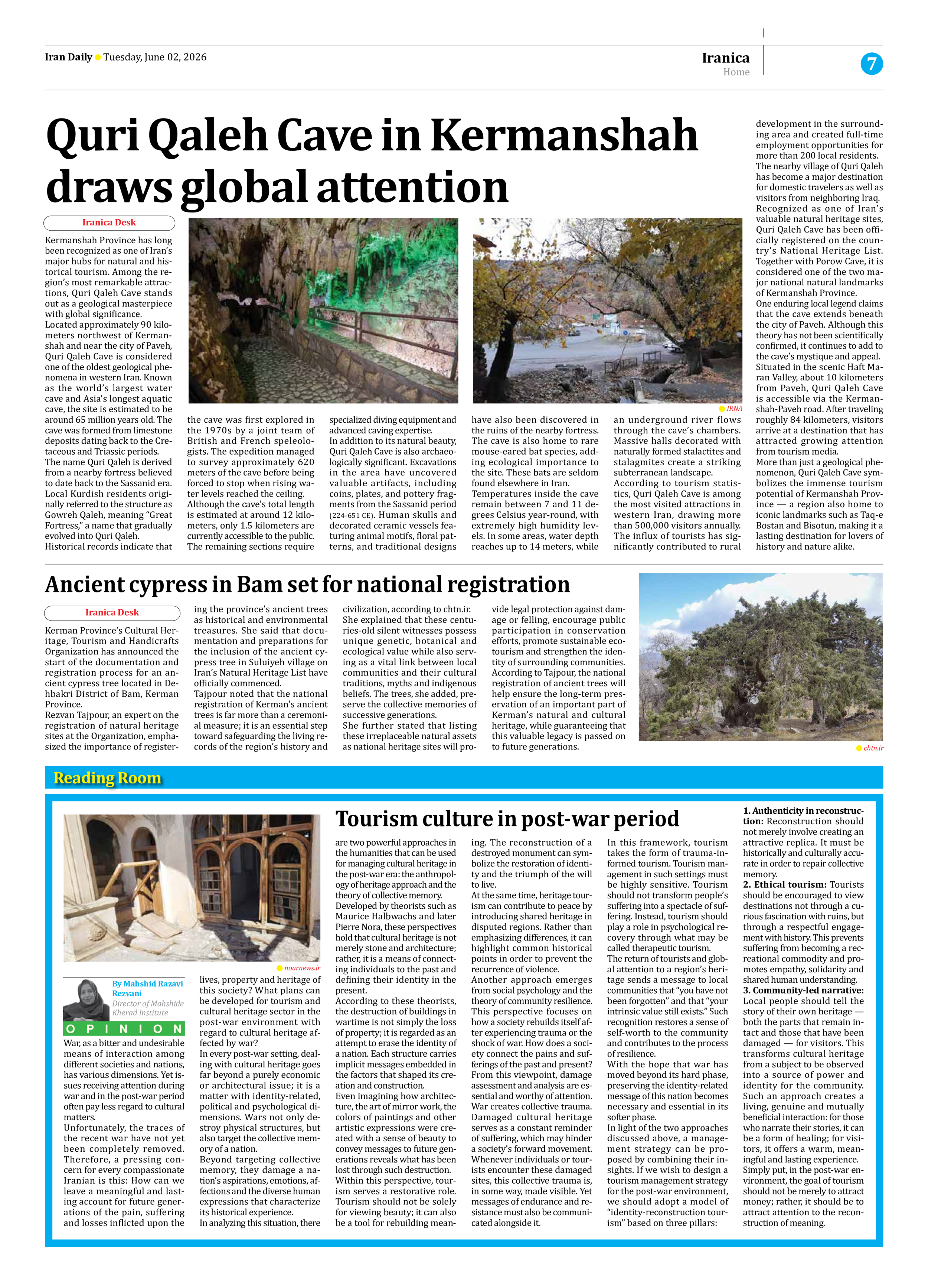
In every post-war setting, dealing with cultural heritage goes far beyond a purely economic or architectural issue; it is a matter with identity-related, political and psychological dimensions. Wars not only destroy physical structures, but also target the collective memory of a nation.
Beyond targeting collective memory, they damage a nation’s aspirations, emotions, affections and the diverse human expressions that characterize its historical experience.
In analyzing this situation, there are two powerful approaches in the humanities that can be used for managing cultural heritage in the post-war era: the anthropology of heritage approach and the theory of collective memory.
Developed by theorists such as Maurice Halbwachs and later Pierre Nora, these perspectives hold that cultural heritage is not merely stone and architecture; rather, it is a means of connecting individuals to the past and defining their identity in the present.
According to these theorists, the destruction of buildings in wartime is not simply the loss of property; it is regarded as an attempt to erase the identity of a nation. Each structure carries implicit messages embedded in the factors that shaped its creation and construction.
Even imagining how architecture, the art of mirror work, the colors of paintings and other artistic expressions were created with a sense of beauty to convey messages to future generations reveals what has been lost through such destruction.
Within this perspective, tourism serves a restorative role. Tourism should not be solely for viewing beauty; it can also be a tool for rebuilding meaning. The reconstruction of a destroyed monument can symbolize the restoration of identity and the triumph of the will to live.
At the same time, heritage tourism can contribute to peace by introducing shared heritage in disputed regions. Rather than emphasizing differences, it can highlight common historical points in order to prevent the recurrence of violence.
Another approach emerges from social psychology and the theory of community resilience. This perspective focuses on how a society rebuilds itself after experiencing trauma or the shock of war. How does a society connect the pains and sufferings of the past and present? From this viewpoint, damage assessment and analysis are essential and worthy of attention.
War creates collective trauma. Damaged cultural heritage serves as a constant reminder of suffering, which may hinder a society’s forward movement. Whenever individuals or tourists encounter these damaged sites, this collective trauma is, in some way, made visible. Yet messages of endurance and resistance must also be communicated alongside it.
In this framework, tourism takes the form of trauma-informed tourism. Tourism management in such settings must be highly sensitive. Tourism should not transform people’s suffering into a spectacle of suffering. Instead, tourism should play a role in psychological recovery through what may be called therapeutic tourism.
The return of tourists and global attention to a region’s heritage sends a message to local communities that “you have not been forgotten” and that “your intrinsic value still exists.” Such recognition restores a sense of self-worth to the community and contributes to the process of resilience.
With the hope that war has moved beyond its hard phase, preserving the identity-related message of this nation becomes necessary and essential in its softer phase.
In light of the two approaches discussed above, a management strategy can be proposed by combining their insights. If we wish to design a tourism management strategy for the post-war environment, we should adopt a model of “identity-reconstruction tourism” based on three pillars:
1. Authenticity in reconstruction: Reconstruction should not merely involve creating an attractive replica. It must be historically and culturally accurate in order to repair collective memory.
2. Ethical tourism: Tourists should be encouraged to view destinations not through a curious fascination with ruins, but through a respectful engagement with history. This prevents suffering from becoming a recreational commodity and promotes empathy, solidarity and shared human understanding.
3. Community-led narrative: Local people should tell the story of their own heritage — both the parts that remain intact and those that have been damaged — for visitors. This transforms cultural heritage from a subject to be observed into a source of power and identity for the community. Such an approach creates a living, genuine and mutually beneficial interaction: for those who narrate their stories, it can be a form of healing; for visitors, it offers a warm, meaningful and lasting experience.
Simply put, in the post-war environment, the goal of tourism should not be merely to attract money; rather, it should be to attract attention to the reconstruction of meaning.