







Copy in clipboard...
Quri Qaleh Cave in Kermanshah draws global attention
Located approximately 90 kilometers northwest of Kermanshah and near the city of Paveh, Quri Qaleh Cave is considered one of the oldest geological phenomena in western Iran. Known as the world’s largest water cave and Asia’s longest aquatic cave, the site is estimated to be around 65 million years old. The cave was formed from limestone deposits dating back to the Cretaceous and Triassic periods.
The name Quri Qaleh is derived from a nearby fortress believed to date back to the Sassanid era. Local Kurdish residents originally referred to the structure as Gowreh Qaleh, meaning “Great Fortress,” a name that gradually evolved into Quri Qaleh.
Historical records indicate that the cave was first explored in the 1970s by a joint team of British and French speleologists. The expedition managed to survey approximately 620 meters of the cave before being forced to stop when rising water levels reached the ceiling.
Although the cave’s total length is estimated at around 12 kilometers, only 1.5 kilometers are currently accessible to the public. The remaining sections require specialized diving equipment and advanced caving expertise.
In addition to its natural beauty, Quri Qaleh Cave is also archaeologically significant. Excavations in the area have uncovered valuable artifacts, including coins, plates, and pottery fragments from the Sassanid period (224-651 CE). Human skulls and decorated ceramic vessels featuring animal motifs, floral patterns, and traditional designs have also been discovered in the ruins of the nearby fortress.
The cave is also home to rare mouse-eared bat species, adding ecological importance to the site. These bats are seldom found elsewhere in Iran.
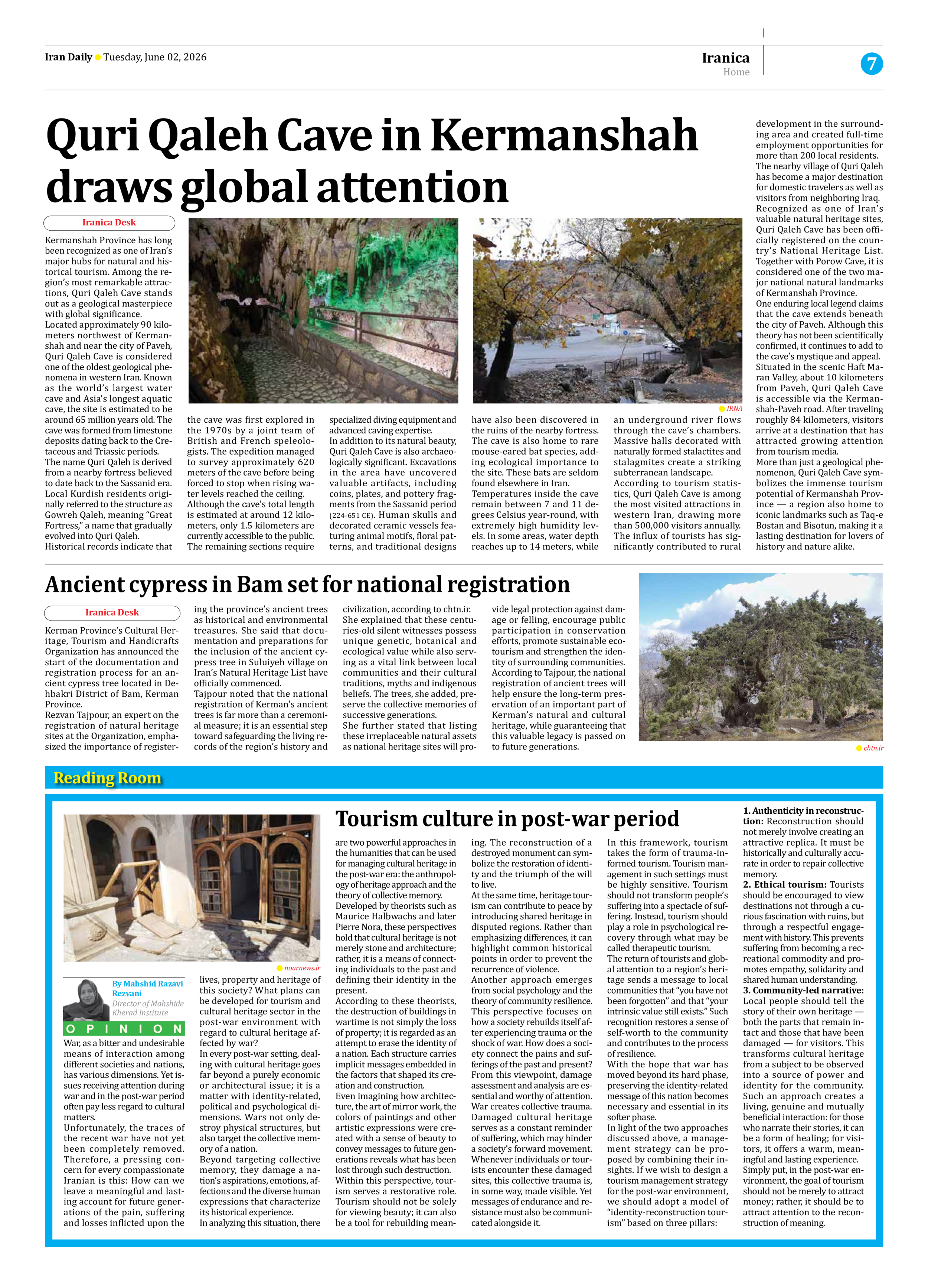
Temperatures inside the cave remain between 7 and 11 degrees Celsius year-round, with extremely high humidity levels. In some areas, water depth reaches up to 14 meters, while an underground river flows through the cave’s chambers. Massive halls decorated with naturally formed stalactites and stalagmites create a striking subterranean landscape.
According to tourism statistics, Quri Qaleh Cave is among the most visited attractions in western Iran, drawing more than 500,000 visitors annually. The influx of tourists has significantly contributed to rural development in the surrounding area and created full-time employment opportunities for more than 200 local residents.
The nearby village of Quri Qaleh has become a major destination for domestic travelers as well as visitors from neighboring Iraq.
Recognized as one of Iran’s valuable natural heritage sites, Quri Qaleh Cave has been officially registered on the country’s National Heritage List. Together with Porow Cave, it is considered one of the two major national natural landmarks of Kermanshah Province.
One enduring local legend claims that the cave extends beneath the city of Paveh. Although this theory has not been scientifically confirmed, it continues to add to the cave’s mystique and appeal.
Situated in the scenic Haft Maran Valley, about 10 kilometers from Paveh, Quri Qaleh Cave is accessible via the Kermanshah-Paveh road. After traveling roughly 84 kilometers, visitors arrive at a destination that has attracted growing attention from tourism media.
More than just a geological phenomenon, Quri Qaleh Cave symbolizes the immense tourism potential of Kermanshah Province — a region also home to iconic landmarks such as Taq-e Bostan and Bisotun, making it a lasting destination for lovers of history and nature alike.