







Alloy steel sector warns of output cuts amid import curbs, war damage
Iran's Alloy Steel Producers Association warned three senior economic officials that current policies could lead to a sharp decline in alloy steel production and potentially force some plants to halt operations.
According to ISNA, the association, in a letter addressed to the minister of industry, mines and trade, the governor of the Central Bank of Iran, and the head of Iran's Customs Administration, called for the "immediate removal of obstacles to imports financed through companies' own export revenues."
The association said steel producers were facing "exhausting bureaucracy" and "non-expert decisions." It said the main problem was that from mid-March until late May, the ability to register import orders through Iran's Integrated Trade System had been disabled for these companies. Even after extensive follow-up, the central bank had refused to issue permits for foreign exchange allocation using companies' own export earnings, it added.
The letter stressed that "steel plants have absolutely no need for foreign exchange resources from the central bank or other sectors of the economy and are only seeking to use their own currency resources, or in other words, the foreign exchange generated from their exports."
The association said the alloy steel industry is now struggling more with domestic obstacles and "self-sanctioning" than with external restrictions.
Western sanctions on Iran, along with damage from recent military attacks on production infrastructure, have further intensified challenges facing the sector.
The association made three urgent requests; automated approval of orders and forex allocation from companies' own export earnings, removal of "excessive bureaucratic filters," immediate release of stranded equipment and raw materials at customs, and guaranteed stability of the trade system to prevent sudden restrictions on steel producers.
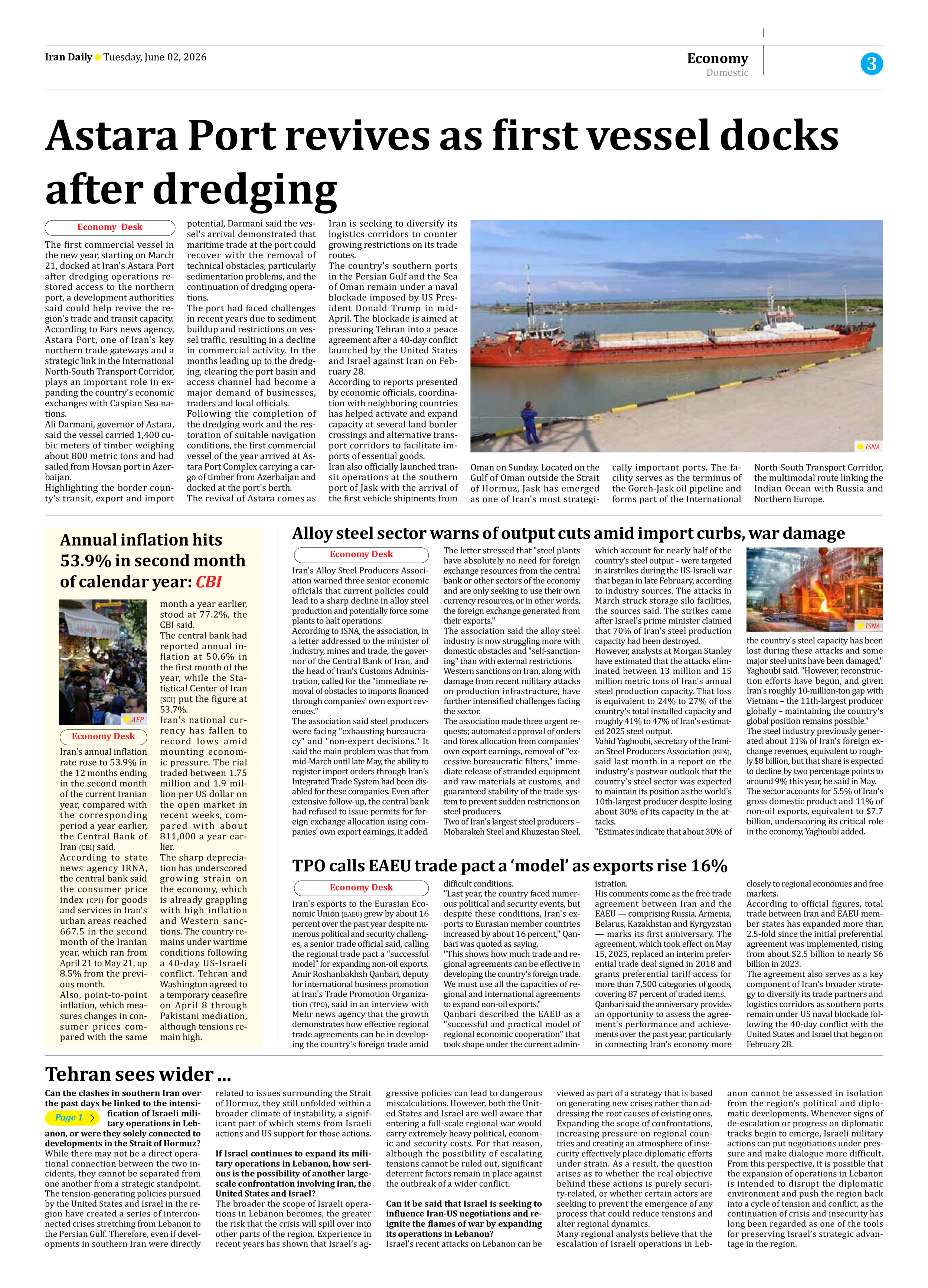
Two of Iran's largest steel producers – Mobarakeh Steel and Khuzestan Steel, which account for nearly half of the country's steel output – were targeted in airstrikes during the US-Israeli war that began in late February, according to industry sources. The attacks in March struck storage silo facilities, the sources said. The strikes came after Israel's prime minister claimed that 70% of Iran's steel production capacity had been destroyed.
However, analysts at Morgan Stanley have estimated that the attacks eliminated between 13 million and 15 million metric tons of Iran's annual steel production capacity. That loss is equivalent to 24% to 27% of the country's total installed capacity and roughly 41% to 47% of Iran's estimated 2025 steel output.
Vahid Yaghoubi, secretary of the Iranian Steel Producers Association (ISPA), said last month in a report on the industry's postwar outlook that the country's steel sector was expected to maintain its position as the world's 10th-largest producer despite losing about 30% of its capacity in the attacks.
"Estimates indicate that about 30% of the country's steel capacity has been lost during these attacks and some major steel units have been damaged," Yaghoubi said. "However, reconstruction efforts have begun, and given Iran's roughly 10-million-ton gap with Vietnam – the 11th-largest producer globally – maintaining the country's global position remains possible."
The steel industry previously generated about 11% of Iran's foreign exchange revenues, equivalent to roughly $8 billion, but that share is expected to decline by two percentage points to around 9% this year, he said in May.
The sector accounts for 5.5% of Iran's gross domestic product and 11% of non-oil exports, equivalent to $7.7 billion, underscoring its critical role in the economy, Yaghoubi added.