







AEOI working with Russia to deploy small nuclear reactors, official says
Iran is working with Russia to develop small nuclear reactors for domestic deployment, a senior atomic energy official said on Sunday.
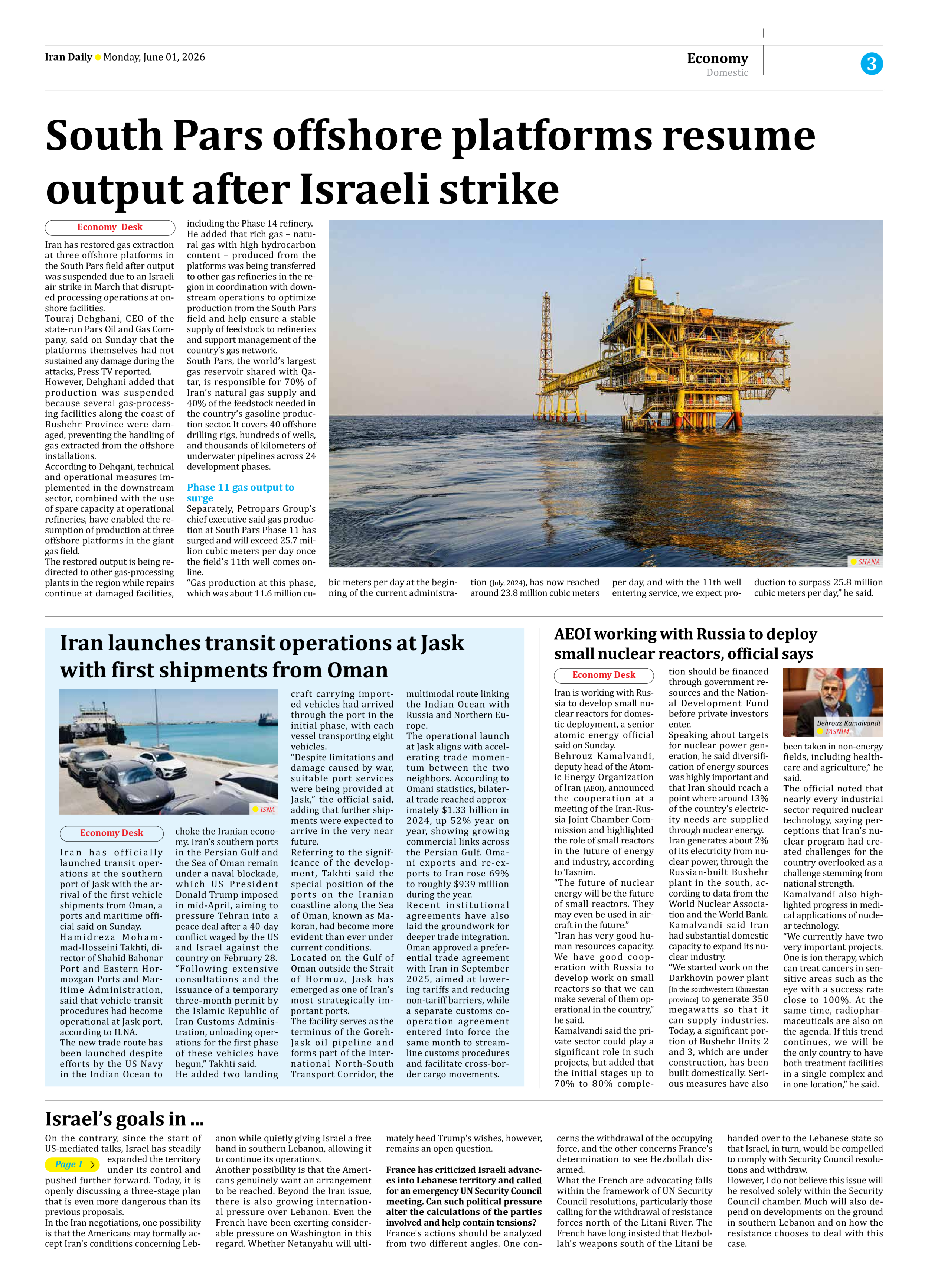
Behrouz Kamalvandi, deputy head of the Atomic Energy Organization of Iran (AEOI), announced the cooperation at a meeting of the Iran-Russia Joint Chamber Commission and highlighted the role of small reactors in the future of energy and industry, according to Tasnim.
“The future of nuclear energy will be the future of small reactors. They may even be used in aircraft in the future.”
“Iran has very good human resources capacity. We have good cooperation with Russia to develop work on small reactors so that we can make several of them operational in the country,” he said.
Kamalvandi said the private sector could play a significant role in such projects, but added that the initial stages up to 70% to 80% completion should be financed through government resources and the National Development Fund before private investors enter.
Speaking about targets for nuclear power generation, he said diversification of energy sources was highly important and that Iran should reach a point where around 13% of the country’s electricity needs are supplied through nuclear energy.
Iran generates about 2% of its electricity from nuclear power, through the Russian-built Bushehr plant in the south, according to data from the World Nuclear Association and the World Bank.
Kamalvandi said Iran had substantial domestic capacity to expand its nuclear industry.
“We started work on the Darkhovin power plant [in the southwestern Khuzestan province] to generate 350 megawatts so that it can supply industries. Today, a significant portion of Bushehr Units 2 and 3, which are under construction, has been built domestically. Serious measures have also been taken in non-energy fields, including healthcare and agriculture,” he said.
The official noted that nearly every industrial sector required nuclear technology, saying perceptions that Iran’s nuclear program had created challenges for the country overlooked as a challenge stemming from national strength.
Kamalvandi also highlighted progress in medical applications of nuclear technology.
“We currently have two very important projects. One is ion therapy, which can treat cancers in sensitive areas such as the eye with a success rate close to 100%. At the same time, radiopharmaceuticals are also on the agenda. If this trend continues, we will be the only country to have both treatment facilities in a single complex and in one location,” he said.