





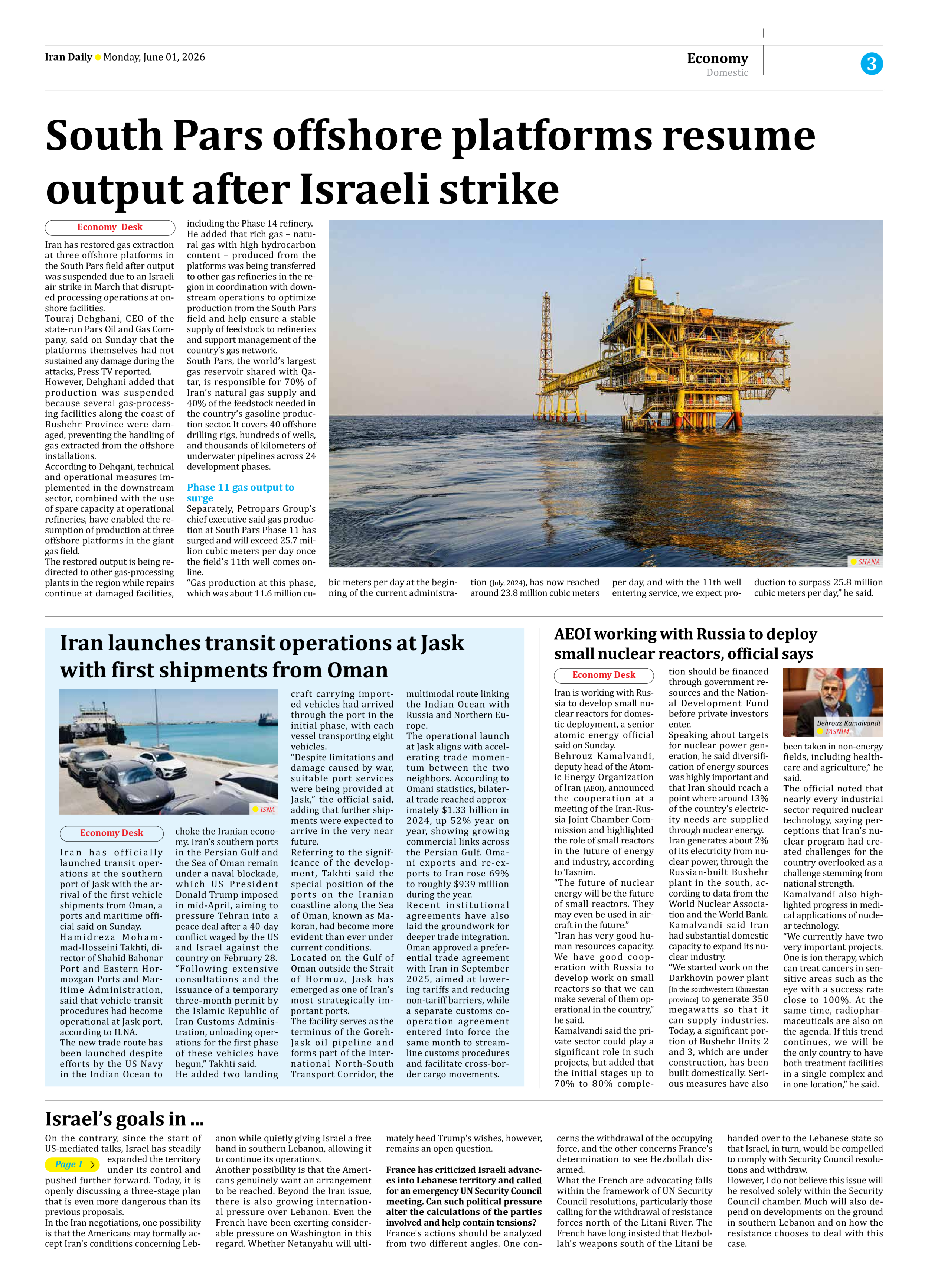


South Pars offshore platforms resume output after Israeli strike
Iran has restored gas extraction at three offshore platforms in the South Pars field after output was suspended due to an Israeli air strike in March that disrupted processing operations at onshore facilities.
Touraj Dehghani, CEO of the state-run Pars Oil and Gas Company, said on Sunday that the platforms themselves had not sustained any damage during the attacks, Press TV reported.
However, Dehghani added that production was suspended because several gas-processing facilities along the coast of Bushehr Province were damaged, preventing the handling of gas extracted from the offshore installations.
According to Dehqani, technical and operational measures implemented in the downstream sector, combined with the use of spare capacity at operational refineries, have enabled the resumption of production at three offshore platforms in the giant gas field.
The restored output is being redirected to other gas-processing plants in the region while repairs continue at damaged facilities, including the Phase 14 refinery.
He added that rich gas – natural gas with high hydrocarbon content – produced from the platforms was being transferred to other gas refineries in the region in coordination with downstream operations to optimize production from the South Pars field and help ensure a stable supply of feedstock to refineries and support management of the country’s gas network.
South Pars, the world’s largest gas reservoir shared with Qatar, is responsible for 70% of Iran’s natural gas supply and 40% of the feedstock needed in the country’s gasoline production sector. It covers 40 offshore drilling rigs, hundreds of wells, and thousands of kilometers of underwater pipelines across 24 development phases.
Phase 11 gas output to surge
Separately, Petropars Group’s chief executive said gas production at South Pars Phase 11 has surged and will exceed 25.7 million cubic meters per day once the field’s 11th well comes online.
“Gas production at this phase, which was about 11.6 million cubic meters per day at the beginning of the current administration (July, 2024), has now reached around 23.8 million cubic meters per day, and with the 11th well entering service, we expect production to surpass 25.8 million cubic meters per day,” he said.