







Mysteries surround 1,500-year-old Zij-e Manijeh
Roughly 15 kilometers before the ancient city of Sarpol-e Zahab, Kermanshah Province, just below a mountain pass that appears to embrace the sky and overlooks what seems like a paradise-like landscape, lies a village that has for centuries hosted a mysterious and enigmatic historical structure at its heart.
Locals in the region each recount different legends and romantic tales about this monument. Some say that when Farhad fell deeply in love with Shirin and began carving through Mount Bisotoun to reach her, his rival Khosrow Parviz, enraged by the love story, had Farhad killed and later exiled Shirin to a palace near Sarpol-e Zahab — believed by some to be this very structure, which has now become a historical monument.
However, the name of the monument somewhat distances it from the tale of Shirin and Farhad. The site is known today as Zij-e Manijeh, and for this reason some locals associate it with another romantic narrative — the tragic story of Bijan and Manijeh from the Shahnameh. According to this version, the site is believed to have been the place where Manijeh stayed for a time after Bijan, son of Giv, was rescued from a deep and dark pit in which Afrasiab, the Turanian king and Manijeh’s father, had imprisoned him, until he was saved by the hero Rostam.
Although these two stories remain local oral traditions, others argue that the word “Zij” refers to an astronomical table or observatory, suggesting that the structure may have functioned as a Sassanid-era observatory around 1,500 years ago. However, the building’s unique architecture makes this claim difficult to verify.
The presence of an ancient paved road nearby, along with another mysterious and still-unexplained structure known as Taq-e Gara, and a historical spring, has led some researchers to suggest that the site may once have functioned as a caravanserai.
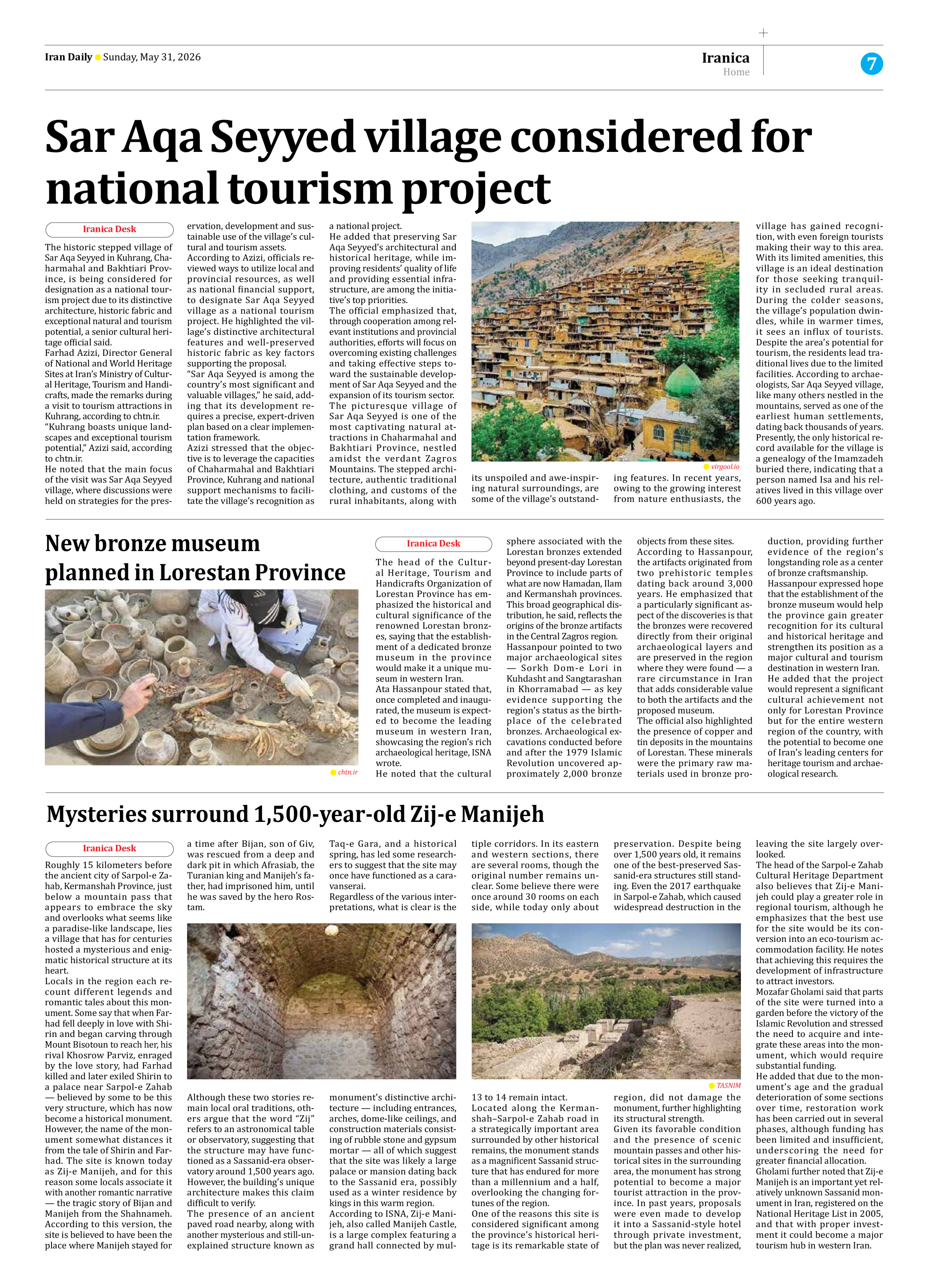
Regardless of the various interpretations, what is clear is the monument’s distinctive architecture — including entrances, arches, dome-like ceilings, and construction materials consisting of rubble stone and gypsum mortar — all of which suggest that the site was likely a large palace or mansion dating back to the Sassanid era, possibly used as a winter residence by kings in this warm region.
According to ISNA, Zij-e Manijeh, also called Manijeh Castle, is a large complex featuring a grand hall connected by multiple corridors. In its eastern and western sections, there are several rooms, though the original number remains unclear. Some believe there were once around 30 rooms on each side, while today only about 13 to 14 remain intact.
Located along the Kermanshah–Sarpol-e Zahab road in a strategically important area surrounded by other historical remains, the monument stands as a magnificent Sassanid structure that has endured for more than a millennium and a half, overlooking the changing fortunes of the region.
One of the reasons this site is considered significant among the province’s historical heritage is its remarkable state of preservation. Despite being over 1,500 years old, it remains one of the best-preserved Sassanid-era structures still standing. Even the 2017 earthquake in Sarpol-e Zahab, which caused widespread destruction in the region, did not damage the monument, further highlighting its structural strength.
Given its favorable condition and the presence of scenic mountain passes and other historical sites in the surrounding area, the monument has strong potential to become a major tourist attraction in the province. In past years, proposals were even made to develop it into a Sassanid-style hotel through private investment, but the plan was never realized, leaving the site largely overlooked.
The head of the Sarpol-e Zahab Cultural Heritage Department also believes that Zij-e Manijeh could play a greater role in regional tourism, although he emphasizes that the best use for the site would be its conversion into an eco-tourism accommodation facility. He notes that achieving this requires the development of infrastructure to attract investors.
Mozafar Gholami said that parts of the site were turned into a garden before the victory of the Islamic Revolution and stressed the need to acquire and integrate these areas into the monument, which would require substantial funding.
He added that due to the monument’s age and the gradual deterioration of some sections over time, restoration work has been carried out in several phases, although funding has been limited and insufficient, underscoring the need for greater financial allocation.
Gholami further noted that Zij-e Manijeh is an important yet relatively unknown Sassanid monument in Iran, registered on the National Heritage List in 2005, and that with proper investment it could become a major tourism hub in western Iran.