







Kar Bafi tradition finds new life in Varzaneh
In the mud-brick homes of Varzaneh, a desert town in Iran’s central Isfahan Province, the centuries-old art of Kar Bafi — a traditional cotton weaving craft — is finding new life once again.
Rooted in the cotton-growing lands of eastern Isfahan, Kar Bafi is far more than a textile technique. For generations, it has formed part of the identity and livelihood of local women, who transformed the white cotton harvested from nearby fields into handwoven cloths rich in beauty and tradition, according to IRNA.
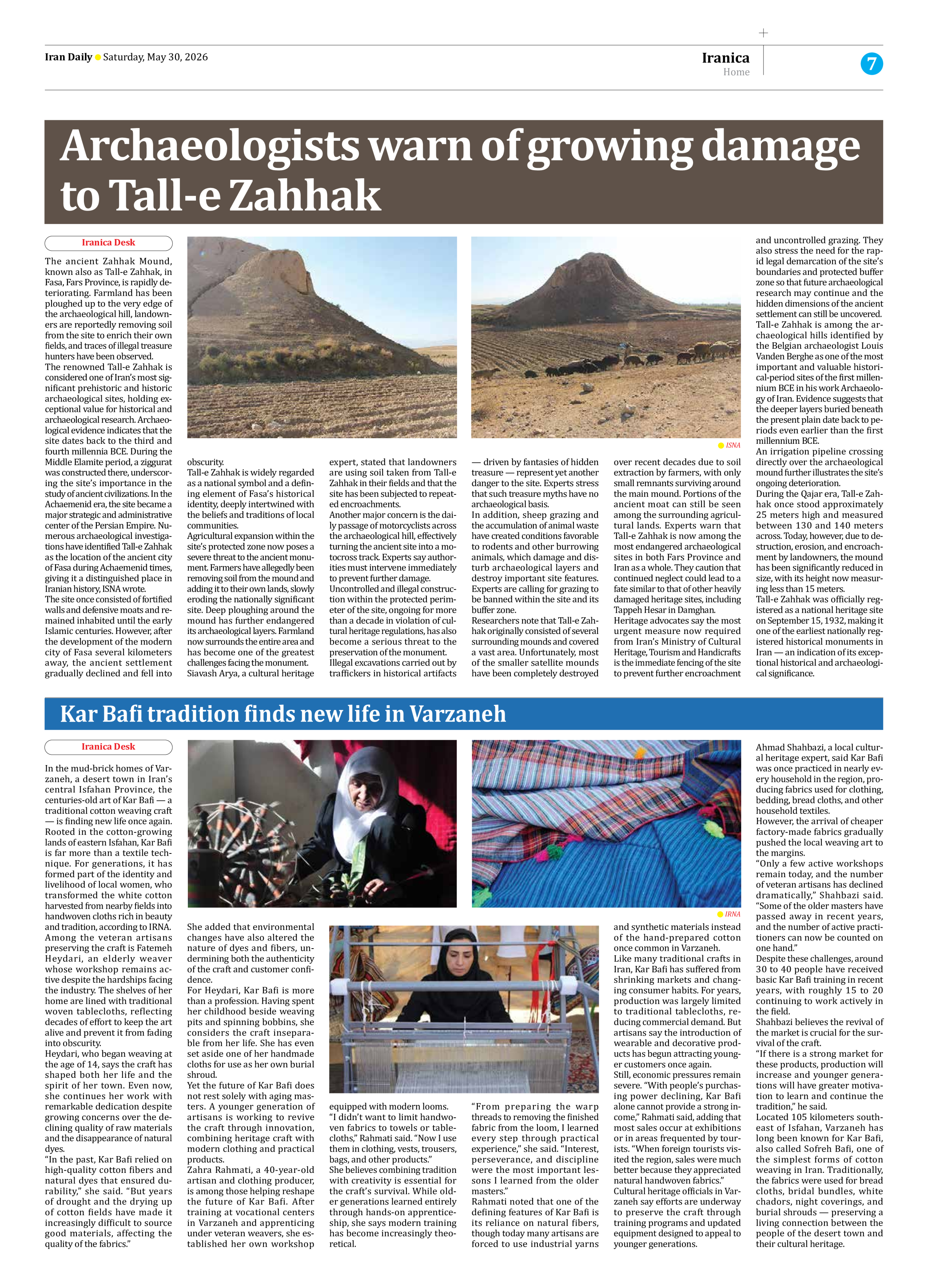
Among the veteran artisans preserving the craft is Fatemeh Heydari, an elderly weaver whose workshop remains active despite the hardships facing the industry. The shelves of her home are lined with traditional woven tablecloths, reflecting decades of effort to keep the art alive and prevent it from fading into obscurity.
Heydari, who began weaving at the age of 14, says the craft has shaped both her life and the spirit of her town. Even now, she continues her work with remarkable dedication despite growing concerns over the declining quality of raw materials and the disappearance of natural dyes.
“In the past, Kar Bafi relied on high-quality cotton fibers and natural dyes that ensured durability,” she said. “But years of drought and the drying up of cotton fields have made it increasingly difficult to source good materials, affecting the quality of the fabrics.”
She added that environmental changes have also altered the nature of dyes and fibers, undermining both the authenticity of the craft and customer confidence.
For Heydari, Kar Bafi is more than a profession. Having spent her childhood beside weaving pits and spinning bobbins, she considers the craft inseparable from her life. She has even set aside one of her handmade cloths for use as her own burial shroud.
Yet the future of Kar Bafi does not rest solely with aging masters. A younger generation of artisans is working to revive the craft through innovation, combining heritage craft with modern clothing and practical products.
Zahra Rahmati, a 40-year-old artisan and clothing producer, is among those helping reshape the future of Kar Bafi. After training at vocational centers in Varzaneh and apprenticing under veteran weavers, she established her own workshop equipped with modern looms.
“I didn’t want to limit handwoven fabrics to towels or tablecloths,” Rahmati said. “Now I use them in clothing, vests, trousers, bags, and other products.”
She believes combining tradition with creativity is essential for the craft’s survival. While older generations learned entirely through hands-on apprenticeship, she says modern training has become increasingly theoretical.
“From preparing the warp threads to removing the finished fabric from the loom, I learned every step through practical experience,” she said. “Interest, perseverance, and discipline were the most important lessons I learned from the older masters.”
Rahmati noted that one of the defining features of Kar Bafi is its reliance on natural fibers, though today many artisans are forced to use industrial yarns and synthetic materials instead of the hand-prepared cotton once common in Varzaneh.
Like many traditional crafts in Iran, Kar Bafi has suffered from shrinking markets and changing consumer habits. For years, production was largely limited to traditional tablecloths, reducing commercial demand. But artisans say the introduction of wearable and decorative products has begun attracting younger customers once again.
Still, economic pressures remain severe. “With people’s purchasing power declining, Kar Bafi alone cannot provide a strong income,” Rahmati said, adding that most sales occur at exhibitions or in areas frequented by tourists. “When foreign tourists visited the region, sales were much better because they appreciated natural handwoven fabrics.”
Cultural heritage officials in Varzaneh say efforts are underway to preserve the craft through training programs and updated equipment designed to appeal to younger generations.
Ahmad Shahbazi, a local cultural heritage expert, said Kar Bafi was once practiced in nearly every household in the region, producing fabrics used for clothing, bedding, bread cloths, and other household textiles.
However, the arrival of cheaper factory-made fabrics gradually pushed the local weaving art to the margins.
“Only a few active workshops remain today, and the number of veteran artisans has declined dramatically,” Shahbazi said. “Some of the older masters have passed away in recent years, and the number of active practitioners can now be counted on one hand.”
Despite these challenges, around 30 to 40 people have received basic Kar Bafi training in recent years, with roughly 15 to 20 continuing to work actively in the field.
Shahbazi believes the revival of the market is crucial for the survival of the craft.
“If there is a strong market for these products, production will increase and younger generations will have greater motivation to learn and continue the tradition,” he said.
Located 105 kilometers southeast of Isfahan, Varzaneh has long been known for Kar Bafi, also called Sofreh Bafi, one of the simplest forms of cotton weaving in Iran. Traditionally, the fabrics were used for bread cloths, bridal bundles, white chadors, night coverings, and burial shrouds — preserving a living connection between the people of the desert town and their cultural heritage.