







Archaeologists warn of growing damage to Tall-e Zahhak
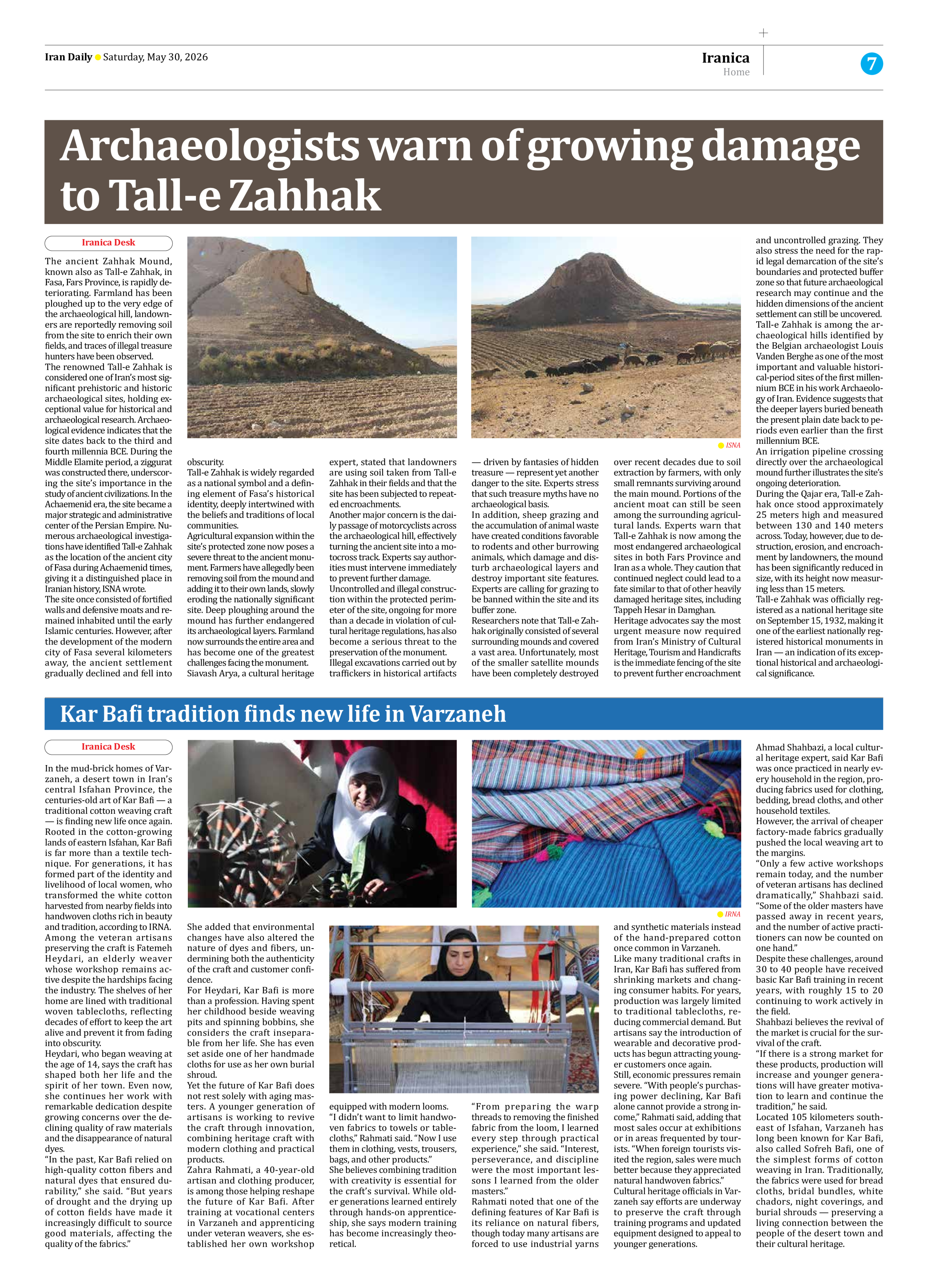
The ancient Zahhak Mound, known also as Tall-e Zahhak, in Fasa, Fars Province, is rapidly deteriorating. Farmland has been ploughed up to the very edge of the archaeological hill, landowners are reportedly removing soil from the site to enrich their own fields, and traces of illegal treasure hunters have been observed.
The renowned Tall-e Zahhak is considered one of Iran’s most significant prehistoric and historic archaeological sites, holding exceptional value for historical and archaeological research. Archaeological evidence indicates that the site dates back to the third and fourth millennia BCE. During the Middle Elamite period, a ziggurat was constructed there, underscoring the site’s importance in the study of ancient civilizations. In the Achaemenid era, the site became a major strategic and administrative center of the Persian Empire. Numerous archaeological investigations have identified Tall-e Zahhak as the location of the ancient city of Fasa during Achaemenid times, giving it a distinguished place in Iranian history, ISNA wrote.
The site once consisted of fortified walls and defensive moats and remained inhabited until the early Islamic centuries. However, after the development of the modern city of Fasa several kilometers away, the ancient settlement gradually declined and fell into obscurity.
Tall-e Zahhak is widely regarded as a national symbol and a defining element of Fasa’s historical identity, deeply intertwined with the beliefs and traditions of local communities.
Agricultural expansion within the site’s protected zone now poses a severe threat to the ancient monument. Farmers have allegedly been removing soil from the mound and adding it to their own lands, slowly eroding the nationally significant site. Deep ploughing around the mound has further endangered its archaeological layers. Farmland now surrounds the entire area and has become one of the greatest challenges facing the monument.
Siavash Arya, a cultural heritage expert, stated that landowners are using soil taken from Tall-e Zahhak in their fields and that the site has been subjected to repeated encroachments.
Another major concern is the daily passage of motorcyclists across the archaeological hill, effectively turning the ancient site into a motocross track. Experts say authorities must intervene immediately to prevent further damage.
Uncontrolled and illegal construction within the protected perimeter of the site, ongoing for more than a decade in violation of cultural heritage regulations, has also become a serious threat to the preservation of the monument.
Illegal excavations carried out by traffickers in historical artifacts — driven by fantasies of hidden treasure — represent yet another danger to the site. Experts stress that such treasure myths have no archaeological basis.
In addition, sheep grazing and the accumulation of animal waste have created conditions favorable to rodents and other burrowing animals, which damage and disturb archaeological layers and destroy important site features. Experts are calling for grazing to be banned within the site and its buffer zone.
Researchers note that Tall-e Zahhak originally consisted of several surrounding mounds and covered a vast area. Unfortunately, most of the smaller satellite mounds have been completely destroyed over recent decades due to soil extraction by farmers, with only small remnants surviving around the main mound. Portions of the ancient moat can still be seen among the surrounding agricultural lands. Experts warn that Tall-e Zahhak is now among the most endangered archaeological sites in both Fars Province and Iran as a whole. They caution that continued neglect could lead to a fate similar to that of other heavily damaged heritage sites, including Tappeh Hesar in Damghan.
Heritage advocates say the most urgent measure now required from Iran’s Ministry of Cultural Heritage, Tourism and Handicrafts is the immediate fencing of the site to prevent further encroachment and uncontrolled grazing. They also stress the need for the rapid legal demarcation of the site’s boundaries and protected buffer zone so that future archaeological research may continue and the hidden dimensions of the ancient settlement can still be uncovered.
Tall-e Zahhak is among the archaeological hills identified by the Belgian archaeologist Louis Vanden Berghe as one of the most important and valuable historical-period sites of the first millennium BCE in his work Archaeology of Iran. Evidence suggests that the deeper layers buried beneath the present plain date back to periods even earlier than the first millennium BCE.
An irrigation pipeline crossing directly over the archaeological mound further illustrates the site’s ongoing deterioration.
During the Qajar era, Tall-e Zahhak once stood approximately 25 meters high and measured between 130 and 140 meters across. Today, however, due to destruction, erosion, and encroachment by landowners, the mound has been significantly reduced in size, with its height now measuring less than 15 meters.
Tall-e Zahhak was officially registered as a national heritage site on September 15, 1932, making it one of the earliest nationally registered historical monuments in Iran — an indication of its exceptional historical and archaeological significance.