







Copy in clipboard...
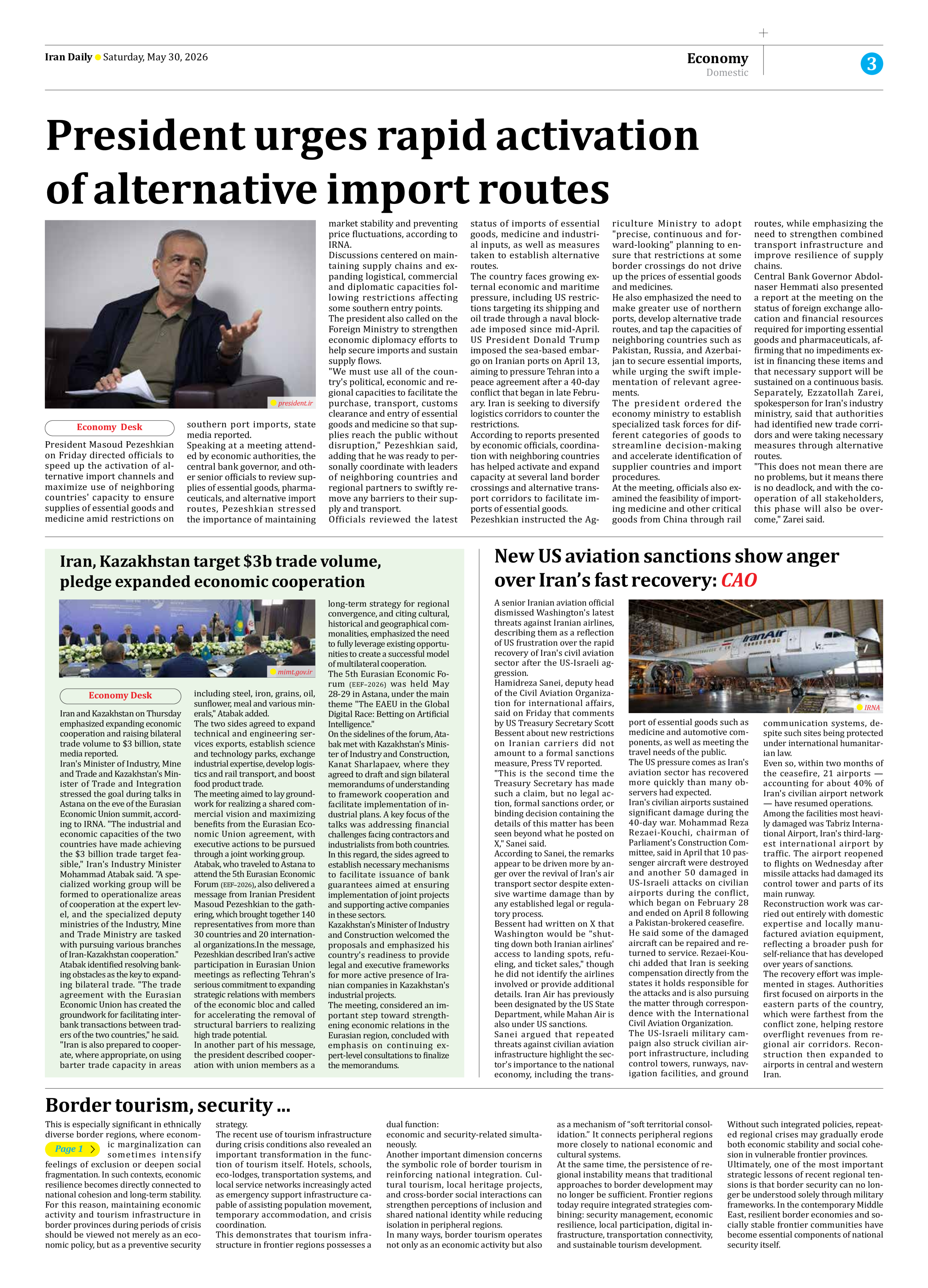
New US aviation sanctions show anger over Iran’s fast recovery: CAO
Hamidreza Sanei, deputy head of the Civil Aviation Organization for international affairs, said on Friday that comments by US Treasury Secretary Scott Bessent about new restrictions on Iranian carriers did not amount to a formal sanctions measure, Press TV reported.
"This is the second time the Treasury Secretary has made such a claim, but no legal action, formal sanctions order, or binding decision containing the details of this matter has been seen beyond what he posted on X," Sanei said.
According to Sanei, the remarks appear to be driven more by anger over the revival of Iran's air transport sector despite extensive wartime damage than by any established legal or regulatory process.
Bessent had written on X that Washington would be "shutting down both Iranian airlines' access to landing spots, refueling, and ticket sales," though he did not identify the airlines involved or provide additional details. Iran Air has previously been designated by the US State Department, while Mahan Air is also under US sanctions.
Sanei argued that repeated threats against civilian aviation infrastructure highlight the sector's importance to the national economy, including the transport of essential goods such as medicine and automotive components, as well as meeting the travel needs of the public.
The US pressure comes as Iran's aviation sector has recovered more quickly than many observers had expected.
Iran's civilian airports sustained significant damage during the 40-day war. Mohammad Reza Rezaei-Kouchi, chairman of Parliament's Construction Committee, said in April that 10 passenger aircraft were destroyed and another 50 damaged in US-Israeli attacks on civilian airports during the conflict, which began on February 28 and ended on April 8 following a Pakistan-brokered ceasefire.
He said some of the damaged aircraft can be repaired and returned to service. Rezaei-Kouchi added that Iran is seeking compensation directly from the states it holds responsible for the attacks and is also pursuing the matter through correspondence with the International Civil Aviation Organization.
The US-Israeli military campaign also struck civilian airport infrastructure, including control towers, runways, navigation facilities, and ground communication systems, despite such sites being protected under international humanitarian law.
Even so, within two months of the ceasefire, 21 airports — accounting for about 40% of Iran's civilian airport network — have resumed operations.
Among the facilities most heavily damaged was Tabriz International Airport, Iran's third-largest international airport by traffic. The airport reopened to flights on Wednesday after missile attacks had damaged its control tower and parts of its main runway.
Reconstruction work was carried out entirely with domestic expertise and locally manufactured aviation equipment, reflecting a broader push for self-reliance that has developed over years of sanctions.
The recovery effort was implemented in stages. Authorities first focused on airports in the eastern parts of the country, which were farthest from the conflict zone, helping restore overflight revenues from regional air corridors. Reconstruction then expanded to airports in central and western Iran.