





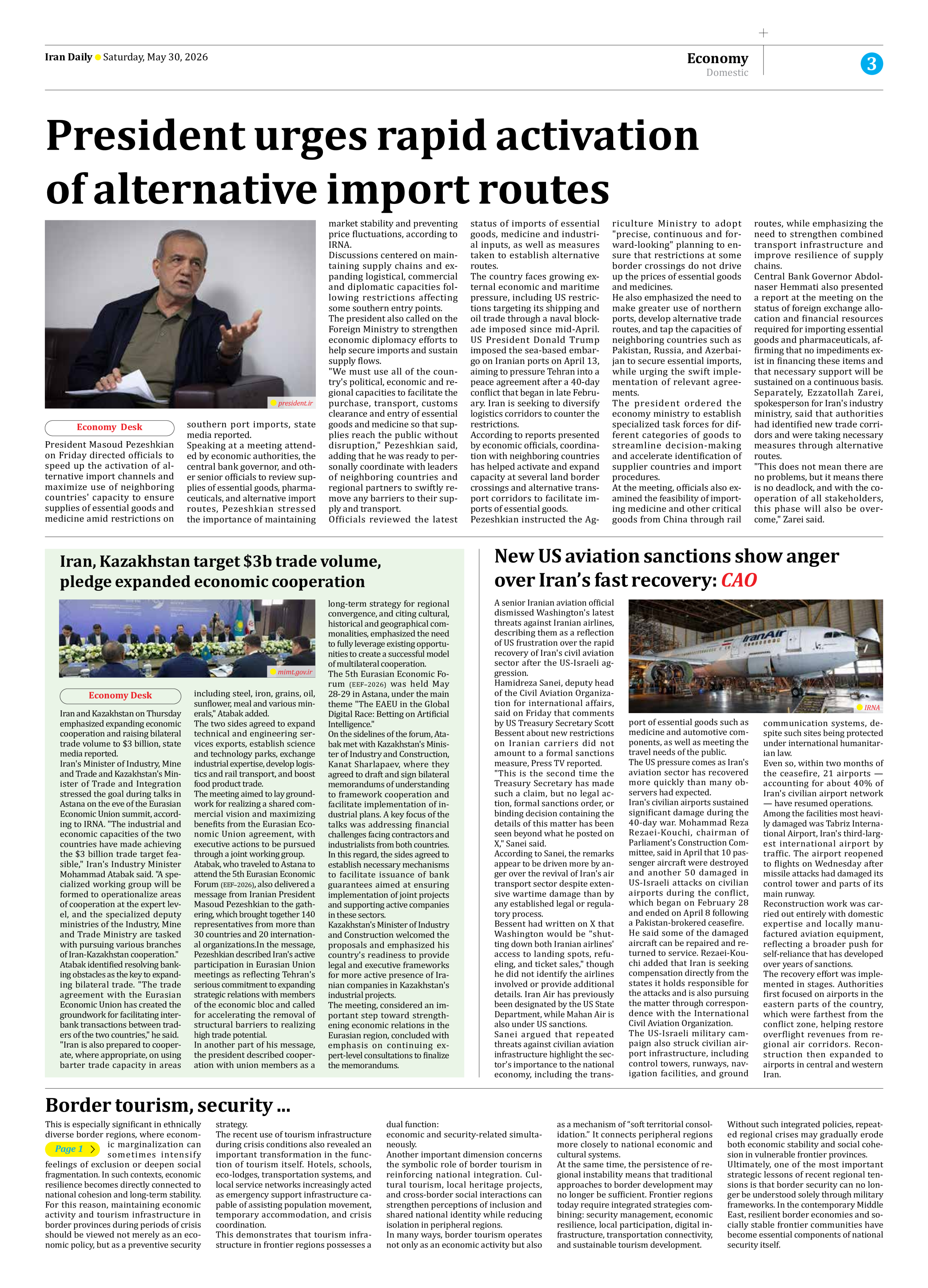


President urges rapid activation of alternative import routes
President Masoud Pezeshkian on Friday directed officials to speed up the activation of alternative import channels and maximize use of neighboring countries' capacity to ensure supplies of essential goods and medicine amid restrictions on southern port imports, state media reported.
Speaking at a meeting attended by economic authorities, the central bank governor, and other senior officials to review supplies of essential goods, pharmaceuticals, and alternative import routes, Pezeshkian stressed the importance of maintaining market stability and preventing price fluctuations, according to IRNA.
Discussions centered on maintaining supply chains and expanding logistical, commercial and diplomatic capacities following restrictions affecting some southern entry points.
The president also called on the Foreign Ministry to strengthen economic diplomacy efforts to help secure imports and sustain supply flows.
"We must use all of the country's political, economic and regional capacities to facilitate the purchase, transport, customs clearance and entry of essential goods and medicine so that supplies reach the public without disruption," Pezeshkian said, adding that he was ready to personally coordinate with leaders of neighboring countries and regional partners to swiftly remove any barriers to their supply and transport.
Officials reviewed the latest status of imports of essential goods, medicine and industrial inputs, as well as measures taken to establish alternative routes.
The country faces growing external economic and maritime pressure, including US restrictions targeting its shipping and oil trade through a naval blockade imposed since mid-April. US President Donald Trump imposed the sea-based embargo on Iranian ports on April 13, aiming to pressure Tehran into a peace agreement after a 40-day conflict that began in late February. Iran is seeking to diversify logistics corridors to counter the restrictions.
According to reports presented by economic officials, coordination with neighboring countries has helped activate and expand capacity at several land border crossings and alternative transport corridors to facilitate imports of essential goods.
Pezeshkian instructed the Agriculture Ministry to adopt "precise, continuous and forward-looking" planning to ensure that restrictions at some border crossings do not drive up the prices of essential goods and medicines.
He also emphasized the need to make greater use of northern ports, develop alternative trade routes, and tap the capacities of neighboring countries such as Pakistan, Russia, and Azerbaijan to secure essential imports, while urging the swift implementation of relevant agreements.
The president ordered the economy ministry to establish specialized task forces for different categories of goods to streamline decision-making and accelerate identification of supplier countries and import procedures.
At the meeting, officials also examined the feasibility of importing medicine and other critical goods from China through rail routes, while emphasizing the need to strengthen combined transport infrastructure and improve resilience of supply chains.
Central Bank Governor Abdolnaser Hemmati also presented a report at the meeting on the status of foreign exchange allocation and financial resources required for importing essential goods and pharmaceuticals, affirming that no impediments exist in financing these items and that necessary support will be sustained on a continuous basis.
Separately, Ezzatollah Zarei, spokesperson for Iran's industry ministry, said that authorities had identified new trade corridors and were taking necessary measures through alternative routes.
"This does not mean there are no problems, but it means there is no deadlock, and with the cooperation of all stakeholders, this phase will also be overcome," Zarei said.