





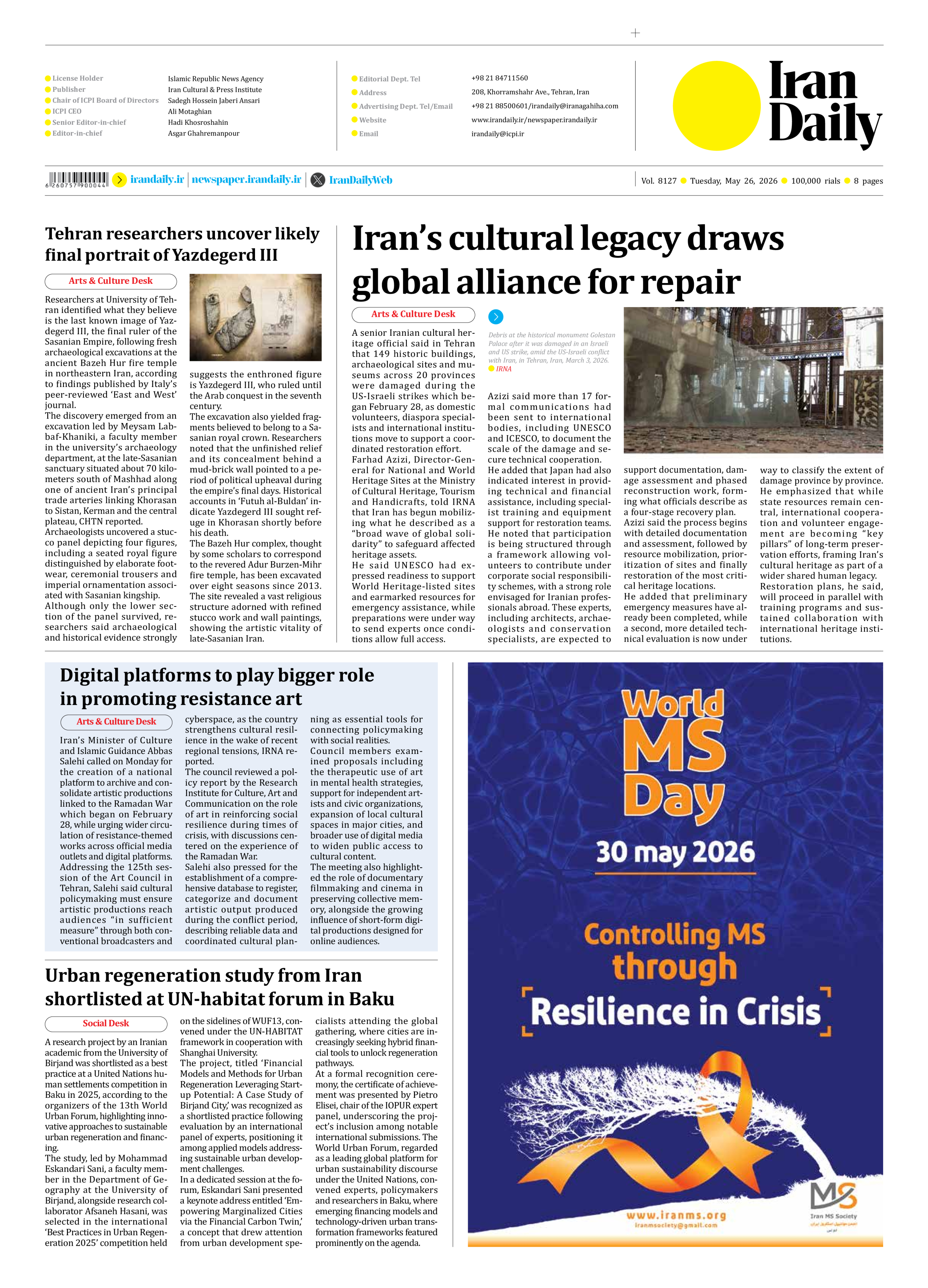


Tehran researchers uncover likely final portrait of Yazdegerd III
Researchers at University of Tehran identified what they believe is the last known image of Yazdegerd III, the final ruler of the Sasanian Empire, following fresh archaeological excavations at the ancient Bazeh Hur fire temple in northeastern Iran, according to findings published by Italy’s peer-reviewed ‘East and West’ journal.
The discovery emerged from an excavation led by Meysam Labbaf-Khaniki, a faculty member in the university’s archaeology department, at the late-Sasanian sanctuary situated about 70 kilometers south of Mashhad along one of ancient Iran’s principal trade arteries linking Khorasan to Sistan, Kerman and the central plateau, CHTN reported.
Archaeologists uncovered a stucco panel depicting four figures, including a seated royal figure distinguished by elaborate footwear, ceremonial trousers and imperial ornamentation associated with Sasanian kingship.
Although only the lower section of the panel survived, researchers said archaeological and historical evidence strongly suggests the enthroned figure is Yazdegerd III, who ruled until the Arab conquest in the seventh century.
The excavation also yielded fragments believed to belong to a Sasanian royal crown. Researchers noted that the unfinished relief and its concealment behind a mud-brick wall pointed to a period of political upheaval during the empire’s final days. Historical accounts in ‘Futuh al-Buldan’ indicate Yazdegerd III sought refuge in Khorasan shortly before his death.
The Bazeh Hur complex, thought by some scholars to correspond to the revered Adur Burzen-Mihr fire temple, has been excavated over eight seasons since 2013. The site revealed a vast religious structure adorned with refined stucco work and wall paintings, showing the artistic vitality of late-Sasanian Iran.