







Iran’s cultural legacy draws global alliance for repair
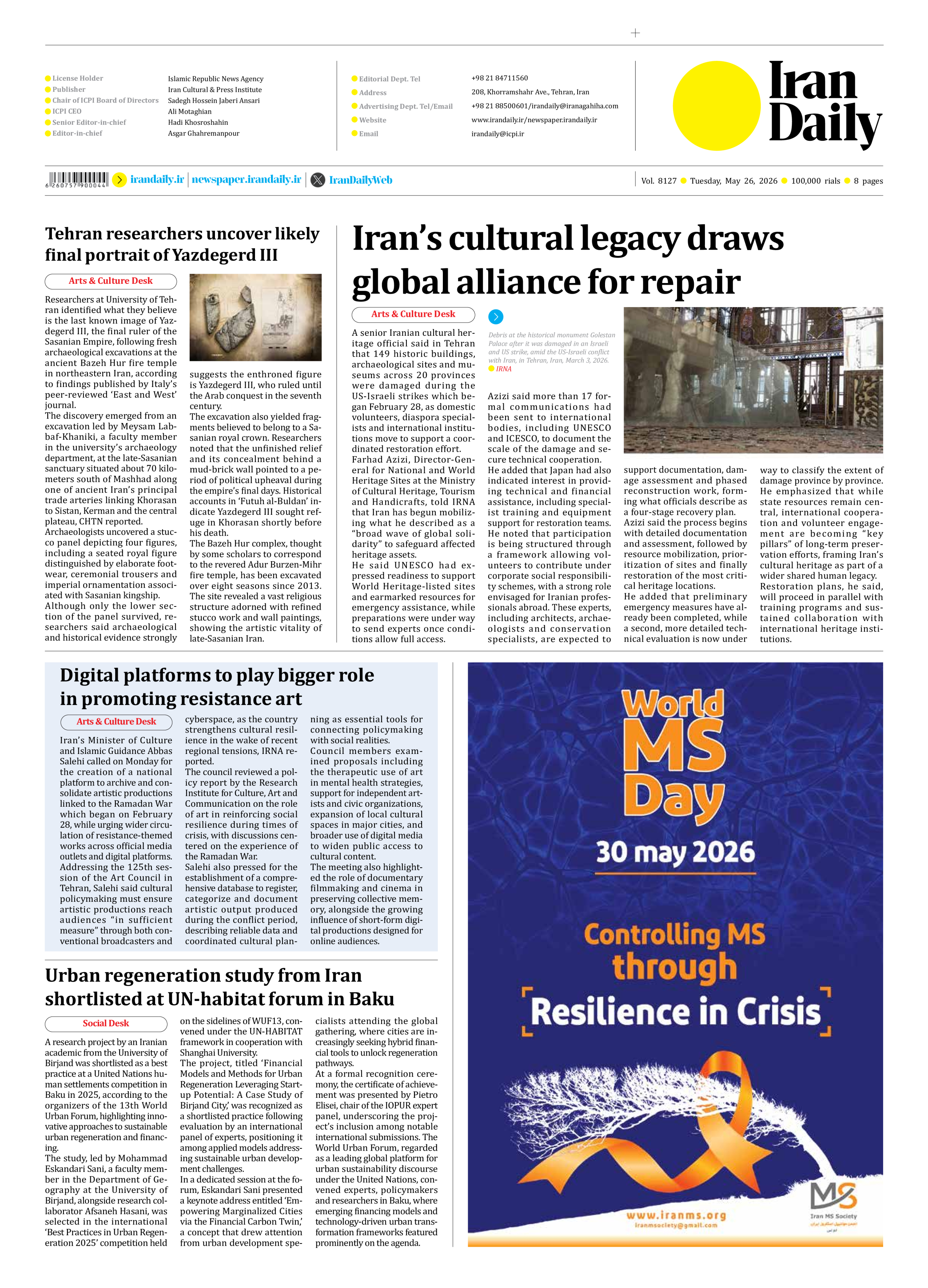
A senior Iranian cultural heritage official said in Tehran that 149 historic buildings, archaeological sites and museums across 20 provinces were damaged during the US-Israeli strikes which began February 28, as domestic volunteers, diaspora specialists and international institutions move to support a coordinated restoration effort.
Farhad Azizi, Director-General for National and World Heritage Sites at the Ministry of Cultural Heritage, Tourism and Handicrafts, told IRNA that Iran has begun mobilizing what he described as a “broad wave of global solidarity” to safeguard affected heritage assets.
He said UNESCO had expressed readiness to support World Heritage-listed sites and earmarked resources for emergency assistance, while preparations were under way to send experts once conditions allow full access.
Azizi said more than 17 formal communications had been sent to international bodies, including UNESCO and ICESCO, to document the scale of the damage and secure technical cooperation.
He added that Japan had also indicated interest in providing technical and financial assistance, including specialist training and equipment support for restoration teams.
He noted that participation is being structured through a framework allowing volunteers to contribute under corporate social responsibility schemes, with a strong role envisaged for Iranian professionals abroad. These experts, including architects, archaeologists and conservation specialists, are expected to support documentation, damage assessment and phased reconstruction work, forming what officials describe as a four-stage recovery plan.
Azizi said the process begins with detailed documentation and assessment, followed by resource mobilization, prioritization of sites and finally restoration of the most critical heritage locations.
He added that preliminary emergency measures have already been completed, while a second, more detailed technical evaluation is now under way to classify the extent of damage province by province.
He emphasized that while state resources remain central, international cooperation and volunteer engagement are becoming “key pillars” of long-term preservation efforts, framing Iran’s cultural heritage as part of a wider shared human legacy.
Restoration plans, he said, will proceed in parallel with training programs and sustained collaboration with international heritage institutions.