







Iranians carry history wherever they go
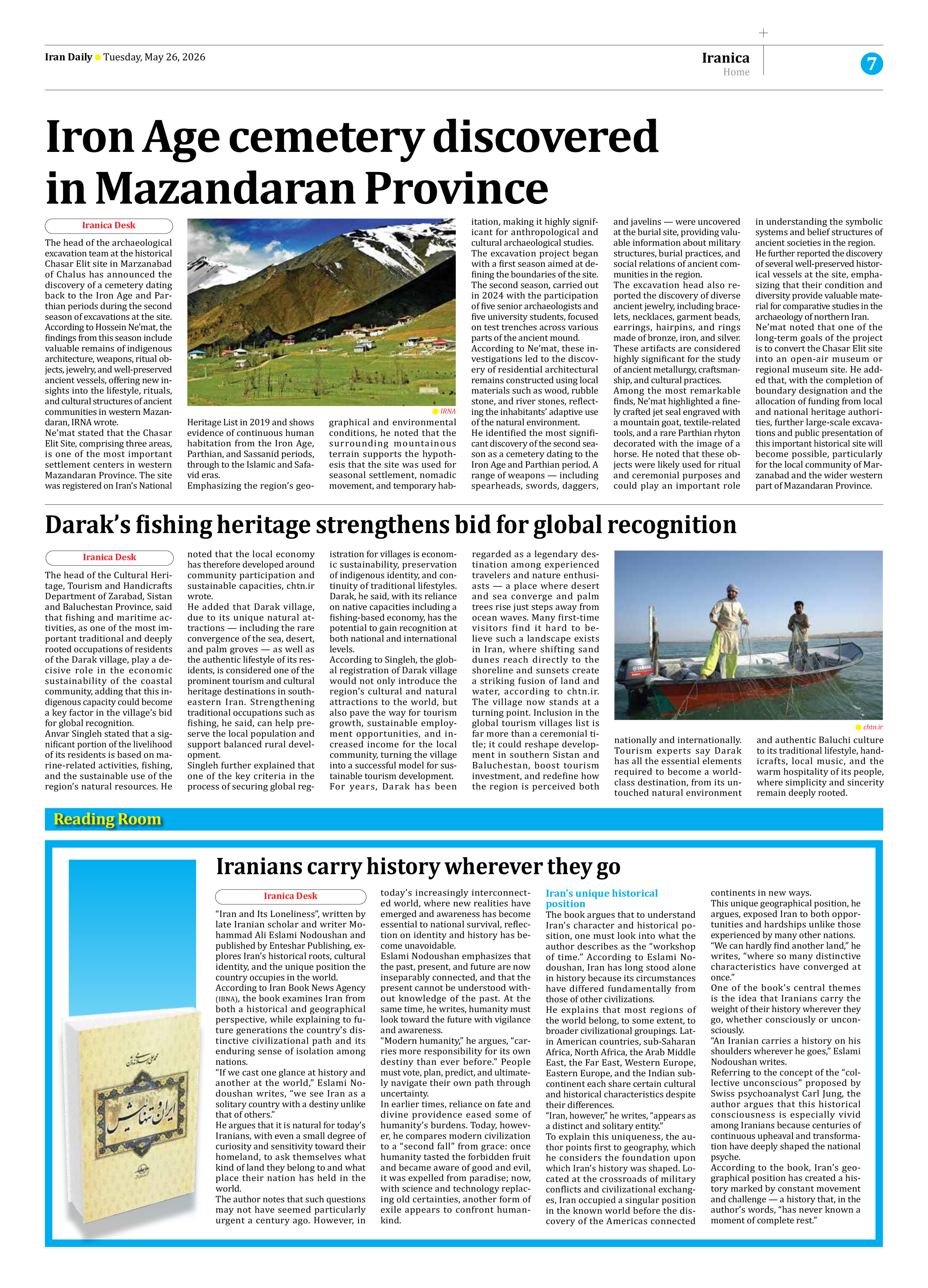
“Iran and Its Loneliness”, written by late Iranian scholar and writer Mohammad Ali Eslami Nodoushan and published by Enteshar Publishing, explores Iran’s historical roots, cultural identity, and the unique position the country occupies in the world.
According to Iran Book News Agency (IBNA), the book examines Iran from both a historical and geographical perspective, while explaining to future generations the country’s distinctive civilizational path and its enduring sense of isolation among nations.
“If we cast one glance at history and another at the world,” Eslami Nodoushan writes, “we see Iran as a solitary country with a destiny unlike that of others.”
He argues that it is natural for today’s Iranians, with even a small degree of curiosity and sensitivity toward their homeland, to ask themselves what kind of land they belong to and what place their nation has held in the world.
The author notes that such questions may not have seemed particularly urgent a century ago. However, in today’s increasingly interconnected world, where new realities have emerged and awareness has become essential to national survival, reflection on identity and history has become unavoidable.
Eslami Nodoushan emphasizes that the past, present, and future are now inseparably connected, and that the present cannot be understood without knowledge of the past. At the same time, he writes, humanity must look toward the future with vigilance and awareness.
“Modern humanity,” he argues, “carries more responsibility for its own destiny than ever before.” People must vote, plan, predict, and ultimately navigate their own path through uncertainty.
In earlier times, reliance on fate and divine providence eased some of humanity’s burdens. Today, however, he compares modern civilization to a “second fall” from grace: once humanity tasted the forbidden fruit and became aware of good and evil, it was expelled from paradise; now, with science and technology replacing old certainties, another form of exile appears to confront humankind.
Iran’s unique historical position
The book argues that to understand Iran’s character and historical position, one must look into what the author describes as the “workshop of time.” According to Eslami Nodoushan, Iran has long stood alone in history because its circumstances have differed fundamentally from those of other civilizations.
He explains that most regions of the world belong, to some extent, to broader civilizational groupings. Latin American countries, sub-Saharan Africa, North Africa, the Arab Middle East, the Far East, Western Europe, Eastern Europe, and the Indian subcontinent each share certain cultural and historical characteristics despite their differences.
“Iran, however,” he writes, “appears as a distinct and solitary entity.”
To explain this uniqueness, the author points first to geography, which he considers the foundation upon which Iran’s history was shaped. Located at the crossroads of military conflicts and civilizational exchanges, Iran occupied a singular position in the known world before the discovery of the Americas connected continents in new ways.
This unique geographical position, he argues, exposed Iran to both opportunities and hardships unlike those experienced by many other nations.
“We can hardly find another land,” he writes, “where so many distinctive characteristics have converged at once.”
One of the book’s central themes is the idea that Iranians carry the weight of their history wherever they go, whether consciously or unconsciously.
“An Iranian carries a history on his shoulders wherever he goes,” Eslami Nodoushan writes.
Referring to the concept of the “collective unconscious” proposed by Swiss psychoanalyst Carl Jung, the author argues that this historical consciousness is especially vivid among Iranians because centuries of continuous upheaval and transformation have deeply shaped the national psyche.
According to the book, Iran’s geographical position has created a history marked by constant movement and challenge — a history that, in the author’s words, “has never known a moment of complete rest.”