







Iron Age cemetery discovered in Mazandaran Province
The head of the archaeological excavation team at the historical Chasar Elit site in Marzanabad of Chalus has announced the discovery of a cemetery dating back to the Iron Age and Parthian periods during the second season of excavations at the site.
According to Hossein Ne’mat, the findings from this season include valuable remains of indigenous architecture, weapons, ritual objects, jewelry, and well-preserved ancient vessels, offering new insights into the lifestyle, rituals, and cultural structures of ancient communities in western Mazandaran, IRNA wrote.
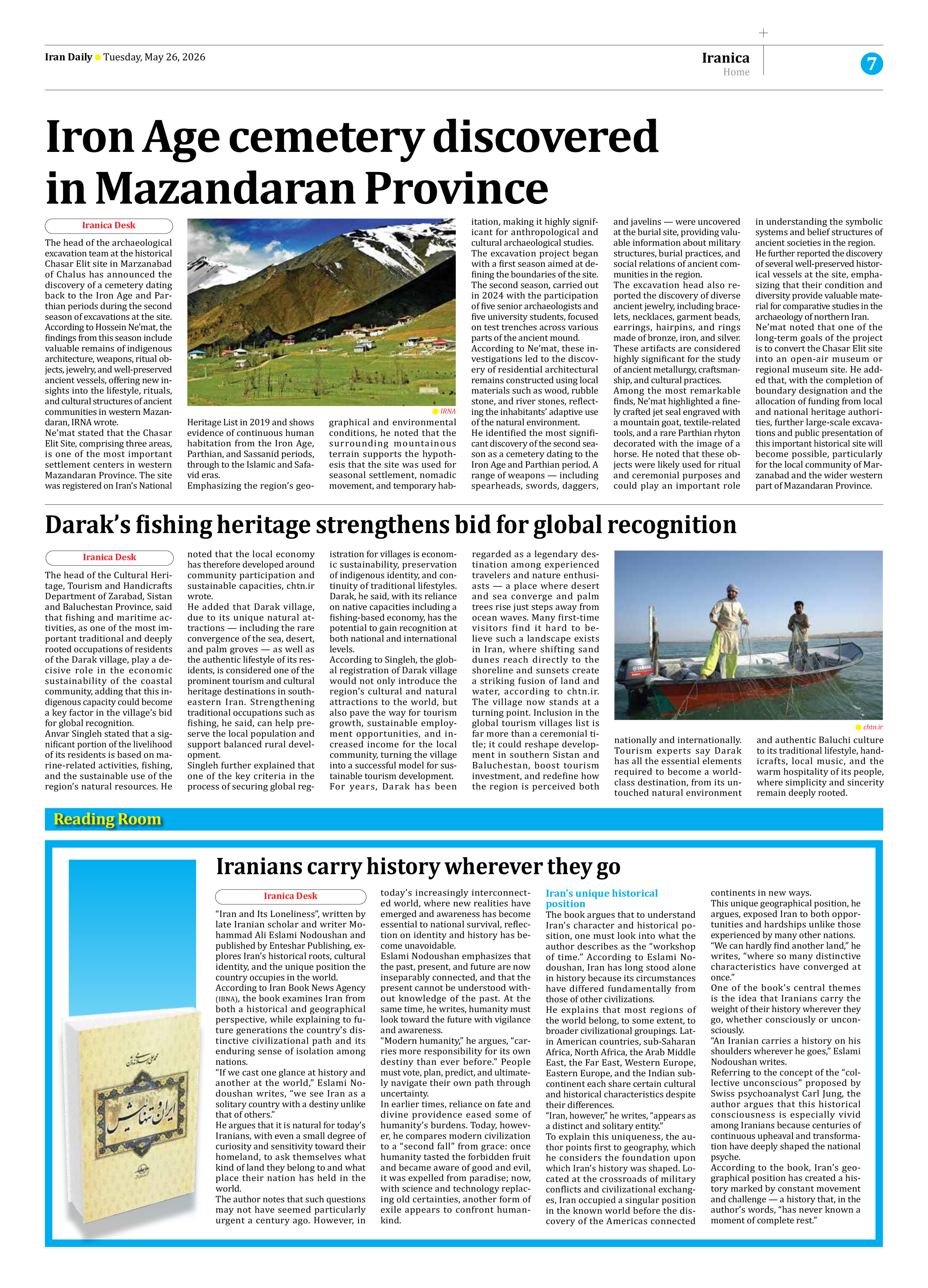
Ne’mat stated that the Chasar Elit Site, comprising three areas, is one of the most important settlement centers in western Mazandaran Province. The site was registered on Iran’s National Heritage List in 2019 and shows evidence of continuous human habitation from the Iron Age, Parthian, and Sassanid periods, through to the Islamic and Safavid eras.
Emphasizing the region’s geographical and environmental conditions, he noted that the surrounding mountainous terrain supports the hypothesis that the site was used for seasonal settlement, nomadic movement, and temporary habitation, making it highly significant for anthropological and cultural archaeological studies.
The excavation project began with a first season aimed at defining the boundaries of the site. The second season, carried out in 2024 with the participation of five senior archaeologists and five university students, focused on test trenches across various parts of the ancient mound.
According to Ne’mat, these investigations led to the discovery of residential architectural remains constructed using local materials such as wood, rubble stone, and river stones, reflecting the inhabitants’ adaptive use of the natural environment.
He identified the most significant discovery of the second season as a cemetery dating to the Iron Age and Parthian period. A range of weapons — including spearheads, swords, daggers, and javelins — were uncovered at the burial site, providing valuable information about military structures, burial practices, and social relations of ancient communities in the region.
The excavation head also reported the discovery of diverse ancient jewelry, including bracelets, necklaces, garment beads, earrings, hairpins, and rings made of bronze, iron, and silver. These artifacts are considered highly significant for the study of ancient metallurgy, craftsmanship, and cultural practices.
Among the most remarkable finds, Ne’mat highlighted a finely crafted jet seal engraved with a mountain goat, textile-related tools, and a rare Parthian rhyton decorated with the image of a horse. He noted that these objects were likely used for ritual and ceremonial purposes and could play an important role in understanding the symbolic systems and belief structures of ancient societies in the region.
He further reported the discovery of several well-preserved historical vessels at the site, emphasizing that their condition and diversity provide valuable material for comparative studies in the archaeology of northern Iran.
Ne’mat noted that one of the long-term goals of the project is to convert the Chasar Elit site into an open-air museum or regional museum site. He added that, with the completion of boundary designation and the allocation of funding from local and national heritage authorities, further large-scale excavations and public presentation of this important historical site will become possible, particularly for the local community of Marzanabad and the wider western part of Mazandaran Province.