







FM spox: Progress in US talks on many issues, but no imminent deal
Trump says negotiations ‘proceeding nicely’
Iran’s Foreign Ministry spokesman said on Monday that Tehran and Washington have reached conclusions on many topics, but this does not mean that an agreement is imminent to end the US-Israeli aggression against the Islamic Republic.
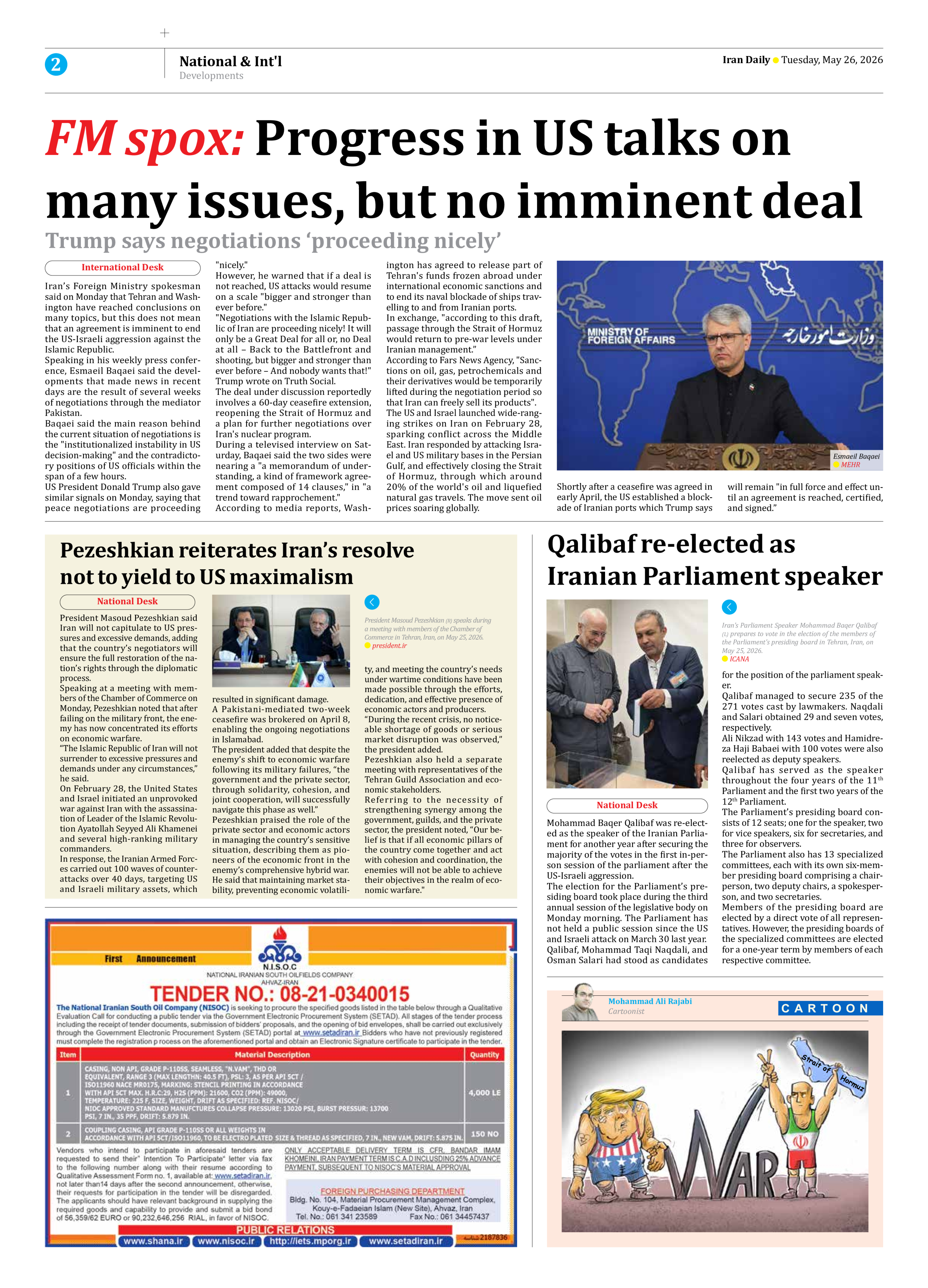
Speaking in his weekly press conference, Esmaeil Baqaei said the developments that made news in recent days are the result of several weeks of negotiations through the mediator Pakistan.
Baqaei said the main reason behind the current situation of negotiations is the "institutionalized instability in US decision-making" and the contradictory positions of US officials within the span of a few hours.
US President Donald Trump also gave similar signals on Monday, saying that peace negotiations are proceeding "nicely."
However, he warned that if a deal is not reached, US attacks would resume on a scale "bigger and stronger than ever before."
"Negotiations with the Islamic Republic of Iran are proceeding nicely! It will only be a Great Deal for all or, no Deal at all – Back to the Battlefront and shooting, but bigger and stronger than ever before – And nobody wants that!" Trump wrote on Truth Social.
The deal under discussion reportedly involves a 60-day ceasefire extension, reopening the Strait of Hormuz and a plan for further negotiations over Iran's nuclear program.
During a televised interview on Saturday, Baqaei said the two sides were nearing a "a memorandum of understanding, a kind of framework agreement composed of 14 clauses," in "a trend toward rapprochement."
According to media reports, Washington has agreed to release part of Tehran's funds frozen abroad under international economic sanctions and to end its naval blockade of ships travelling to and from Iranian ports.
In exchange, "according to this draft, passage through the Strait of Hormuz would return to pre-war levels under Iranian management.”
According to Fars News Agency, "Sanctions on oil, gas, petrochemicals and their derivatives would be temporarily lifted during the negotiation period so that Iran can freely sell its products".
The US and Israel launched wide-ranging strikes on Iran on February 28, sparking conflict across the Middle East. Iran responded by attacking Israel and US military bases in the Persian Gulf, and effectively closing the Strait of Hormuz, through which around 20% of the world's oil and liquefied natural gas travels. The move sent oil prices soaring globally.
Shortly after a ceasefire was agreed in early April, the US established a blockade of Iranian ports which Trump says will remain "in full force and effect until an agreement is reached, certified, and signed.”