







Tehran mural captures global attention as symbol of Iranian resolve
A towering new mural unveiled in Tehran’s Republic Square has drawn wide attention from Western, regional and Hebrew-language media, turning a public artwork into the latest front in the battle of narratives surrounding Iran’s regional posture and national identity.
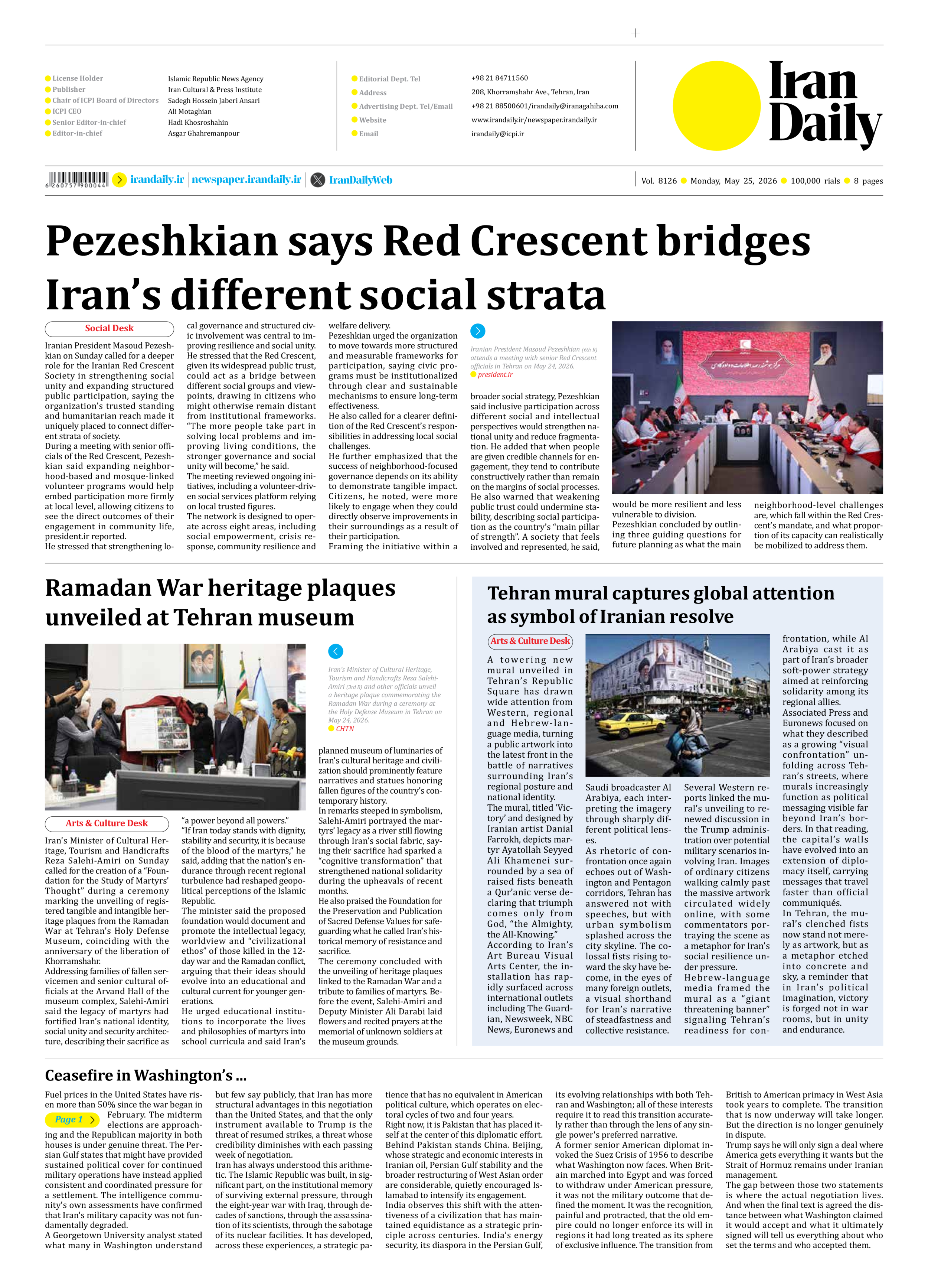
The mural, titled ‘Victory’ and designed by Iranian artist Danial Farrokh, depicts martyr Ayatollah Seyyed Ali Khamenei surrounded by a sea of raised fists beneath a Qur’anic verse declaring that triumph comes only from God, “the Almighty, the All-Knowing.”
According to Iran’s Art Bureau Visual Arts Center, the installation has rapidly surfaced across international outlets including The Guardian, Newsweek, NBC News, Euronews and Saudi broadcaster Al Arabiya, each interpreting the imagery through sharply different political lenses.
As rhetoric of confrontation once again echoes out of Washington and Pentagon corridors, Tehran has answered not with speeches, but with urban symbolism splashed across the city skyline. The colossal fists rising toward the sky have become, in the eyes of many foreign outlets, a visual shorthand for Iran’s narrative of steadfastness and collective resistance.
Several Western reports linked the mural’s unveiling to renewed discussion in the Trump administration over potential military scenarios involving Iran. Images of ordinary citizens walking calmly past the massive artwork circulated widely online, with some commentators portraying the scene as a metaphor for Iran’s social resilience under pressure.
Hebrew-language media framed the mural as a “giant threatening banner” signaling Tehran’s readiness for confrontation, while Al Arabiya cast it as part of Iran’s broader soft-power strategy aimed at reinforcing solidarity among its regional allies.
Associated Press and Euronews focused on what they described as a growing “visual confrontation” unfolding across Tehran’s streets, where murals increasingly function as political messaging visible far beyond Iran’s borders. In that reading, the capital’s walls have evolved into an extension of diplomacy itself, carrying messages that travel faster than official communiqués.
In Tehran, the mural’s clenched fists now stand not merely as artwork, but as a metaphor etched into concrete and sky, a reminder that in Iran’s political imagination, victory is forged not in war rooms, but in unity and endurance.