





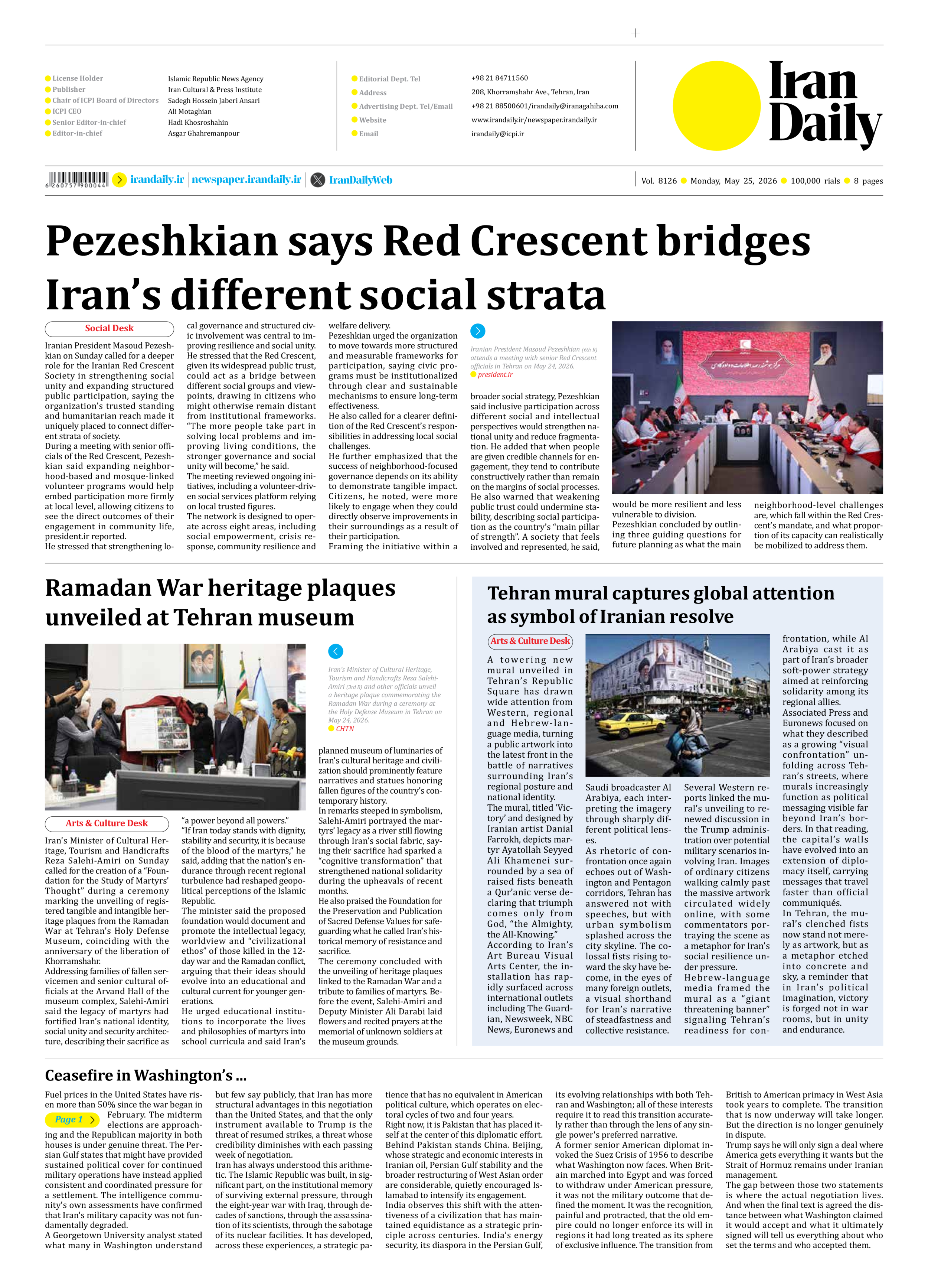


Pezeshkian says Red Crescent bridges Iran’s different social strata
Iranian President Masoud Pezeshkian on Sunday called for a deeper role for the Iranian Red Crescent Society in strengthening social unity and expanding structured public participation, saying the organization’s trusted standing and humanitarian reach made it uniquely placed to connect different strata of society.
During a meeting with senior officials of the Red Crescent, Pezeshkian said expanding neighborhood-based and mosque-linked volunteer programs would help embed participation more firmly at local level, allowing citizens to see the direct outcomes of their engagement in community life, president.ir reported.
He stressed that strengthening local governance and structured civic involvement was central to improving resilience and social unity.
He stressed that the Red Crescent, given its widespread public trust, could act as a bridge between different social groups and viewpoints, drawing in citizens who might otherwise remain distant from institutional frameworks. “The more people take part in solving local problems and improving living conditions, the stronger governance and social unity will become,” he said.
The meeting reviewed ongoing initiatives, including a volunteer-driven social services platform relying on local trusted figures.
The network is designed to operate across eight areas, including social empowerment, crisis response, community resilience and welfare delivery.
Pezeshkian urged the organization to move towards more structured and measurable frameworks for participation, saying civic programs must be institutionalized through clear and sustainable mechanisms to ensure long-term effectiveness.
He also called for a clearer definition of the Red Crescent’s responsibilities in addressing local social challenges.
He further emphasized that the success of neighborhood-focused governance depends on its ability to demonstrate tangible impact. Citizens, he noted, were more likely to engage when they could directly observe improvements in their surroundings as a result of their participation.
Framing the initiative within a broader social strategy, Pezeshkian said inclusive participation across different social and intellectual perspectives would strengthen national unity and reduce fragmentation. He added that when people are given credible channels for engagement, they tend to contribute constructively rather than remain on the margins of social processes.
He also warned that weakening public trust could undermine stability, describing social participation as the country’s “main pillar of strength”. A society that feels involved and represented, he said, would be more resilient and less vulnerable to division.
Pezeshkian concluded by outlining three guiding questions for future planning as what the main neighborhood-level challenges are, which fall within the Red Crescent’s mandate, and what proportion of its capacity can realistically be mobilized to address them.