







Ardabil Carpet remains masterpiece of Persian Art in London
Among the many Iranian artistic and historical treasures preserved in major museums around the world, the Ardabil Carpet holds an exceptional place. Considered by many scholars of Islamic art and carpet history to be one of the finest and most important carpets ever woven, the masterpiece is not only a testament to the skill of Iranian weavers but also a symbol of the peak of Persian artistic achievement during the Safavid era.
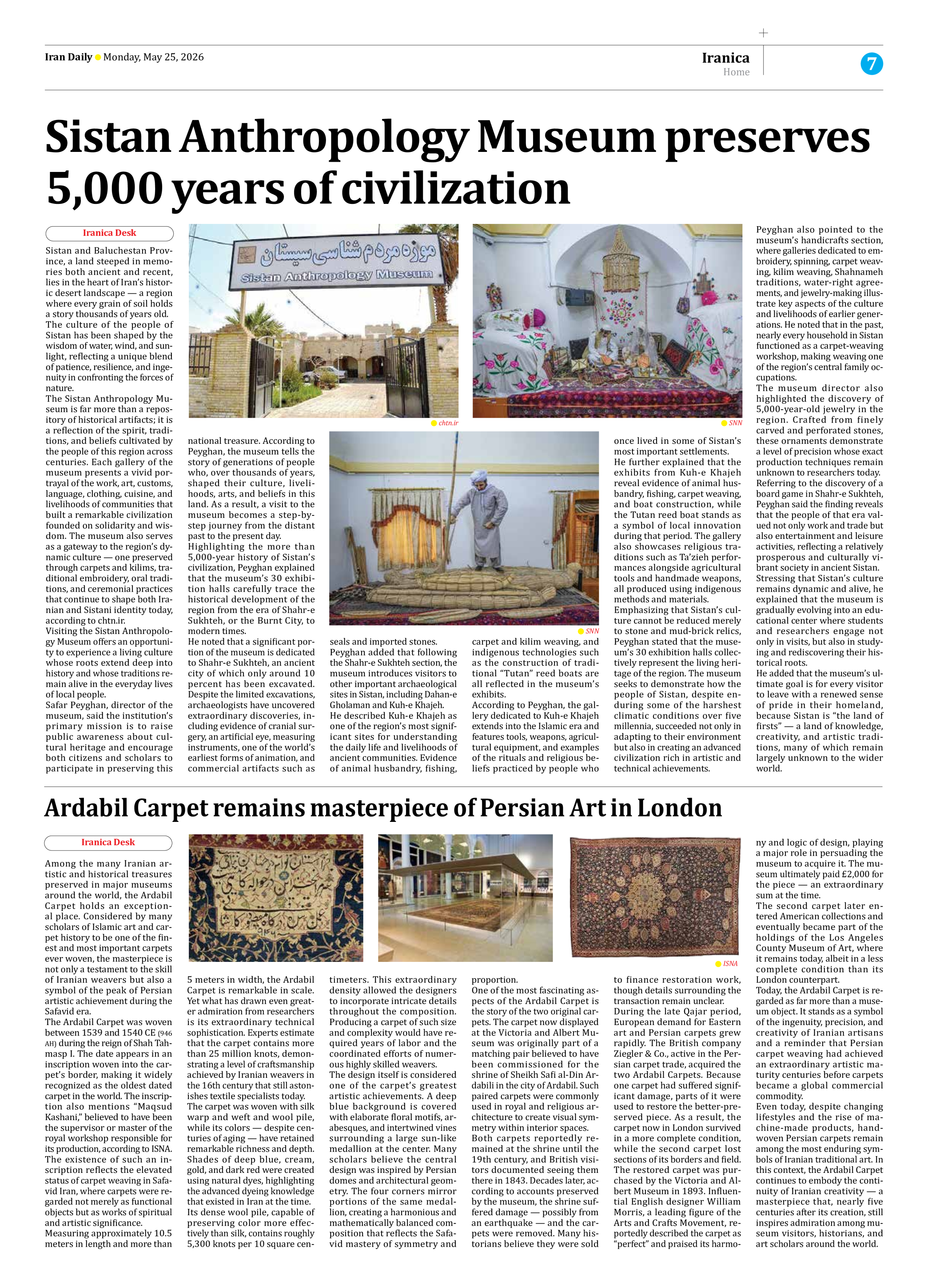
The Ardabil Carpet was woven between 1539 and 1540 CE (946 AH) during the reign of Shah Tahmasp I. The date appears in an inscription woven into the carpet’s border, making it widely recognized as the oldest dated carpet in the world. The inscription also mentions “Maqsud Kashani,” believed to have been the supervisor or master of the royal workshop responsible for its production, according to ISNA.
The existence of such an inscription reflects the elevated status of carpet weaving in Safavid Iran, where carpets were regarded not merely as functional objects but as works of spiritual and artistic significance.
Measuring approximately 10.5 meters in length and more than 5 meters in width, the Ardabil Carpet is remarkable in scale. Yet what has drawn even greater admiration from researchers is its extraordinary technical sophistication. Experts estimate that the carpet contains more than 25 million knots, demonstrating a level of craftsmanship achieved by Iranian weavers in the 16th century that still astonishes textile specialists today.
The carpet was woven with silk warp and weft and wool pile, while its colors — despite centuries of aging — have retained remarkable richness and depth. Shades of deep blue, cream, gold, and dark red were created using natural dyes, highlighting the advanced dyeing knowledge that existed in Iran at the time.
Its dense wool pile, capable of preserving color more effectively than silk, contains roughly 5,300 knots per 10 square centimeters. This extraordinary density allowed the designers to incorporate intricate details throughout the composition. Producing a carpet of such size and complexity would have required years of labor and the coordinated efforts of numerous highly skilled weavers.
The design itself is considered one of the carpet’s greatest artistic achievements. A deep blue background is covered with elaborate floral motifs, arabesques, and intertwined vines surrounding a large sun-like medallion at the center. Many scholars believe the central design was inspired by Persian domes and architectural geometry. The four corners mirror portions of the same medallion, creating a harmonious and mathematically balanced composition that reflects the Safavid mastery of symmetry and proportion.
One of the most fascinating aspects of the Ardabil Carpet is the story of the two original carpets. The carpet now displayed at the Victoria and Albert Museum was originally part of a matching pair believed to have been commissioned for the shrine of Sheikh Safi al-Din Ardabili in the city of Ardabil. Such paired carpets were commonly used in royal and religious architecture to create visual symmetry within interior spaces.
Both carpets reportedly remained at the shrine until the 19th century, and British visitors documented seeing them there in 1843. Decades later, according to accounts preserved by the museum, the shrine suffered damage — possibly from an earthquake — and the carpets were removed. Many historians believe they were sold to finance restoration work, though details surrounding the transaction remain unclear.
During the late Qajar period, European demand for Eastern art and Persian carpets grew rapidly. The British company Ziegler & Co., active in the Persian carpet trade, acquired the two Ardabil Carpets. Because one carpet had suffered significant damage, parts of it were used to restore the better-preserved piece. As a result, the carpet now in London survived in a more complete condition, while the second carpet lost sections of its borders and field.
The restored carpet was purchased by the Victoria and Albert Museum in 1893. Influential English designer William Morris, a leading figure of the Arts and Crafts Movement, reportedly described the carpet as “perfect” and praised its harmony and logic of design, playing a major role in persuading the museum to acquire it. The museum ultimately paid £2,000 for the piece — an extraordinary sum at the time.
The second carpet later entered American collections and eventually became part of the holdings of the Los Angeles County Museum of Art, where it remains today, albeit in a less complete condition than its London counterpart.
Today, the Ardabil Carpet is regarded as far more than a museum object. It stands as a symbol of the ingenuity, precision, and creativity of Iranian artisans and a reminder that Persian carpet weaving had achieved an extraordinary artistic maturity centuries before carpets became a global commercial commodity.
Even today, despite changing lifestyles and the rise of machine-made products, handwoven Persian carpets remain among the most enduring symbols of Iranian traditional art. In this context, the Ardabil Carpet continues to embody the continuity of Iranian creativity — a masterpiece that, nearly five centuries after its creation, still inspires admiration among museum visitors, historians, and art scholars around the world.