







Sistan Anthropology Museum preserves 5,000 years of civilization
Sistan and Baluchestan Province, a land steeped in memories both ancient and recent, lies in the heart of Iran’s historic desert landscape — a region where every grain of soil holds a story thousands of years old.
The culture of the people of Sistan has been shaped by the wisdom of water, wind, and sunlight, reflecting a unique blend of patience, resilience, and ingenuity in confronting the forces of nature.
The Sistan Anthropology Museum is far more than a repository of historical artifacts; it is a reflection of the spirit, traditions, and beliefs cultivated by the people of this region across centuries. Each gallery of the museum presents a vivid portrayal of the work, art, customs, language, clothing, cuisine, and livelihoods of communities that built a remarkable civilization founded on solidarity and wisdom. The museum also serves as a gateway to the region’s dynamic culture — one preserved through carpets and kilims, traditional embroidery, oral traditions, and ceremonial practices that continue to shape both Iranian and Sistani identity today, according to chtn.ir.
Visiting the Sistan Anthropology Museum offers an opportunity to experience a living culture whose roots extend deep into history and whose traditions remain alive in the everyday lives of local people.
Safar Peyghan, director of the museum, said the institution’s primary mission is to raise public awareness about cultural heritage and encourage both citizens and scholars to participate in preserving this national treasure. According to Peyghan, the museum tells the story of generations of people who, over thousands of years, shaped their culture, livelihoods, arts, and beliefs in this land. As a result, a visit to the museum becomes a step-by-step journey from the distant past to the present day.
Highlighting the more than 5,000-year history of Sistan’s civilization, Peyghan explained that the museum’s 30 exhibition halls carefully trace the historical development of the region from the era of Shahr-e Sukhteh, or the Burnt City, to modern times.
He noted that a significant portion of the museum is dedicated to Shahr-e Sukhteh, an ancient city of which only around 10 percent has been excavated. Despite the limited excavations, archaeologists have uncovered extraordinary discoveries, including evidence of cranial surgery, an artificial eye, measuring instruments, one of the world’s earliest forms of animation, and commercial artifacts such as seals and imported stones.
Peyghan added that following the Shahr-e Sukhteh section, the museum introduces visitors to other important archaeological sites in Sistan, including Dahan-e Gholaman and Kuh-e Khajeh.
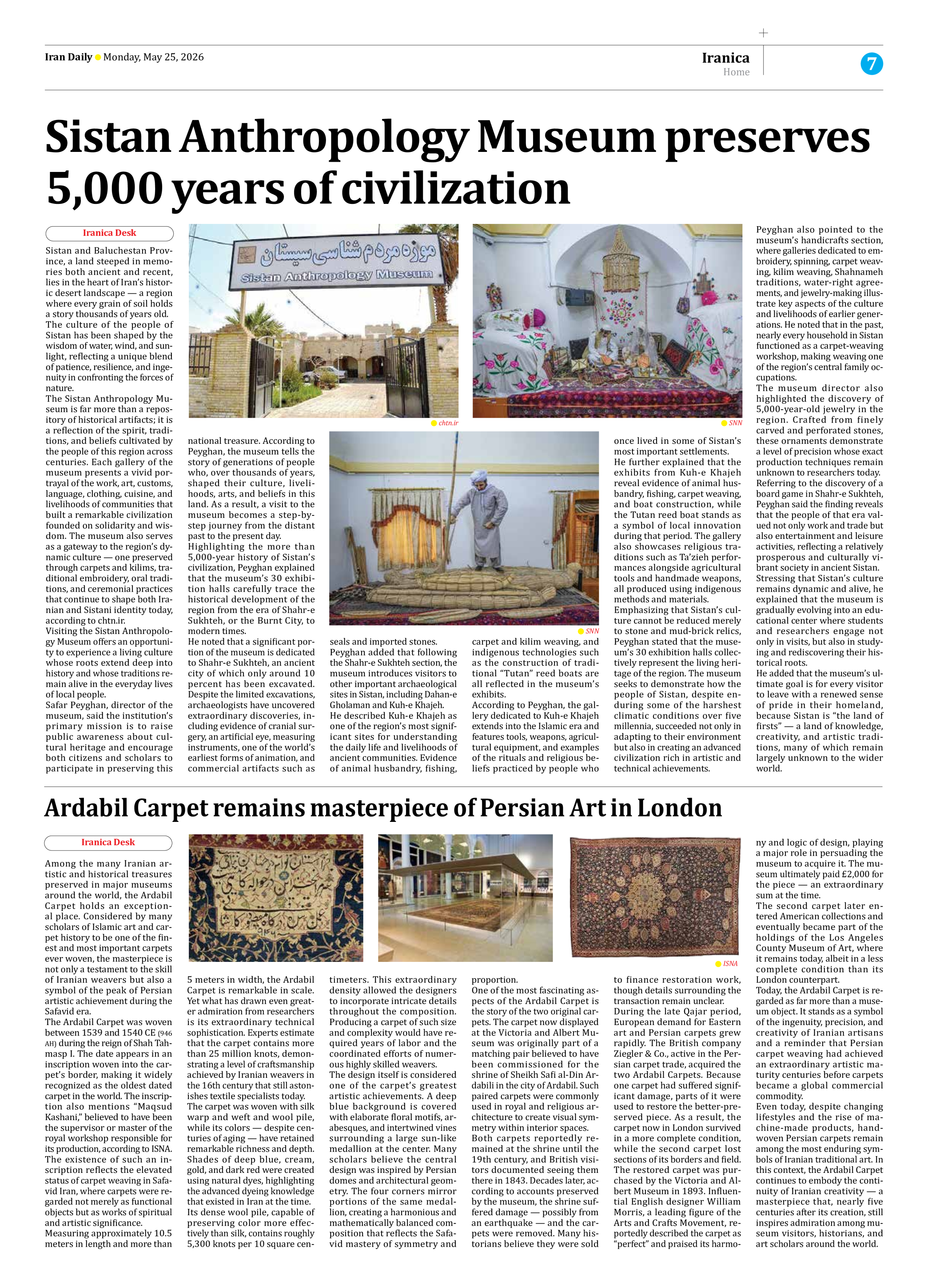
He described Kuh-e Khajeh as one of the region’s most significant sites for understanding the daily life and livelihoods of ancient communities. Evidence of animal husbandry, fishing, carpet and kilim weaving, and indigenous technologies such as the construction of traditional “Tutan” reed boats are all reflected in the museum’s exhibits.
According to Peyghan, the gallery dedicated to Kuh-e Khajeh extends into the Islamic era and features tools, weapons, agricultural equipment, and examples of the rituals and religious beliefs practiced by people who once lived in some of Sistan’s most important settlements.
He further explained that the exhibits from Kuh-e Khajeh reveal evidence of animal husbandry, fishing, carpet weaving, and boat construction, while the Tutan reed boat stands as a symbol of local innovation during that period. The gallery also showcases religious traditions such as Ta’zieh performances alongside agricultural tools and handmade weapons, all produced using indigenous methods and materials.
Emphasizing that Sistan’s culture cannot be reduced merely to stone and mud-brick relics, Peyghan stated that the museum’s 30 exhibition halls collectively represent the living heritage of the region. The museum seeks to demonstrate how the people of Sistan, despite enduring some of the harshest climatic conditions over five millennia, succeeded not only in adapting to their environment but also in creating an advanced civilization rich in artistic and technical achievements.
Peyghan also pointed to the museum’s handicrafts section, where galleries dedicated to embroidery, spinning, carpet weaving, kilim weaving, Shahnameh traditions, water-right agreements, and jewelry-making illustrate key aspects of the culture and livelihoods of earlier generations. He noted that in the past, nearly every household in Sistan functioned as a carpet-weaving workshop, making weaving one of the region’s central family occupations.
The museum director also highlighted the discovery of 5,000-year-old jewelry in the region. Crafted from finely carved and perforated stones, these ornaments demonstrate a level of precision whose exact production techniques remain unknown to researchers today.
Referring to the discovery of a board game in Shahr-e Sukhteh, Peyghan said the finding reveals that the people of that era valued not only work and trade but also entertainment and leisure activities, reflecting a relatively prosperous and culturally vibrant society in ancient Sistan.
Stressing that Sistan’s culture remains dynamic and alive, he explained that the museum is gradually evolving into an educational center where students and researchers engage not only in visits, but also in studying and rediscovering their historical roots.
He added that the museum’s ultimate goal is for every visitor to leave with a renewed sense of pride in their homeland, because Sistan is “the land of firsts” — a land of knowledge, creativity, and artistic traditions, many of which remain largely unknown to the wider world.