







NIGC signs 77 strategic contracts to curb gas consumption ahead of winter
Iran's National Iranian Gas Company (NIGC) has signed 77 strategic contracts with energy service companies, known as “Karvar”, aimed at stabilizing gas supplies across the country through smart technologies and consumption optimization, CEO Saeed Tavakkoli said Sunday, as the country prepares for higher winter demand and ongoing pressure on its energy infrastructure.
Tavakkoli said the measures were part of efforts to address Iran’s energy consumption imbalance and maintain the stability of the national gas network.
Tavakkoli told Radio Eqtesad that the activities of the Karvar companies had expanded from 22 projects to 77, while provincial authorities have rolled out roughly 280 operational measures to prepare for winter scenarios.
The NIGC chief said the companies were working with knowledge-based firms to develop smart boiler room systems, including electronic components and devices such as anti-scale equipment aimed at improving efficiency and reducing gas consumption.
Tavakkoli said NIGC maintain integrated management through the National Gas Dispatching Center, although consumption management strategies differ from province to province depending on local energy demand patterns.
“In some northern provinces such as Mazandaran, 94% of energy consumption is concentrated in the residential and commercial sectors, while in other provinces the main share belongs to industry,” he said, citing Qom as an example where industrial consumption accounts for the largest share.
He added that gas demand shifted heavily toward residential and commercial sectors during winter because of lower temperatures, adding that Iran’s extensive gas network required special planning to ensure uninterrupted nationwide supply.
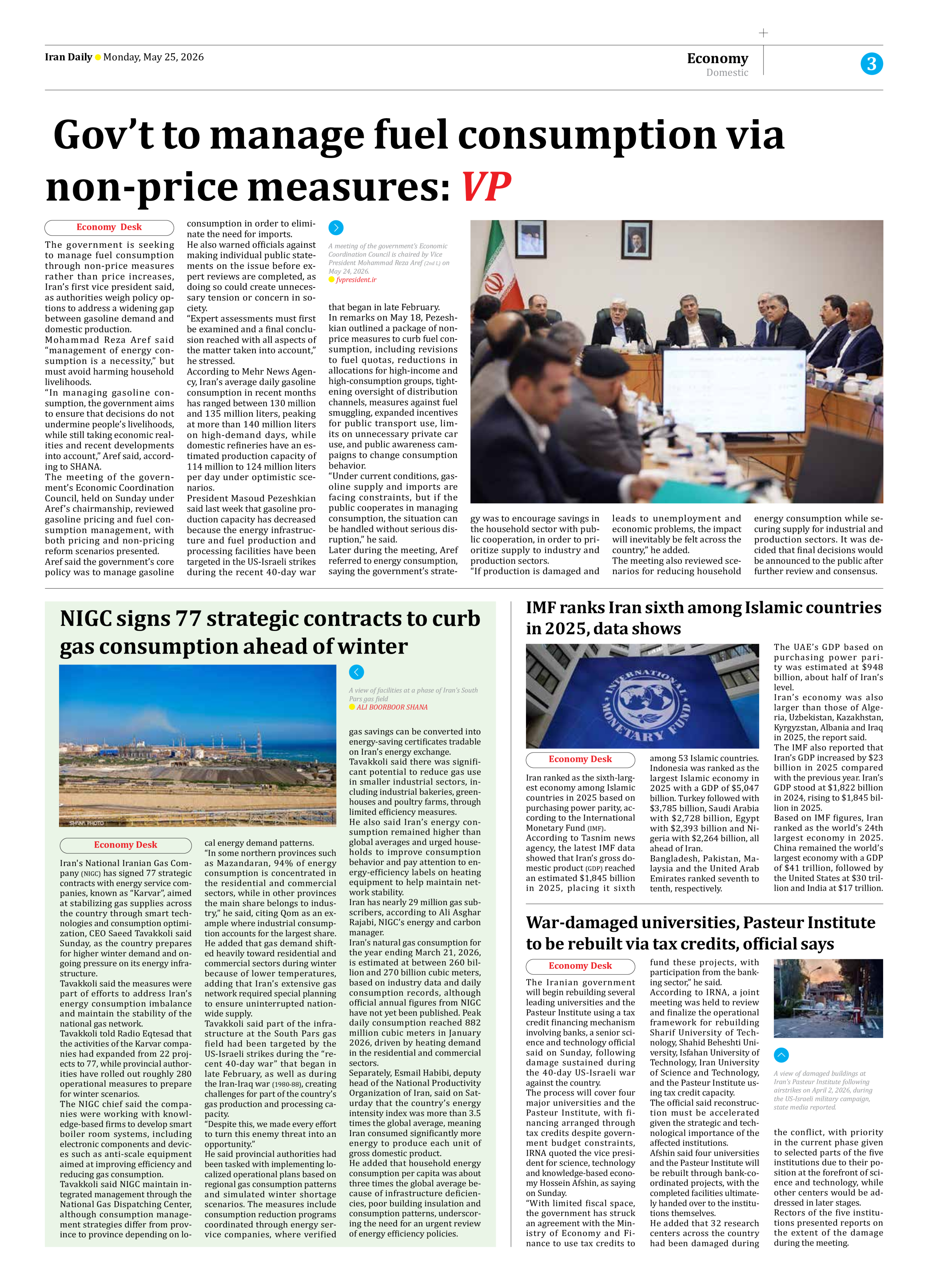
Tavakkoli said part of the infrastructure at the South Pars gas field had been targeted by the US-Israeli strikes during the “recent 40-day war” that began in late February, as well as during the Iran-Iraq war (1980-88), creating challenges for part of the country’s gas production and processing capacity.
“Despite this, we made every effort to turn this enemy threat into an opportunity.”
He said provincial authorities had been tasked with implementing localized operational plans based on regional gas consumption patterns and simulated winter shortage scenarios. The measures include consumption reduction programs coordinated through energy service companies, where verified gas savings can be converted into energy-saving certificates tradable on Iran’s energy exchange.
Tavakkoli said there was significant potential to reduce gas use in smaller industrial sectors, including industrial bakeries, greenhouses and poultry farms, through limited efficiency measures.
He also said Iran’s energy consumption remained higher than global averages and urged households to improve consumption behavior and pay attention to energy-efficiency labels on heating equipment to help maintain network stability.
Iran has nearly 29 million gas subscribers, according to Ali Asghar Rajabi, NIGC’s energy and carbon manager.
Iran’s natural gas consumption for the year ending March 21, 2026, is estimated at between 260 billion and 270 billion cubic meters, based on industry data and daily consumption records, although official annual figures from NIGC have not yet been published. Peak daily consumption reached 882 million cubic meters in January 2026, driven by heating demand in the residential and commercial sectors.
Separately, Esmail Habibi, deputy head of the National Productivity Organization of Iran, said on Saturday that the country’s energy intensity index was more than 3.5 times the global average, meaning Iran consumed significantly more energy to produce each unit of gross domestic product.
He added that household energy consumption per capita was about three times the global average because of infrastructure deficiencies, poor building insulation and consumption patterns, underscoring the need for an urgent review of energy efficiency policies.