







Gov’t to manage fuel consumption via non-price measures: VP
The government is seeking to manage fuel consumption through non-price measures rather than price increases, Iran’s first vice president said, as authorities weigh policy options to address a widening gap between gasoline demand and domestic production.
Mohammad Reza Aref said “management of energy consumption is a necessity,” but must avoid harming household livelihoods.
“In managing gasoline consumption, the government aims to ensure that decisions do not undermine people’s livelihoods, while still taking economic realities and recent developments into account,” Aref said, according to SHANA.
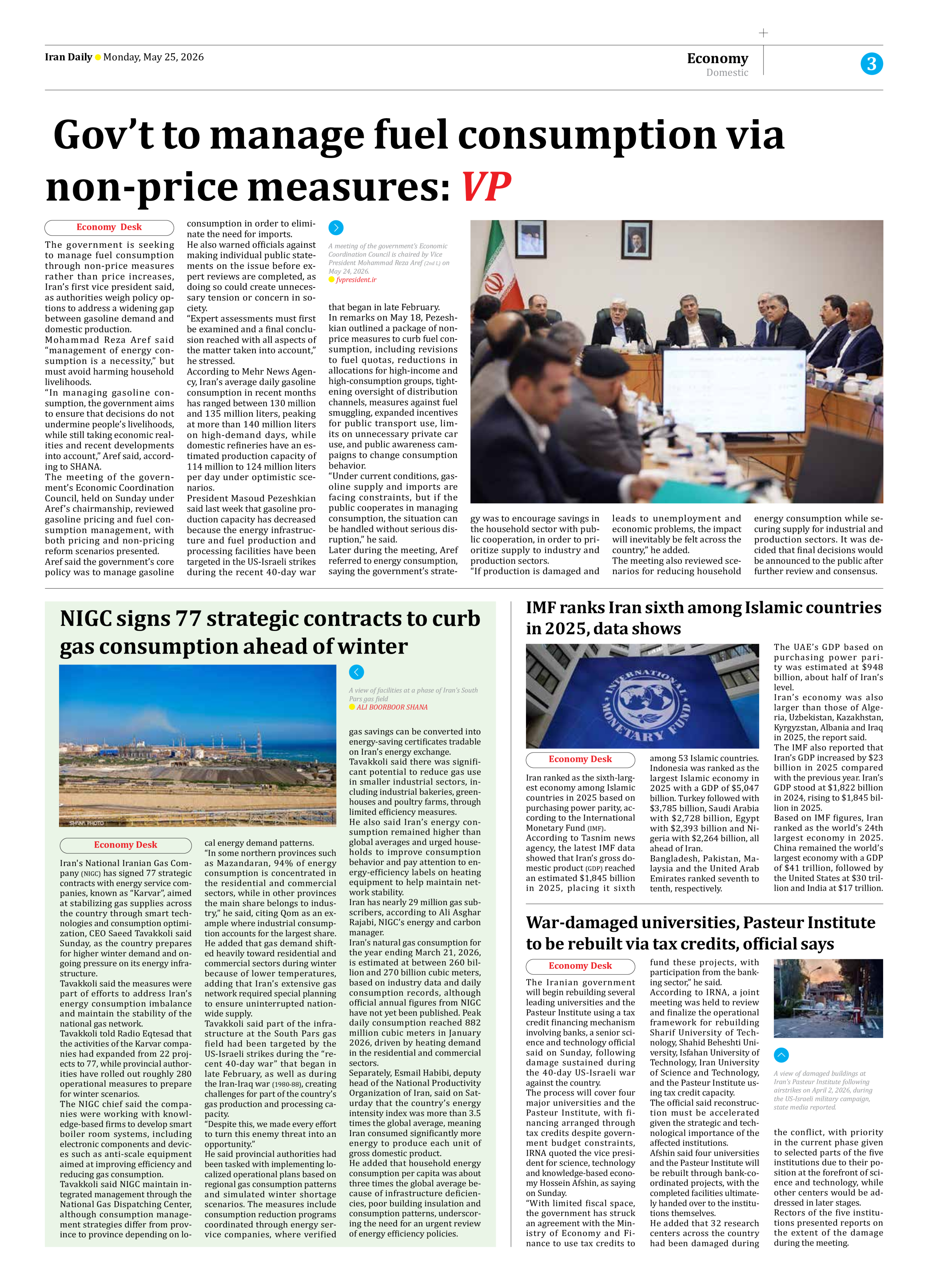
The meeting of the government’s Economic Coordination Council, held on Sunday under Aref’s chairmanship, reviewed gasoline pricing and fuel consumption management, with both pricing and non-pricing reform scenarios presented.
Aref said the government’s core policy was to manage gasoline consumption in order to eliminate the need for imports.
He also warned officials against making individual public statements on the issue before expert reviews are completed, as doing so could create unnecessary tension or concern in society.
“Expert assessments must first be examined and a final conclusion reached with all aspects of the matter taken into account,” he stressed.
According to Mehr News Agency, Iran’s average daily gasoline consumption in recent months has ranged between 130 million and 135 million liters, peaking at more than 140 million liters on high-demand days, while domestic refineries have an estimated production capacity of 114 million to 124 million liters per day under optimistic scenarios.
President Masoud Pezeshkian said last week that gasoline production capacity has decreased because the energy infrastructure and fuel production and processing facilities have been targeted in the US-Israeli strikes during the recent 40-day war that began in late February.
In remarks on May 18, Pezeshkian outlined a package of non-price measures to curb fuel consumption, including revisions to fuel quotas, reductions in allocations for high-income and high-consumption groups, tightening oversight of distribution channels, measures against fuel smuggling, expanded incentives for public transport use, limits on unnecessary private car use, and public awareness campaigns to change consumption behavior.
“Under current conditions, gasoline supply and imports are facing constraints, but if the public cooperates in managing consumption, the situation can be handled without serious disruption,” he said.
Later during the meeting, Aref referred to energy consumption, saying the government’s strategy was to encourage savings in the household sector with public cooperation, in order to prioritize supply to industry and production sectors.
“If production is damaged and leads to unemployment and economic problems, the impact will inevitably be felt across the country,” he added.
The meeting also reviewed scenarios for reducing household energy consumption while securing supply for industrial and production sectors. It was decided that final decisions would be announced to the public after further review and consensus.