





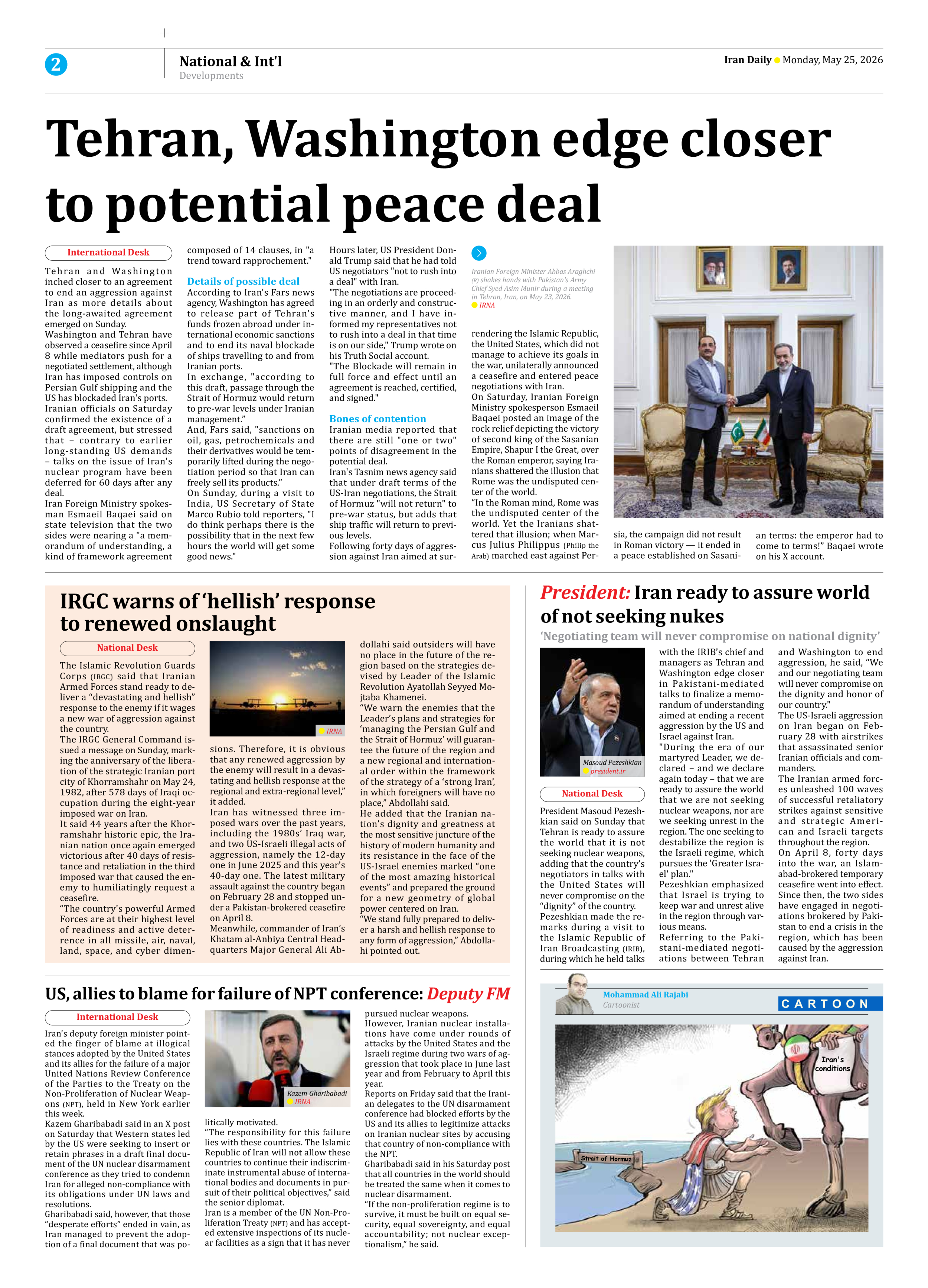


Tehran, Washington edge closer to potential peace deal
Tehran and Washington inched closer to an agreement to end an aggression against Iran as more details about the long-awaited agreement emerged on Sunday.
Washington and Tehran have observed a ceasefire since April 8 while mediators push for a negotiated settlement, although Iran has imposed controls on Persian Gulf shipping and the US has blockaded Iran's ports.
Iranian officials on Saturday confirmed the existence of a draft agreement, but stressed that – contrary to earlier long-standing US demands – talks on the issue of Iran's nuclear program have been deferred for 60 days after any deal.
Iran Foreign Ministry spokesman Esmaeil Baqaei said on state television that the two sides were nearing a "a memorandum of understanding, a kind of framework agreement composed of 14 clauses, in "a trend toward rapprochement."
Details of possible deal
According to Iran's Fars news agency, Washington has agreed to release part of Tehran's funds frozen abroad under international economic sanctions and to end its naval blockade of ships travelling to and from Iranian ports.
In exchange, "according to this draft, passage through the Strait of Hormuz would return to pre-war levels under Iranian management.”
And, Fars said, "sanctions on oil, gas, petrochemicals and their derivatives would be temporarily lifted during the negotiation period so that Iran can freely sell its products.”
On Sunday, during a visit to India, US Secretary of State Marco Rubio told reporters, "I do think perhaps there is the possibility that in the next few hours the world will get some good news."
Hours later, US President Donald Trump said that he had told US negotiators "not to rush into a deal" with Iran.
"The negotiations are proceeding in an orderly and constructive manner, and I have informed my representatives not to rush into a deal in that time is on our side," Trump wrote on his Truth Social account.
"The Blockade will remain in full force and effect until an agreement is reached, certified, and signed."
Bones of contention
Iranian media reported that there are still "one or two" points of disagreement in the potential deal.
Iran's Tasnim news agency said that under draft terms of the US-Iran negotiations, the Strait of Hormuz "will not return" to pre-war status, but adds that ship traffic will return to previous levels.
Following forty days of aggression against Iran aimed at surrendering the Islamic Republic, the United States, which did not manage to achieve its goals in the war, unilaterally announced a ceasefire and entered peace negotiations with Iran.
On Saturday, Iranian Foreign Ministry spokesperson Esmaeil Baqaei posted an image of the rock relief depicting the victory of second king of the Sasanian Empire, Shapur I the Great, over the Roman emperor, saying Iranians shattered the illusion that Rome was the undisputed center of the world.
“In the Roman mind, Rome was the undisputed center of the world. Yet the Iranians shattered that illusion; when Marcus Julius Philippus (Philip the Arab) marched east against Persia, the campaign did not result in Roman victory — it ended in a peace established on Sasanian terms: the emperor had to come to terms!” Baqaei wrote on his X account.