





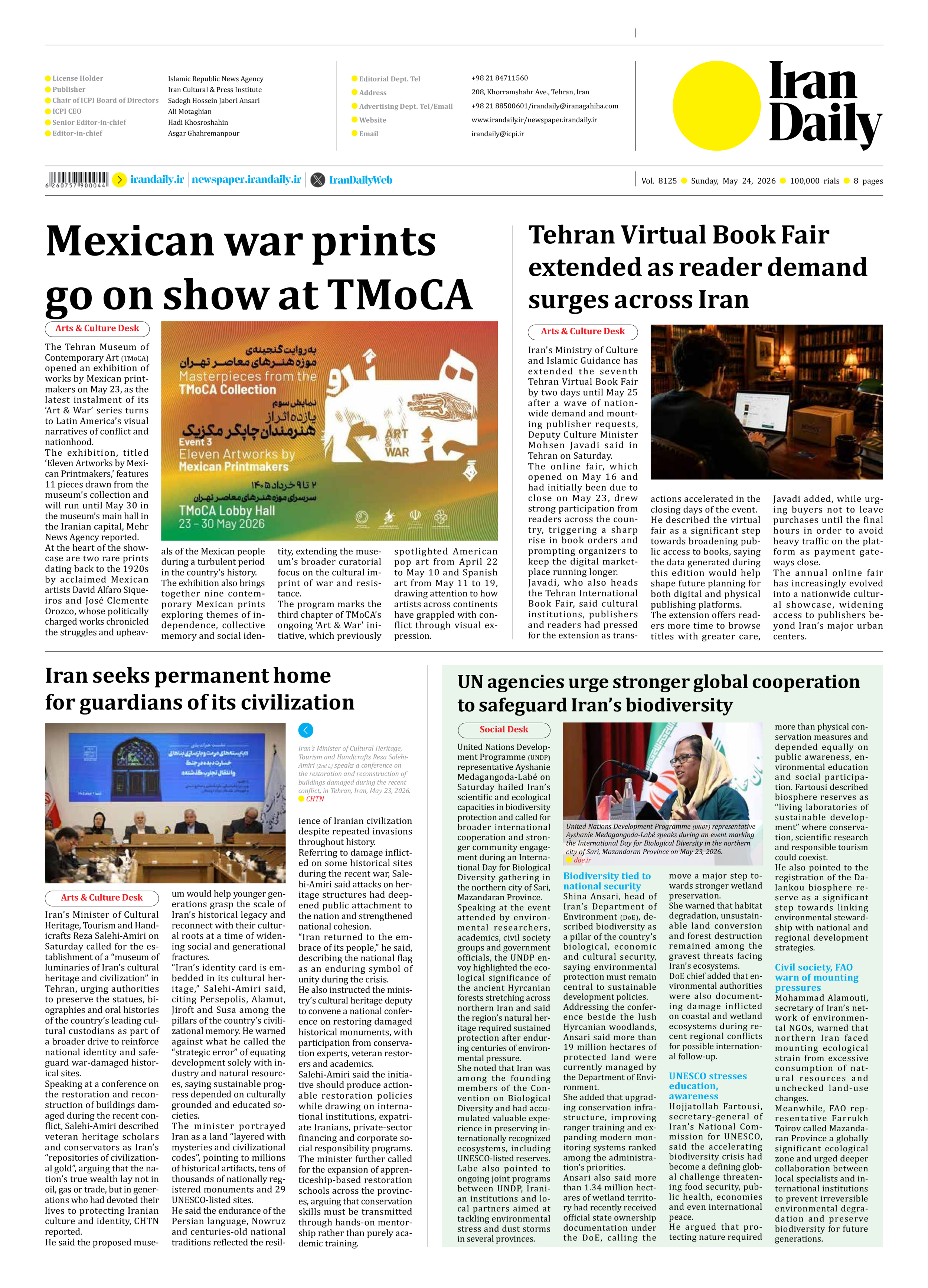


UN agencies urge stronger global cooperation to safeguard Iran’s biodiversity
United Nations Development Programme (UNDP) representative Ayshanie Medagangoda-Labé on Saturday hailed Iran’s scientific and ecological capacities in biodiversity protection and called for broader international cooperation and stronger community engagement during an International Day for Biological Diversity gathering in the northern city of Sari, Mazandaran Province.
Speaking at the event attended by environmental researchers, academics, civil society groups and government officials, the UNDP envoy highlighted the ecological significance of the ancient Hyrcanian forests stretching across northern Iran and said the region’s natural heritage required sustained protection after enduring centuries of environmental pressure.
She noted that Iran was among the founding members of the Convention on Biological Diversity and had accumulated valuable experience in preserving internationally recognized ecosystems, including UNESCO-listed reserves. Labe also pointed to ongoing joint programs between UNDP, Iranian institutions and local partners aimed at tackling environmental stress and dust storms in several provinces.
Biodiversity tied to national security
Shina Ansari, head of Iran’s Department of Environment (DoE), described biodiversity as a pillar of the country’s biological, economic and cultural security, saying environmental protection must remain central to sustainable development policies.
Addressing the conference beside the lush Hyrcanian woodlands, Ansari said more than 19 million hectares of protected land were currently managed by the Department of Environment.
She added that upgrading conservation infrastructure, improving ranger training and expanding modern monitoring systems ranked among the administration’s priorities.
Ansari also said more than 1.34 million hectares of wetland territory had recently received official state ownership documentation under the DoE, calling the move a major step towards stronger wetland preservation.
She warned that habitat degradation, unsustainable land conversion and forest destruction remained among the gravest threats facing Iran’s ecosystems.
DoE chief added that environmental authorities were also documenting damage inflicted on coastal and wetland ecosystems during recent regional conflicts for possible international follow-up.
UNESCO stresses education, awareness
Hojjatollah Fartousi, secretary-general of Iran’s National Commission for UNESCO, said the accelerating biodiversity crisis had become a defining global challenge threatening food security, public health, economies and even international peace.
He argued that protecting nature required more than physical conservation measures and depended equally on public awareness, environmental education and social participation. Fartousi described biosphere reserves as “living laboratories of sustainable development” where conservation, scientific research and responsible tourism could coexist.
He also pointed to the registration of the Dalankou biosphere reserve as a significant step towards linking environmental stewardship with national and regional development strategies.
Civil society, FAO warn of mounting pressures
Mohammad Alamouti, secretary of Iran’s network of environmental NGOs, warned that northern Iran faced mounting ecological strain from excessive consumption of natural resources and unchecked land-use changes.
Meanwhile, FAO representative Farrukh Toirov called Mazandaran Province a globally significant ecological zone and urged deeper collaboration between local specialists and international institutions to prevent irreversible environmental degradation and preserve biodiversity for future generations.