







Isfahan launches major restoration drive for damaged monuments
The head of the Isfahan Municipality’s Renovation and Rehabilitation Organization has announced that 80 percent of restoration and reconstruction work on historical buildings damaged in recent attacks US and Israel has been completed, adding that most structural damage will be fully repaired within the next two weeks.
Speaking to IRNA, Mohammadali Izadkhasti outlined the municipality’s crisis management and reconstruction measures aimed at restoring Isfahan’s damaged historical fabric following the recent attacks.
He said that immediately after the incidents, and under the guidance of the provincial governor-general, Isfahan Municipality and the provincial Cultural Heritage Organization launched emergency operations. Initial efforts included extensive social and media campaigns, such as forming human chains around historical monuments to draw international attention to what he described as a cultural tragedy.
Izadkhasti added that detailed technical and legal dossiers documenting the scale and extent of damage to Isfahan’s historical buildings were also prepared jointly by the municipality and cultural heritage authorities. According to him, the reports have been submitted to Iran’s National Commission for UNESCO and other relevant international bodies.
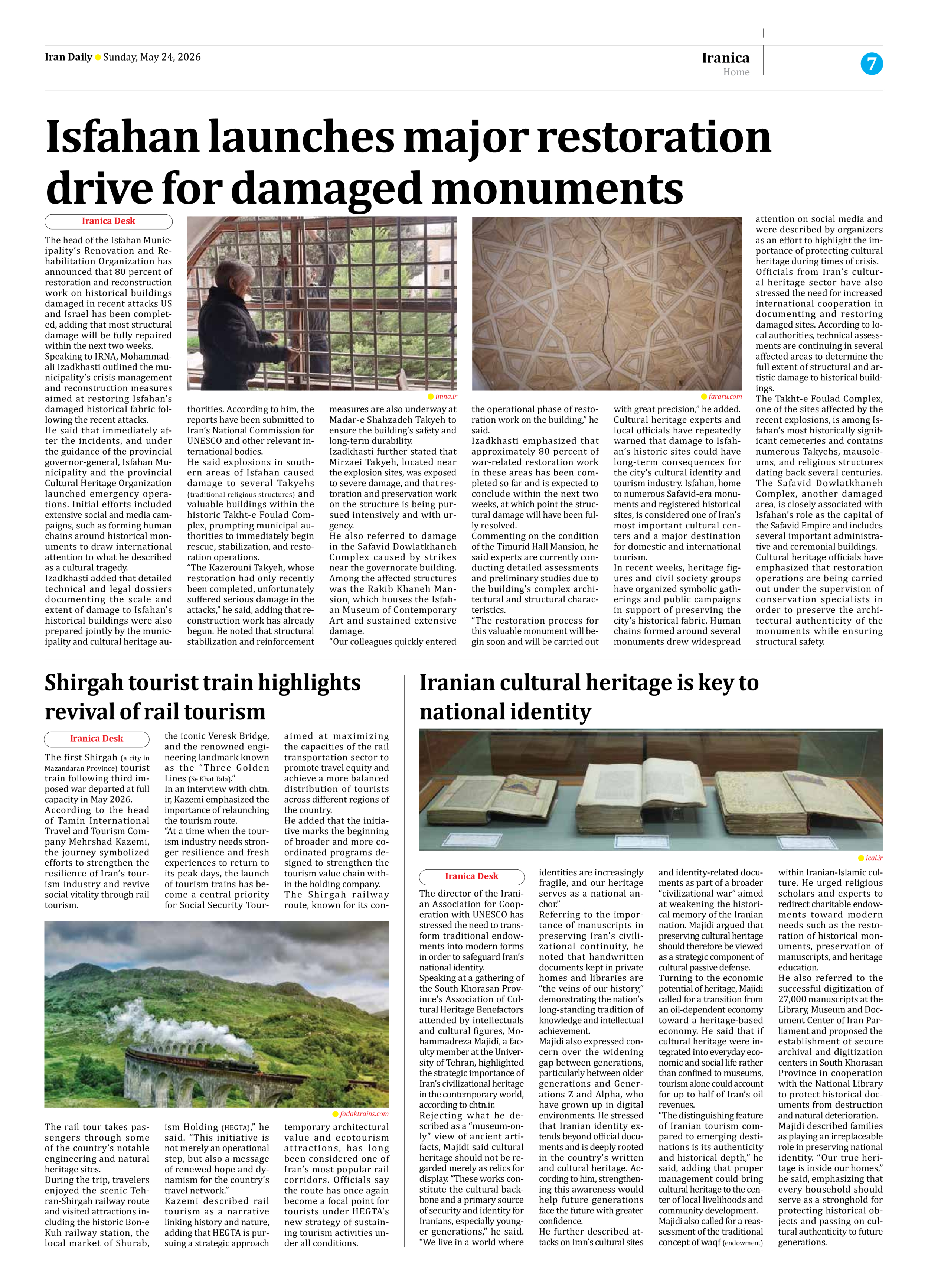
He said explosions in southern areas of Isfahan caused damage to several Takyehs (traditional religious structures) and valuable buildings within the historic Takht-e Foulad Complex, prompting municipal authorities to immediately begin rescue, stabilization, and restoration operations.
“The Kazerouni Takyeh, whose restoration had only recently been completed, unfortunately suffered serious damage in the attacks,” he said, adding that reconstruction work has already begun. He noted that structural stabilization and reinforcement measures are also underway at Madar-e Shahzadeh Takyeh to ensure the building’s safety and long-term durability.
Izadkhasti further stated that Mirzaei Takyeh, located near the explosion sites, was exposed to severe damage, and that restoration and preservation work on the structure is being pursued intensively and with urgency.
He also referred to damage in the Safavid Dowlatkhaneh Complex caused by strikes near the governorate building. Among the affected structures was the Rakib Khaneh Mansion, which houses the Isfahan Museum of Contemporary Art and sustained extensive damage.
“Our colleagues quickly entered the operational phase of restoration work on the building,” he said.
Izadkhasti emphasized that approximately 80 percent of war-related restoration work in these areas has been completed so far and is expected to conclude within the next two weeks, at which point the structural damage will have been fully resolved.
Commenting on the condition of the Timurid Hall Mansion, he said experts are currently conducting detailed assessments and preliminary studies due to the building’s complex architectural and structural characteristics.
“The restoration process for this valuable monument will begin soon and will be carried out with great precision,” he added.
Cultural heritage experts and local officials have repeatedly warned that damage to Isfahan’s historic sites could have long-term consequences for the city’s cultural identity and tourism industry. Isfahan, home to numerous Safavid-era monuments and registered historical sites, is considered one of Iran’s most important cultural centers and a major destination for domestic and international tourism.
In recent weeks, heritage figures and civil society groups have organized symbolic gatherings and public campaigns in support of preserving the city’s historical fabric. Human chains formed around several monuments drew widespread attention on social media and were described by organizers as an effort to highlight the importance of protecting cultural heritage during times of crisis.
Officials from Iran’s cultural heritage sector have also stressed the need for increased international cooperation in documenting and restoring damaged sites. According to local authorities, technical assessments are continuing in several affected areas to determine the full extent of structural and artistic damage to historical buildings.
The Takht-e Foulad Complex, one of the sites affected by the recent explosions, is among Isfahan’s most historically significant cemeteries and contains numerous Takyehs, mausoleums, and religious structures dating back several centuries. The Safavid Dowlatkhaneh Complex, another damaged area, is closely associated with Isfahan’s role as the capital of the Safavid Empire and includes several important administrative and ceremonial buildings.
Cultural heritage officials have emphasized that restoration operations are being carried out under the supervision of conservation specialists in order to preserve the architectural authenticity of the monuments while ensuring structural safety.