







Lesser-known monuments of Shiraz step into spotlight
Coinciding with Cultural Heritage Week, several lesser-known monuments and mausoleums in Shiraz have once again drawn public attention. From the Haft-Tanan Garden Museum, which houses historical stone inscriptions, to the tombs of Abesh-Khatun and Sibawayh, each narrating a distinct chapter of the city’s historical and intellectual identity, these sites collectively reveal that Shiraz’s history extends far beyond its most famous landmarks within the old urban fabric.
Cultural Heritage Week (May 18-24) serves as an opportunity to look beyond well-known monuments and re-examine memorials that remain quietly embedded within the historic texture of Shiraz — each preserving a fragment of the city’s collective memory, according to ISNA.
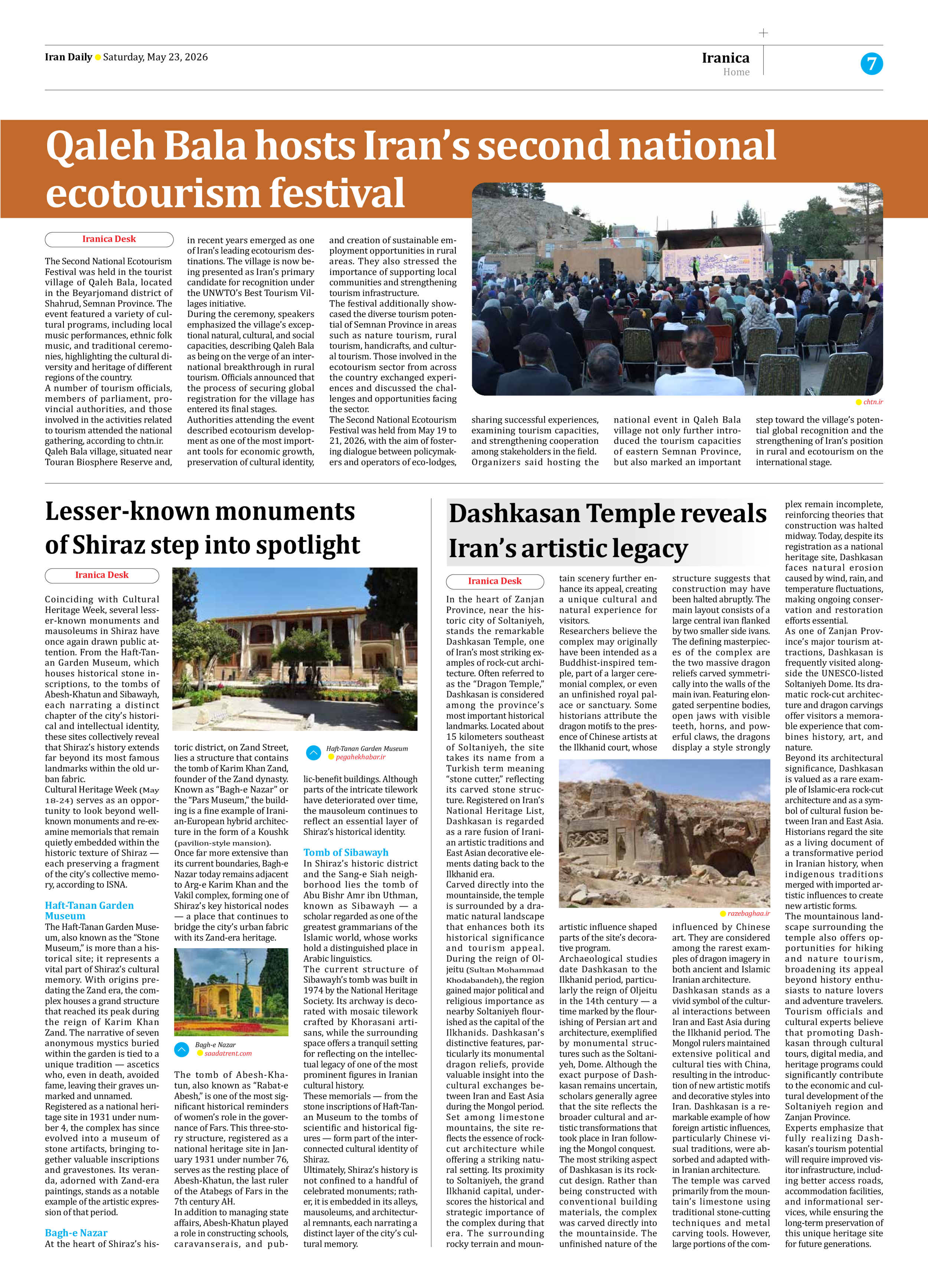
Haft-Tanan Garden Museum
The Haft-Tanan Garden Museum, also known as the “Stone Museum,” is more than a historical site; it represents a vital part of Shiraz’s cultural memory. With origins predating the Zand era, the complex houses a grand structure that reached its peak during the reign of Karim Khan Zand. The narrative of seven anonymous mystics buried within the garden is tied to a unique tradition — ascetics who, even in death, avoided fame, leaving their graves unmarked and unnamed.
Registered as a national heritage site in 1931 under number 4, the complex has since evolved into a museum of stone artifacts, bringing together valuable inscriptions and gravestones. Its veranda, adorned with Zand-era paintings, stands as a notable example of the artistic expression of that period.
Bagh-e Nazar
At the heart of Shiraz’s historic district, on Zand Street, lies a structure that contains the tomb of Karim Khan Zand, founder of the Zand dynasty. Known as “Bagh-e Nazar” or the “Pars Museum,” the building is a fine example of Iranian-European hybrid architecture in the form of a Koushk (pavilion-style mansion).
Once far more extensive than its current boundaries, Bagh-e Nazar today remains adjacent to Arg-e Karim Khan and the Vakil complex, forming one of Shiraz’s key historical nodes — a place that continues to bridge the city’s urban fabric with its Zand-era heritage.
The tomb of Abesh-Khatun, also known as “Rabat-e Abesh,” is one of the most significant historical reminders of women’s role in the governance of Fars. This three-story structure, registered as a national heritage site in January 1931 under number 76, serves as the resting place of Abesh-Khatun, the last ruler of the Atabegs of Fars in the 7th century AH.
In addition to managing state affairs, Abesh-Khatun played a role in constructing schools, caravanserais, and public-benefit buildings. Although parts of the intricate tilework have deteriorated over time, the mausoleum continues to reflect an essential layer of Shiraz’s historical identity.
Tomb of Sibawayh
In Shiraz’s historic district and the Sang-e Siah neighborhood lies the tomb of Abu Bishr Amr ibn Uthman, known as Sibawayh — a scholar regarded as one of the greatest grammarians of the Islamic world, whose works hold a distinguished place in Arabic linguistics.
The current structure of Sibawayh’s tomb was built in 1974 by the National Heritage Society. Its archway is decorated with mosaic tilework crafted by Khorasani artisans, while the surrounding space offers a tranquil setting for reflecting on the intellectual legacy of one of the most prominent figures in Iranian cultural history.
These memorials — from the stone inscriptions of Haft-Tanan Museum to the tombs of scientific and historical figures — form part of the interconnected cultural identity of Shiraz.
Ultimately, Shiraz’s history is not confined to a handful of celebrated monuments; rather, it is embedded in its alleys, mausoleums, and architectural remnants, each narrating a distinct layer of the city’s cultural memory.