





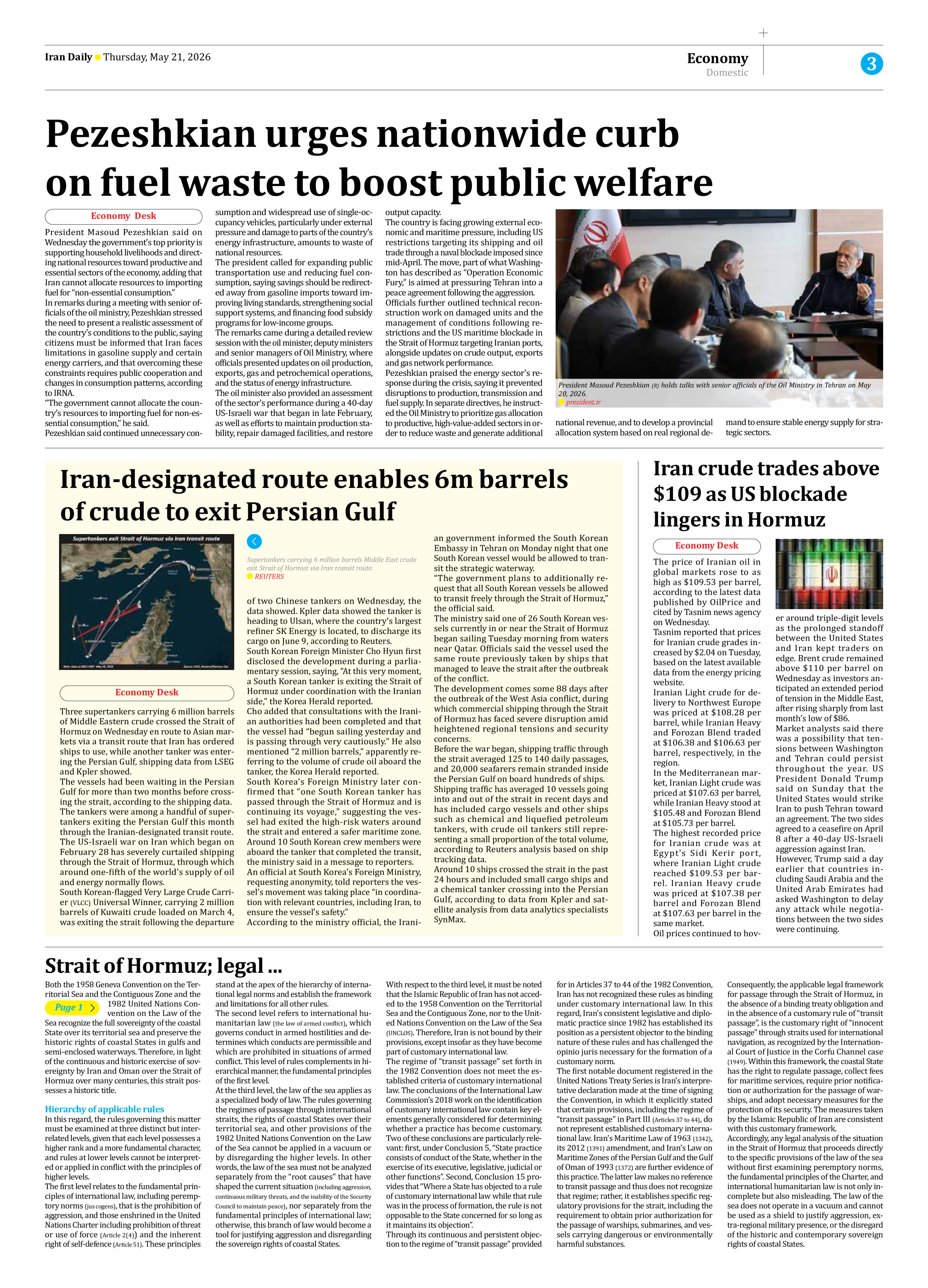


Iran-designated route enables 6m barrels of crude to exit Persian Gulf
Three supertankers carrying 6 million barrels of Middle Eastern crude crossed the Strait of Hormuz on Wednesday en route to Asian markets via a transit route that Iran has ordered ships to use, while another tanker was entering the Persian Gulf, shipping data from LSEG and Kpler showed.
The vessels had been waiting in the Persian Gulf for more than two months before crossing the strait, according to the shipping data.
The tankers were among a handful of supertankers exiting the Persian Gulf this month through the Iranian-designated transit route.
The US-Israeli war on Iran which began on February 28 has severely curtailed shipping through the Strait of Hormuz, through which around one-fifth of the world's supply of oil and energy normally flows.
South Korean-flagged Very Large Crude Carrier (VLCC) Universal Winner, carrying 2 million barrels of Kuwaiti crude loaded on March 4, was exiting the strait following the departure of two Chinese tankers on Wednesday, the data showed. Kpler data showed the tanker is heading to Ulsan, where the country's largest refiner SK Energy is located, to discharge its cargo on June 9, according to Reuters.
South Korean Foreign Minister Cho Hyun first disclosed the development during a parliamentary session, saying, “At this very moment, a South Korean tanker is exiting the Strait of Hormuz under coordination with the Iranian side,” the Korea Herald reported.
Cho added that consultations with the Iranian authorities had been completed and that the vessel had “begun sailing yesterday and is passing through very cautiously.” He also mentioned “2 million barrels,” apparently referring to the volume of crude oil aboard the tanker, the Korea Herald reported.
South Korea’s Foreign Ministry later confirmed that “one South Korean tanker has passed through the Strait of Hormuz and is continuing its voyage,” suggesting the vessel had exited the high-risk waters around the strait and entered a safer maritime zone. Around 10 South Korean crew members were aboard the tanker that completed the transit, the ministry said in a message to reporters.
An official at South Korea’s Foreign Ministry, requesting anonymity, told reporters the vessel’s movement was taking place “in coordination with relevant countries, including Iran, to ensure the vessel’s safety.”
According to the ministry official, the Iranian government informed the South Korean Embassy in Tehran on Monday night that one South Korean vessel would be allowed to transit the strategic waterway.
“The government plans to additionally request that all South Korean vessels be allowed to transit freely through the Strait of Hormuz,” the official said.
The ministry said one of 26 South Korean vessels currently in or near the Strait of Hormuz began sailing Tuesday morning from waters near Qatar. Officials said the vessel used the same route previously taken by ships that managed to leave the strait after the outbreak of the conflict.
The development comes some 88 days after the outbreak of the West Asia conflict, during which commercial shipping through the Strait of Hormuz has faced severe disruption amid heightened regional tensions and security concerns.
Before the war began, shipping traffic through the strait averaged 125 to 140 daily passages, and 20,000 seafarers remain stranded inside the Persian Gulf on board hundreds of ships.
Shipping traffic has averaged 10 vessels going into and out of the strait in recent days and has included cargo vessels and other ships such as chemical and liquefied petroleum tankers, with crude oil tankers still representing a small proportion of the total volume, according to Reuters analysis based on ship tracking data.
Around 10 ships crossed the strait in the past 24 hours and included small cargo ships and a chemical tanker crossing into the Persian Gulf, according to data from Kpler and satellite analysis from data analytics specialists SynMax.