





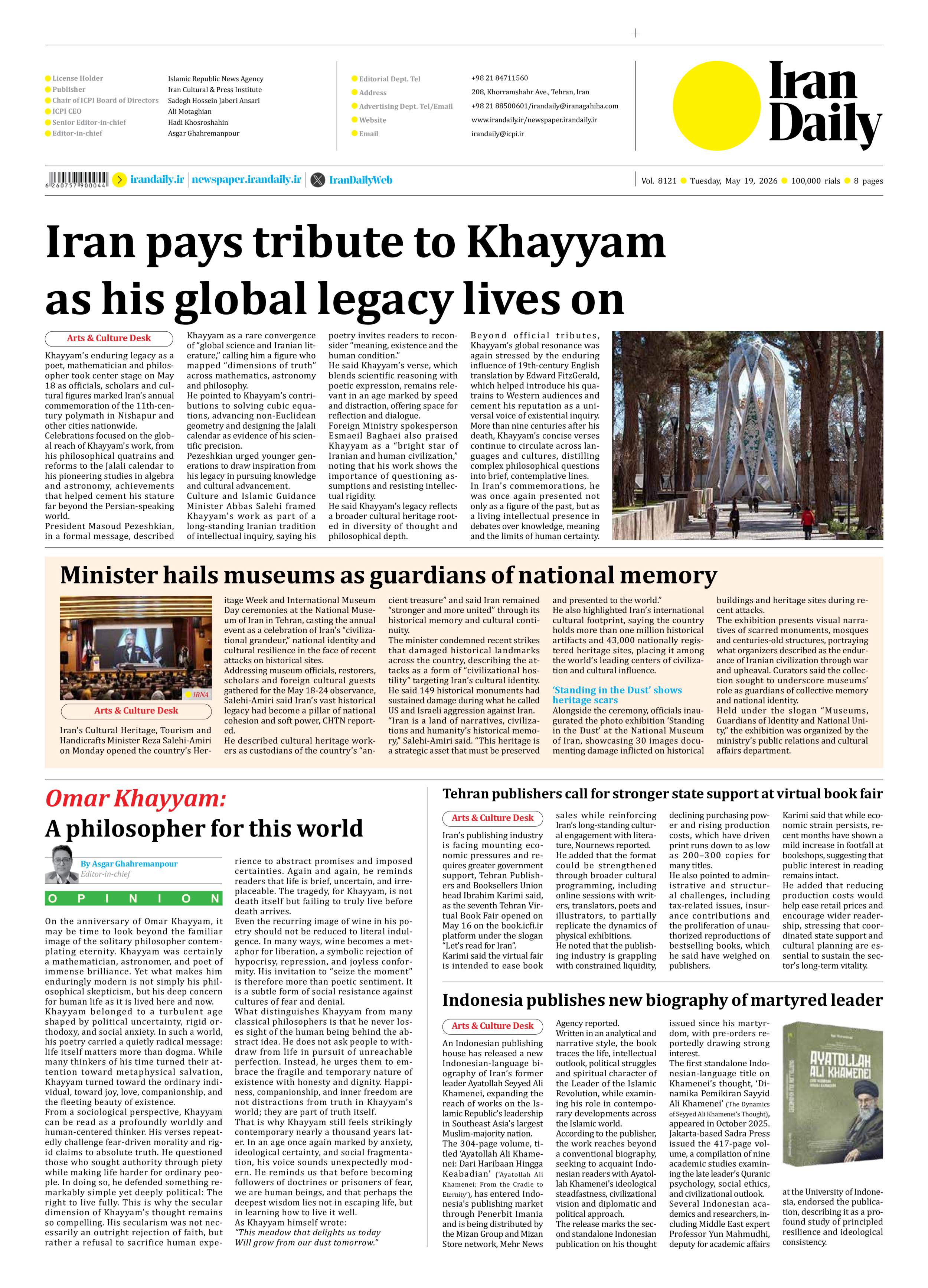


Iran pays tribute to Khayyam as his global legacy lives on
Khayyam’s enduring legacy as a poet, mathematician and philosopher took center stage on May 18 as officials, scholars and cultural figures marked Iran’s annual commemoration of the 11th-century polymath in Nishapur and other cities nationwide.
Celebrations focused on the global reach of Khayyam’s work, from his philosophical quatrains and reforms to the Jalali calendar to his pioneering studies in algebra and astronomy, achievements that helped cement his stature far beyond the Persian-speaking world.
President Masoud Pezeshkian, in a formal message, described Khayyam as a rare convergence of “global science and Iranian literature,” calling him a figure who mapped “dimensions of truth” across mathematics, astronomy and philosophy.
He pointed to Khayyam’s contributions to solving cubic equations, advancing non-Euclidean geometry and designing the Jalali calendar as evidence of his scientific precision.
Pezeshkian urged younger generations to draw inspiration from his legacy in pursuing knowledge and cultural advancement.
Culture and Islamic Guidance Minister Abbas Salehi framed Khayyam’s work as part of a long-standing Iranian tradition of intellectual inquiry, saying his poetry invites readers to reconsider “meaning, existence and the human condition.”
He said Khayyam’s verse, which blends scientific reasoning with poetic expression, remains relevant in an age marked by speed and distraction, offering space for reflection and dialogue.
Foreign Ministry spokesperson Esmaeil Baghaei also praised Khayyam as a “bright star of Iranian and human civilization,” noting that his work shows the importance of questioning assumptions and resisting intellectual rigidity.
He said Khayyam’s legacy reflects a broader cultural heritage rooted in diversity of thought and philosophical depth.
Beyond official tributes, Khayyam’s global resonance was again stressed by the enduring influence of 19th-century English translation by Edward FitzGerald, which helped introduce his quatrains to Western audiences and cement his reputation as a universal voice of existential inquiry.
More than nine centuries after his death, Khayyam’s concise verses continue to circulate across languages and cultures, distilling complex philosophical questions into brief, contemplative lines.
In Iran’s commemorations, he was once again presented not only as a figure of the past, but as a living intellectual presence in debates over knowledge, meaning and the limits of human certainty.