







Reading Room
A forward-looking perspective on written heritage
By Akbar Irani
Head of Institute for Written Heritage
This year, Iran finds itself in one of its most sensitive historical periods, a situation and crisis that few had anticipated on such a scale. Naturally, cultural and artistic institutions, like other organizations and state bodies, have also faced significant challenges and setbacks. This is largely due to serious disruptions in the country’s financial and economic cycles, as well as a decline in state revenues. As a result, government support for the cultural and artistic sector has been uneven, and it is perhaps unprecedented for cultural and artistic communities to face such difficulties.
The 19th of Iranian month of Ordibehesht (May 9) is officially designated in Iran’s national calendar as “National Documents and Written Heritage Day”. Each year, it coincided with the Tehran International Book Fair; however, during the COVID-19 pandemic and again in the current period, when holding in-person exhibitions has not been possible, this commemoration has not been observed in its usual form.
Written heritage — the intellectual legacy of Iranian scholars and thinkers throughout history — is among the treasures that has long been a source of national pride and a forward-looking reference for the future. The use of past heritage to better understand a country’s future is a practice common to all nations with deep historical roots. Societies without such roots are either forced to rely on or appropriate the historical heritage of others, or to turn to sources lacking cultural and historical value.
Iran, with its long historical continuity both before and after the advent of Islam, possesses a vast corpus of manuscripts and written records, from stone inscriptions and epigraphs to later paper-based works. These texts carry the intellectual legacy of great thinkers whose ideas eventually reached far beyond Iran, influencing parts of the Western world. Approximately 500 to 600 years ago, works such as Avicenna’s The Canon of Medicine and Al-Razi’s Al-Hawi were printed and taught, while algorithms derived from Al-Khwarizmi’s work were widely adopted and used. The importance of this written heritage and its impact on global knowledge is therefore undeniable.
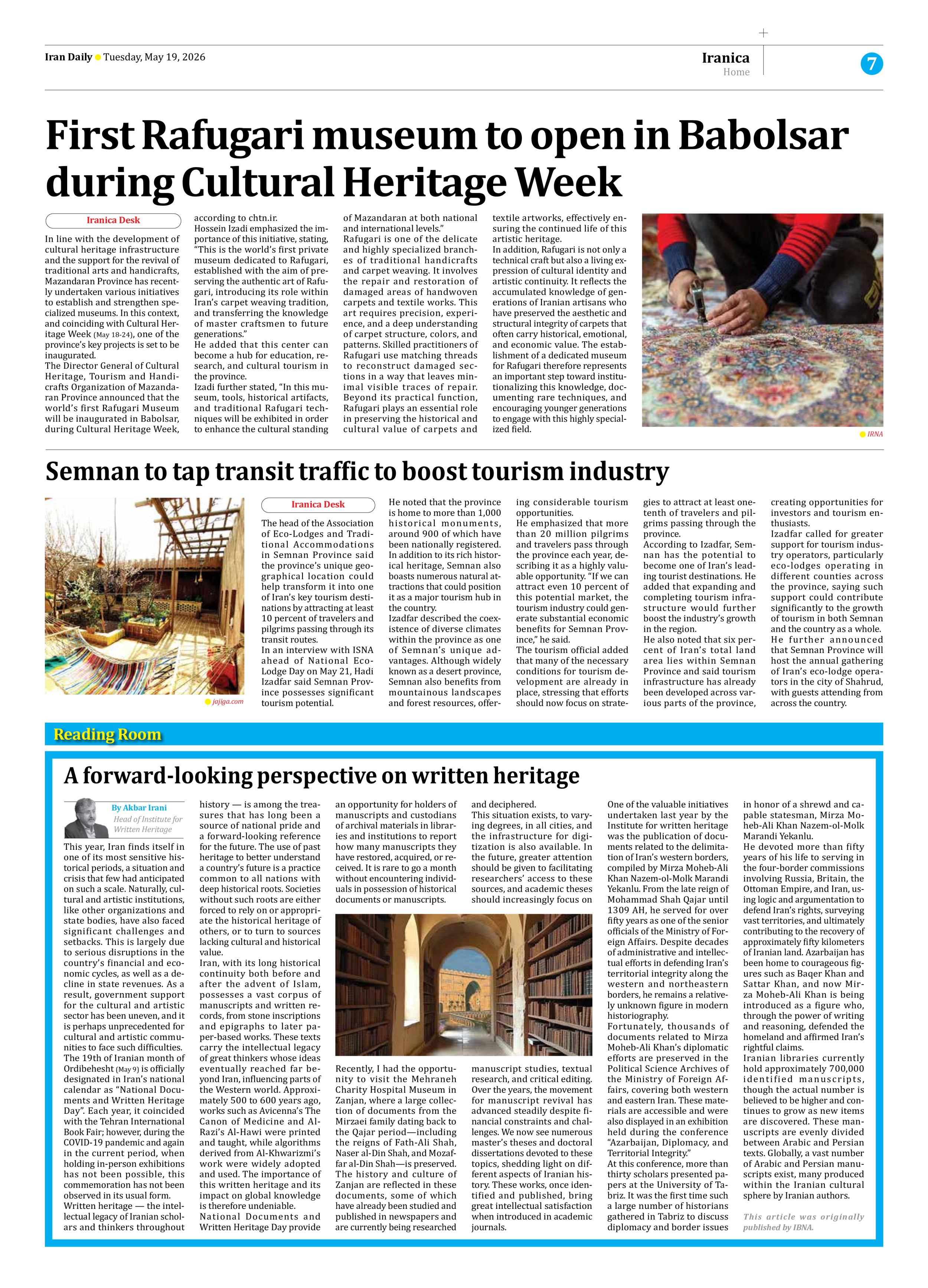
National Documents and Written Heritage Day provide an opportunity for holders of manuscripts and custodians of archival materials in libraries and institutions to report how many manuscripts they have restored, acquired, or received. It is rare to go a month without encountering individuals in possession of historical documents or manuscripts.
Recently, I had the opportunity to visit the Mehraneh Charity Hospital Museum in Zanjan, where a large collection of documents from the Mirzaei family dating back to the Qajar period—including the reigns of Fath-Ali Shah, Naser al-Din Shah, and Mozaffar al-Din Shah—is preserved. The history and culture of Zanjan are reflected in these documents, some of which have already been studied and published in newspapers and are currently being researched and deciphered.
This situation exists, to varying degrees, in all cities, and the infrastructure for digitization is also available. In the future, greater attention should be given to facilitating researchers’ access to these sources, and academic theses should increasingly focus on manuscript studies, textual research, and critical editing. Over the years, the movement for manuscript revival has advanced steadily despite financial constraints and challenges. We now see numerous master’s theses and doctoral dissertations devoted to these topics, shedding light on different aspects of Iranian history. These works, once identified and published, bring great intellectual satisfaction when introduced in academic journals.
One of the valuable initiatives undertaken last year by the Institute for written heritage was the publication of documents related to the delimitation of Iran’s western borders, compiled by Mirza Moheb-Ali Khan Nazem-ol-Molk Marandi Yekanlu. From the late reign of Mohammad Shah Qajar until 1309 AH, he served for over fifty years as one of the senior officials of the Ministry of Foreign Affairs. Despite decades of administrative and intellectual efforts in defending Iran’s territorial integrity along the western and northeastern borders, he remains a relatively unknown figure in modern historiography.
Fortunately, thousands of documents related to Mirza Moheb-Ali Khan’s diplomatic efforts are preserved in the Political Science Archives of the Ministry of Foreign Affairs, covering both western and eastern Iran. These materials are accessible and were also displayed in an exhibition held during the conference “Azarbaijan, Diplomacy, and Territorial Integrity.”
At this conference, more than thirty scholars presented papers at the University of Tabriz. It was the first time such a large number of historians gathered in Tabriz to discuss diplomacy and border issues in honor of a shrewd and capable statesman, Mirza Moheb-Ali Khan Nazem-ol-Molk Marandi Yekanlu.
He devoted more than fifty years of his life to serving in the four-border commissions involving Russia, Britain, the Ottoman Empire, and Iran, using logic and argumentation to defend Iran’s rights, surveying vast territories, and ultimately contributing to the recovery of approximately fifty kilometers of Iranian land. Azarbaijan has been home to courageous figures such as Baqer Khan and Sattar Khan, and now Mirza Moheb-Ali Khan is being introduced as a figure who, through the power of writing and reasoning, defended the homeland and affirmed Iran’s rightful claims.
Iranian libraries currently hold approximately 700,000 identified manuscripts, though the actual number is believed to be higher and continues to grow as new items are discovered. These manuscripts are evenly divided between Arabic and Persian texts. Globally, a vast number of Arabic and Persian manuscripts exist, many produced within the Iranian cultural sphere by Iranian authors.
This article was originally
published by IBNA.