







Sirjan demostrates rich heritage, expanding tourism potential
Kerman Province, as one of the largest and most geographically diverse provinces in Iran, enjoys a four-season climate, a long historical background, and a wide range of natural, cultural, and economic attractions. Thanks to its ancient cities, remarkable deserts, high mountains, and rich cultural heritage, the province is considered one of the key destinations for both domestic and international tourism.
Within this vast region, Sirjan stands out as one of the most important areas in western Kerman Province, with significant economic, logistical, and tourism importance. Covering more than 13,000 square kilometers, Sirjan is strategically located along the transit routes connecting Kerman, Fars, and Hormozgan provinces. This geographical position has turned the city into a key transportation hub in southeastern Iran, playing an important role in economic growth, trade exchanges, and the development of infrastructure and tourism services.
Beyond its economic significance, Sirjan also has a rich historical and cultural background. Over time, the city has been a point of cultural interaction and convergence, resulting in notable social and cultural diversity. The blend of urban life with rural and nomadic lifestyles has given the region a distinct identity, setting it apart from many surrounding areas.
From a natural perspective, Sirjan is a diverse, four-season region. Its landscapes range from mountains and vast plains to protected areas and unique ecosystems, forming a valuable foundation for ecotourism and nature-based travel. This geographical and climatic diversity has gradually transformed the city into one of the emerging tourism destinations in Kerman Province, alongside its industrial and economic roles.
Ali Memarnejad, Deputy Head of Kerman Province’s Cultural Heritage, Tourism and Handicrafts Organization, recently highlighted Sirjan’s exceptional potential in an interview. He referred to the region’s nomadic lifestyle, its numerous historical attractions, the Gohar Park recreational complex as the largest tourism village in the Middle East, and the Siah-Kuh Protected Area as a natural treasure. He also described the global registration of Shiriki Pich kilim as a lasting honor for the region.
He described Sirjan as a unique and fascinating destination for tourists, noting that one of its most distinctive features is its nomadic character. The presence of mountains and suitable migration routes has historically attracted numerous tribes and nomads to the area, making nomadic culture a defining element of Sirjan’s identity.
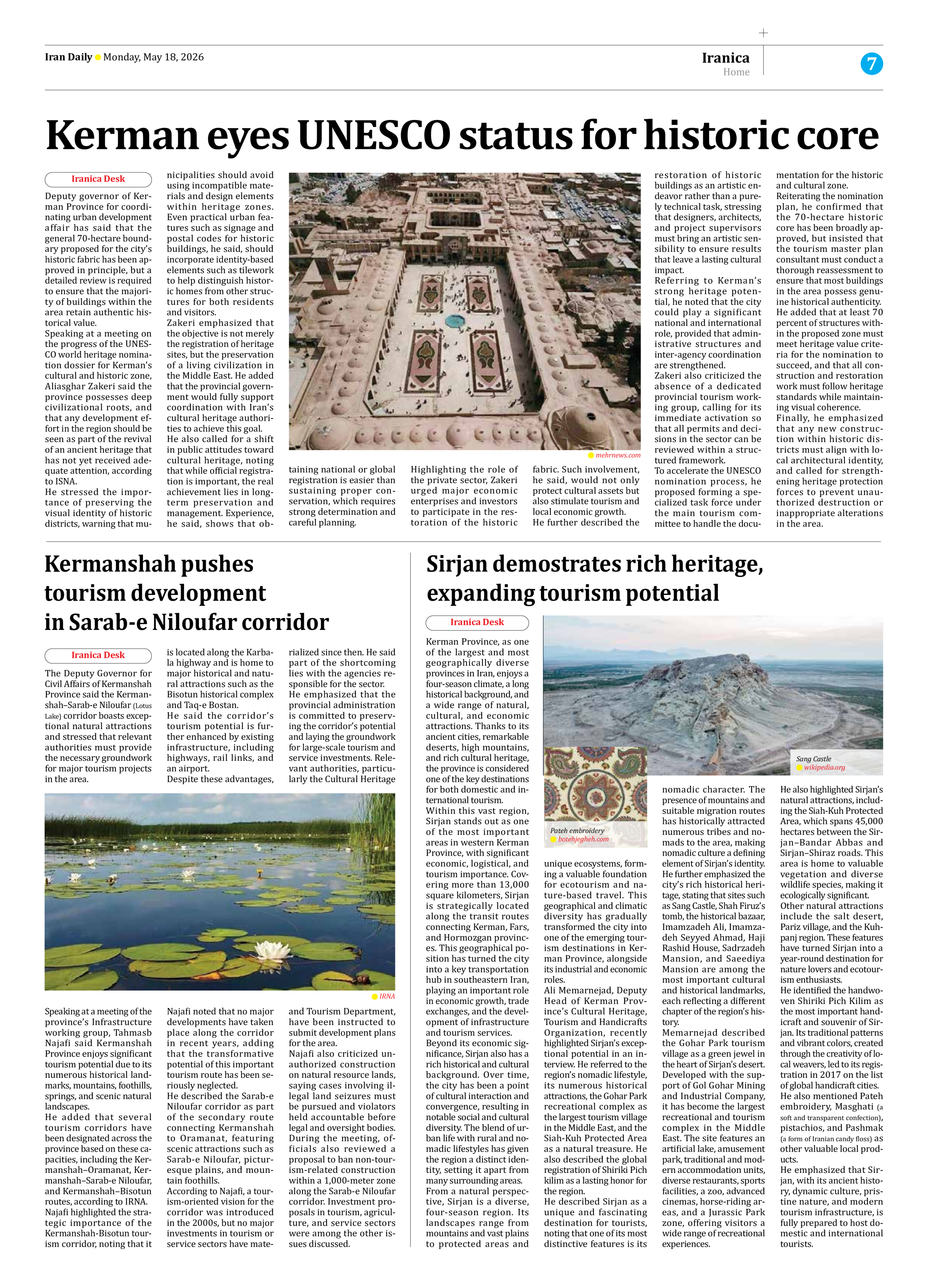
He further emphasized the city’s rich historical heritage, stating that sites such as Sang Castle, Shah Firuz’s tomb, the historical bazaar, Imamzadeh Ali, Imamzadeh Seyyed Ahmad, Haji Rashid House, Sadrzadeh Mansion, and Saeediya Mansion are among the most important cultural and historical landmarks, each reflecting a different chapter of the region’s history.
Memarnejad described the Gohar Park tourism village as a green jewel in the heart of Sirjan’s desert. Developed with the support of Gol Gohar Mining and Industrial Company, it has become the largest recreational and tourism complex in the Middle East. The site features an artificial lake, amusement park, traditional and modern accommodation units, diverse restaurants, sports facilities, a zoo, advanced cinemas, horse-riding areas, and a Jurassic Park zone, offering visitors a wide range of recreational experiences.
He also highlighted Sirjan’s natural attractions, including the Siah-Kuh Protected Area, which spans 45,000 hectares between the Sirjan–Bandar Abbas and Sirjan–Shiraz roads. This area is home to valuable vegetation and diverse wildlife species, making it ecologically significant.
Other natural attractions include the salt desert, Pariz village, and the Kuhpanj region. These features have turned Sirjan into a year-round destination for nature lovers and ecotourism enthusiasts.
He identified the handwoven Shiriki Pich Kilim as the most important handicraft and souvenir of Sirjan. Its traditional patterns and vibrant colors, created through the creativity of local weavers, led to its registration in 2017 on the list of global handicraft cities.
He also mentioned Pateh embroidery, Masghati (a soft and transparent confection), pistachios, and Pashmak (a form of Iranian candy floss) as other valuable local products.
He emphasized that Sirjan, with its ancient history, dynamic culture, pristine nature, and modern tourism infrastructure, is fully prepared to host domestic and international tourists.