





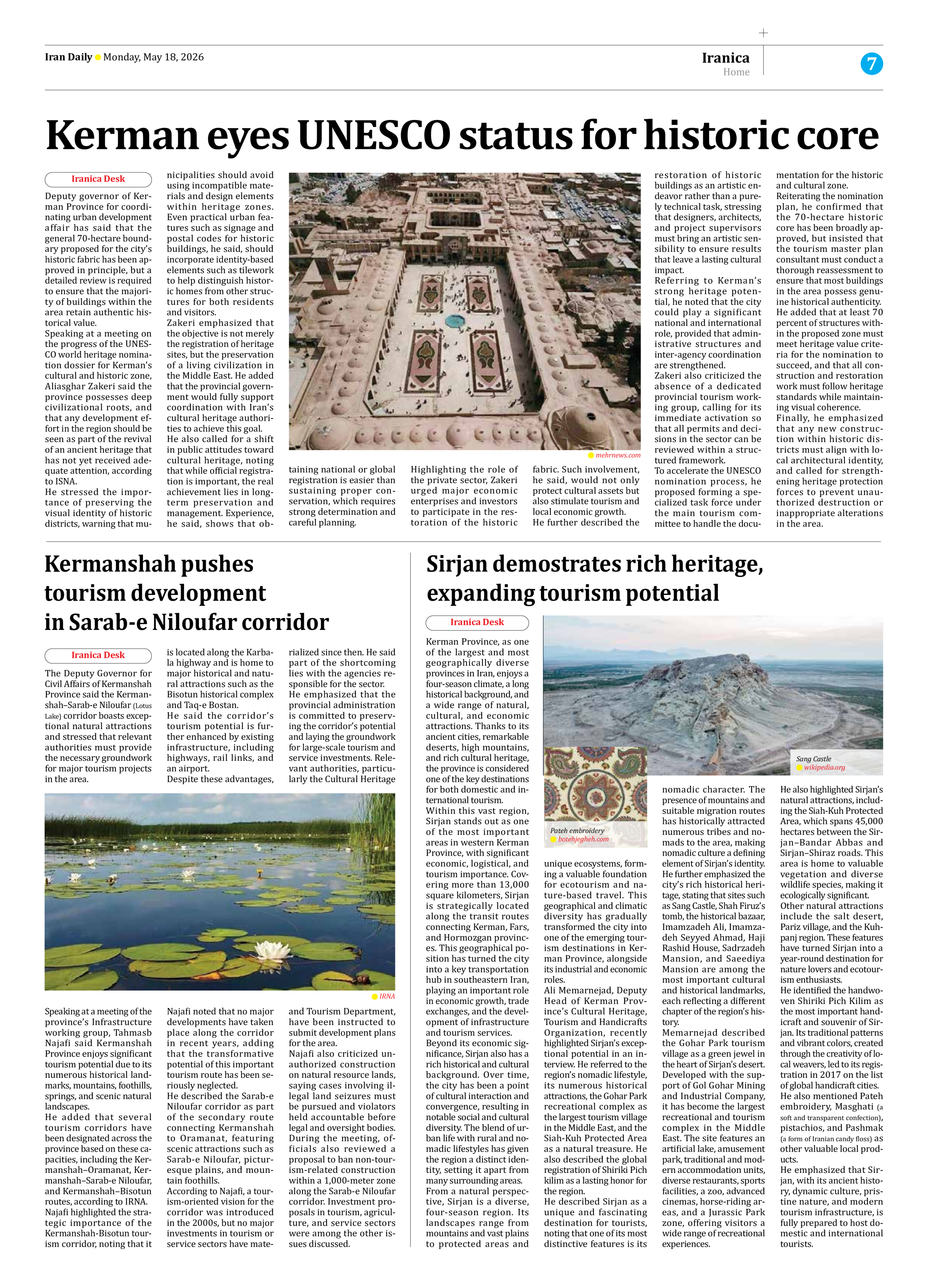


Kerman eyes UNESCO status for historic core
Deputy governor of Kerman Province for coordinating urban development affair has said that the general 70-hectare boundary proposed for the city’s historic fabric has been approved in principle, but a detailed review is required to ensure that the majority of buildings within the area retain authentic historical value.
Speaking at a meeting on the progress of the UNESCO world heritage nomination dossier for Kerman’s cultural and historic zone, Aliasghar Zakeri said the province possesses deep civilizational roots, and that any development effort in the region should be seen as part of the revival of an ancient heritage that has not yet received adequate attention, according to ISNA.
He stressed the importance of preserving the visual identity of historic districts, warning that municipalities should avoid using incompatible materials and design elements within heritage zones. Even practical urban features such as signage and postal codes for historic buildings, he said, should incorporate identity-based elements such as tilework to help distinguish historic homes from other structures for both residents and visitors.
Zakeri emphasized that the objective is not merely the registration of heritage sites, but the preservation of a living civilization in the Middle East. He added that the provincial government would fully support coordination with Iran’s cultural heritage authorities to achieve this goal.
He also called for a shift in public attitudes toward cultural heritage, noting that while official registration is important, the real achievement lies in long-term preservation and management. Experience, he said, shows that obtaining national or global registration is easier than sustaining proper conservation, which requires strong determination and careful planning.
Highlighting the role of the private sector, Zakeri urged major economic enterprises and investors to participate in the restoration of the historic fabric. Such involvement, he said, would not only protect cultural assets but also stimulate tourism and local economic growth.
He further described the restoration of historic buildings as an artistic endeavor rather than a purely technical task, stressing that designers, architects, and project supervisors must bring an artistic sensibility to ensure results that leave a lasting cultural impact.
Referring to Kerman’s strong heritage potential, he noted that the city could play a significant national and international role, provided that administrative structures and inter-agency coordination are strengthened.
Zakeri also criticized the absence of a dedicated provincial tourism working group, calling for its immediate activation so that all permits and decisions in the sector can be reviewed within a structured framework.
To accelerate the UNESCO nomination process, he proposed forming a specialized task force under the main tourism committee to handle the documentation for the historic and cultural zone.
Reiterating the nomination plan, he confirmed that the 70-hectare historic core has been broadly approved, but insisted that the tourism master plan consultant must conduct a thorough reassessment to ensure that most buildings in the area possess genuine historical authenticity.
He added that at least 70 percent of structures within the proposed zone must meet heritage value criteria for the nomination to succeed, and that all construction and restoration work must follow heritage standards while maintaining visual coherence.
Finally, he emphasized that any new construction within historic districts must align with local architectural identity, and called for strengthening heritage protection forces to prevent unauthorized destruction or inappropriate alterations in the area.