





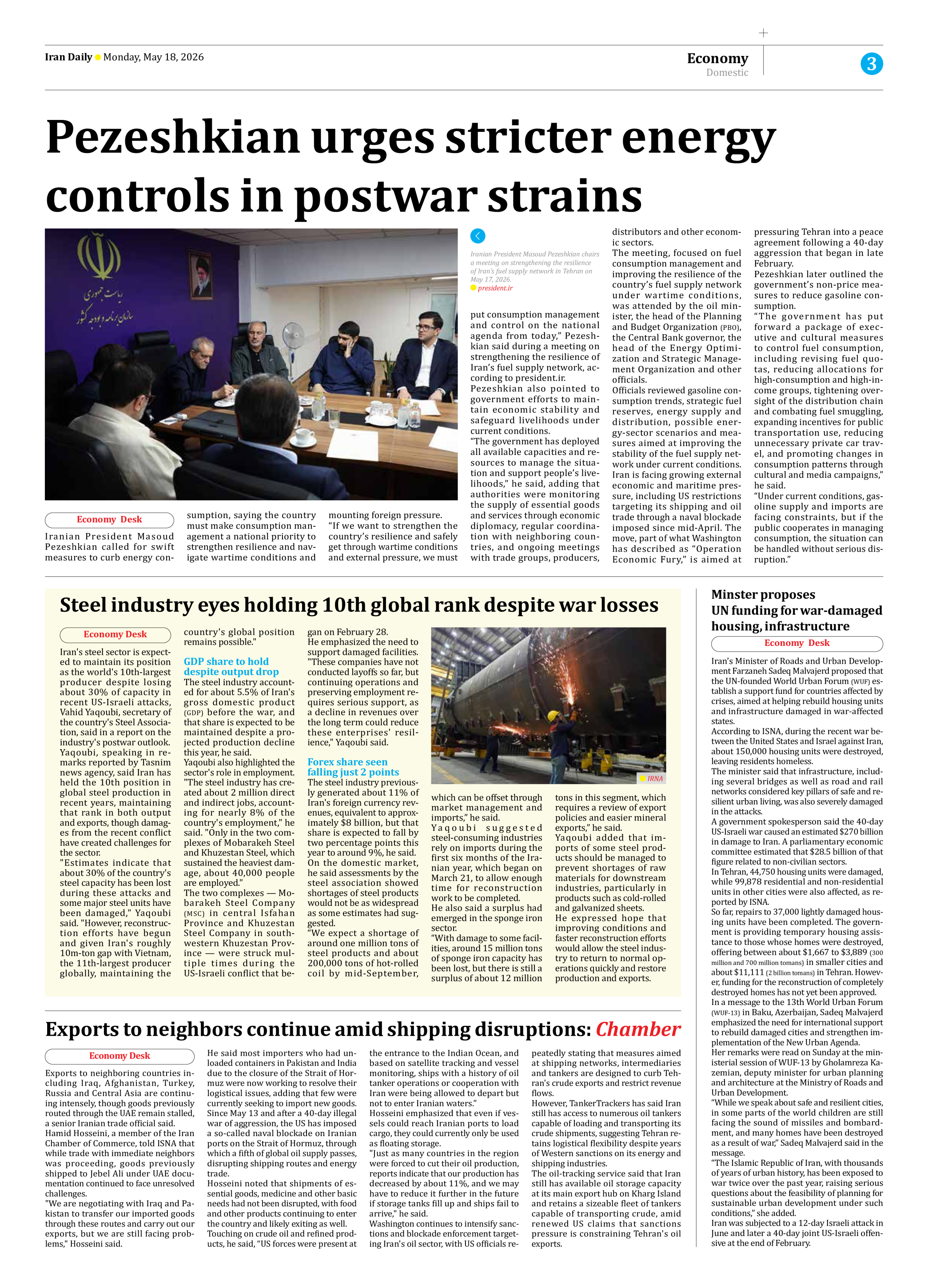


Steel industry eyes holding 10th global rank despite war losses
Iran's steel sector is expected to maintain its position as the world's 10th-largest producer despite losing about 30% of capacity in recent US-Israeli attacks, Vahid Yaqoubi, secretary of the country's Steel Association, said in a report on the industry's postwar outlook.
Yaqoubi, speaking in remarks reported by Tasnim news agency, said Iran has held the 10th position in global steel production in recent years, maintaining that rank in both output and exports, though damages from the recent conflict have created challenges for the sector.
"Estimates indicate that about 30% of the country's steel capacity has been lost during these attacks and some major steel units have been damaged," Yaqoubi said. "However, reconstruction efforts have begun and given Iran's roughly 10m-ton gap with Vietnam, the 11th-largest producer globally, maintaining the country's global position remains possible."
GDP share to hold despite output drop
The steel industry accounted for about 5.5% of Iran's gross domestic product (GDP) before the war, and that share is expected to be maintained despite a projected production decline this year, he said.
Yaqoubi also highlighted the sector's role in employment. "The steel industry has created about 2 million direct and indirect jobs, accounting for nearly 8% of the country's employment," he said. "Only in the two complexes of Mobarakeh Steel and Khuzestan Steel, which sustained the heaviest damage, about 40,000 people are employed."
The two complexes — Mobarakeh Steel Company (MSC) in central Isfahan Province and Khuzestan Steel Company in southwestern Khuzestan Province — were struck multiple times during the US-Israeli conflict that began on February 28.
He emphasized the need to support damaged facilities. "These companies have not conducted layoffs so far, but continuing operations and preserving employment requires serious support, as a decline in revenues over the long term could reduce these enterprises' resilience," Yaqoubi said.
Forex share seen falling just 2 points
The steel industry previously generated about 11% of Iran's foreign currency revenues, equivalent to approximately $8 billion, but that share is expected to fall by two percentage points this year to around 9%, he said.
On the domestic market, he said assessments by the steel association showed shortages of steel products would not be as widespread as some estimates had suggested.
“We expect a shortage of around one million tons of steel products and about 200,000 tons of hot-rolled coil by mid-September, which can be offset through market management and imports,” he said.
Yaqoubi suggested steel-consuming industries rely on imports during the first six months of the Iranian year, which began on March 21, to allow enough time for reconstruction work to be completed.
He also said a surplus had emerged in the sponge iron sector.
“With damage to some facilities, around 15 million tons of sponge iron capacity has been lost, but there is still a surplus of about 12 million tons in this segment, which requires a review of export policies and easier mineral exports,” he said.
Yaqoubi added that imports of some steel products should be managed to prevent shortages of raw materials for downstream industries, particularly in products such as cold-rolled and galvanized sheets.
He expressed hope that improving conditions and faster reconstruction efforts would allow the steel industry to return to normal operations quickly and restore production and exports.