







President hopeful Pakistan’s efforts will bring lasting regional peace
US presence only stokes insecurity, instability: Qalibaf
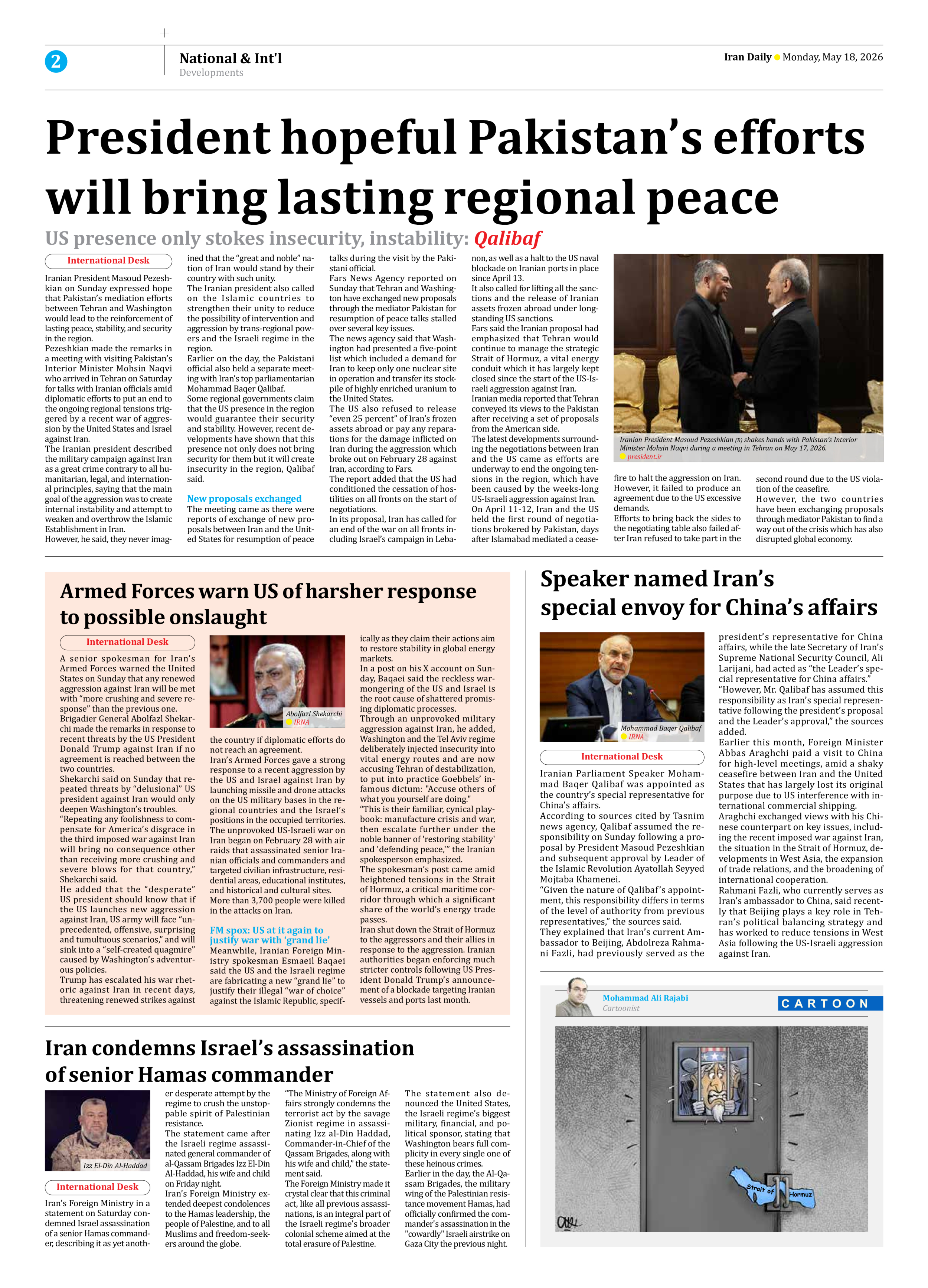
Iranian President Masoud Pezeshkian on Sunday expressed hope that Pakistan’s mediation efforts between Tehran and Washington would lead to the reinforcement of lasting peace, stability, and security in the region.
Pezeshkian made the remarks in a meeting with visiting Pakistan’s Interior Minister Mohsin Naqvi who arrived in Tehran on Saturday for talks with Iranian officials amid diplomatic efforts to put an end to the ongoing regional tensions triggered by a recent war of aggression by the United States and Israel against Iran.
The Iranian president described the military campaign against Iran as a great crime contrary to all humanitarian, legal, and international principles, saying that the main goal of the aggression was to create internal instability and attempt to weaken and overthrow the Islamic Establishment in Iran.
However, he said, they never imagined that the “great and noble” nation of Iran would stand by their country with such unity.
The Iranian president also called on the Islamic countries to strengthen their unity to reduce the possibility of intervention and aggression by trans-regional powers and the Israeli regime in the region.
Earlier on the day, the Pakistani official also held a separate meeting with Iran’s top parliamentarian Mohammad Baqer Qalibaf.
Some regional governments claim that the US presence in the region would guarantee their security and stability. However, recent developments have shown that this presence not only does not bring security for them but it will create insecurity in the region, Qalibaf said.
New proposals exchanged
The meeting came as there were reports of exchange of new proposals between Iran and the United States for resumption of peace talks during the visit by the Pakistani official.
Fars News Agency reported on Sunday that Tehran and Washington have exchanged new proposals through the mediator Pakistan for resumption of peace talks stalled over several key issues.
The news agency said that Washington had presented a five-point list which included a demand for Iran to keep only one nuclear site in operation and transfer its stockpile of highly enriched uranium to the United States.
The US also refused to release “even 25 percent” of Iran’s frozen assets abroad or pay any reparations for the damage inflicted on Iran during the aggression which broke out on February 28 against Iran, according to Fars.
The report added that the US had conditioned the cessation of hostilities on all fronts on the start of negotiations.
In its proposal, Iran has called for an end of the war on all fronts including Israel’s campaign in Lebanon, as well as a halt to the US naval blockade on Iranian ports in place since April 13.
It also called for lifting all the sanctions and the release of Iranian assets frozen abroad under longstanding US sanctions.
Fars said the Iranian proposal had emphasized that Tehran would continue to manage the strategic Strait of Hormuz, a vital energy conduit which it has largely kept closed since the start of the US-Israeli aggression against Iran.
Iranian media reported that Tehran conveyed its views to the Pakistan after receiving a set of proposals from the American side.
The latest developments surrounding the negotiations between Iran and the US came as efforts are underway to end the ongoing tensions in the region, which have been caused by the weeks-long US-Israeli aggression against Iran.
On April 11-12, Iran and the US held the first round of negotiations brokered by Pakistan, days after Islamabad mediated a ceasefire to halt the aggression on Iran. However, it failed to produce an agreement due to the US excessive demands.
Efforts to bring back the sides to the negotiating table also failed after Iran refused to take part in the second round due to the US violation of the ceasefire.
However, the two countries have been exchanging proposals through mediator Pakistan to find a way out of the crisis which has also disrupted global economy.