







Belqeys Citadel bridges legend, history in North Khorasan
The ancient Belqeys Citadel, located near the city of Esfarayen on the edge of the vast plains of North Khorasan Province in northeastern Iran, is considered one of the country’s most significant yet lesser-known historical landmarks.
The massive mud-brick complex is not merely an archaeological monument, but the remains of an ancient city that once played a major social, economic, and defensive role in the region. Despite centuries of natural erosion and the passage of time, the citadel remains one of North Khorasan Province’s most important historical attractions, with strong potential to draw tourists interested in history, architecture, and cultural travel, according to IRNA.
Archaeological studies indicate that the origins of the site date back to early historical periods, particularly the Sassanid era, before undergoing further expansion during the Islamic period. Researchers say this continuity demonstrates that the citadel preserved its strategic function for centuries while adapting to the needs of successive periods.
Historians believe the complex was once part of a larger urban settlement that occupied a key position along eastern Iran’s historic trade and communication routes.
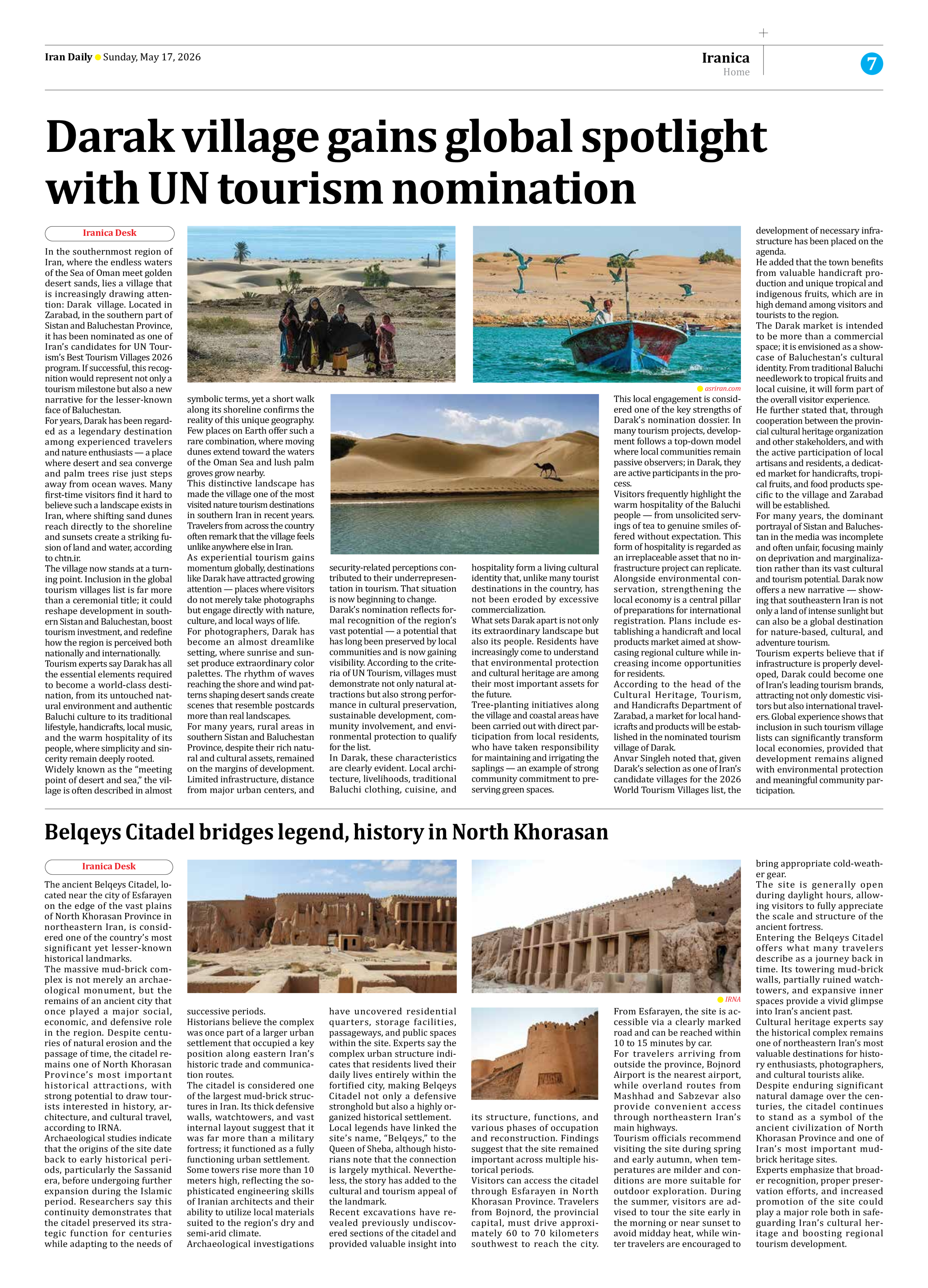
The citadel is considered one of the largest mud-brick structures in Iran. Its thick defensive walls, watchtowers, and vast internal layout suggest that it was far more than a military fortress; it functioned as a fully functioning urban settlement.
Some towers rise more than 10 meters high, reflecting the sophisticated engineering skills of Iranian architects and their ability to utilize local materials suited to the region’s dry and semi-arid climate.
Archaeological investigations have uncovered residential quarters, storage facilities, passageways, and public spaces within the site. Experts say the complex urban structure indicates that residents lived their daily lives entirely within the fortified city, making Belqeys Citadel not only a defensive stronghold but also a highly organized historical settlement.
Local legends have linked the site’s name, “Belqeys,” to the Queen of Sheba, although historians note that the connection is largely mythical. Nevertheless, the story has added to the cultural and tourism appeal of the landmark.
Recent excavations have revealed previously undiscovered sections of the citadel and provided valuable insight into its structure, functions, and various phases of occupation and reconstruction. Findings suggest that the site remained important across multiple historical periods.
Visitors can access the citadel through Esfarayen in North Khorasan Province. Travelers from Bojnord, the provincial capital, must drive approximately 60 to 70 kilometers southwest to reach the city. From Esfarayen, the site is accessible via a clearly marked road and can be reached within 10 to 15 minutes by car.
For travelers arriving from outside the province, Bojnord Airport is the nearest airport, while overland routes from Mashhad and Sabzevar also provide convenient access through northeastern Iran’s main highways.
Tourism officials recommend visiting the site during spring and early autumn, when temperatures are milder and conditions are more suitable for outdoor exploration. During the summer, visitors are advised to tour the site early in the morning or near sunset to avoid midday heat, while winter travelers are encouraged to bring appropriate cold-weather gear.
The site is generally open during daylight hours, allowing visitors to fully appreciate the scale and structure of the ancient fortress.
Entering the Belqeys Citadel offers what many travelers describe as a journey back in time. Its towering mud-brick walls, partially ruined watchtowers, and expansive inner spaces provide a vivid glimpse into Iran’s ancient past.
Cultural heritage experts say the historical complex remains one of northeastern Iran’s most valuable destinations for history enthusiasts, photographers, and cultural tourists alike.
Despite enduring significant natural damage over the centuries, the citadel continues to stand as a symbol of the ancient civilization of North Khorasan Province and one of Iran’s most important mud-brick heritage sites.
Experts emphasize that broader recognition, proper preservation efforts, and increased promotion of the site could play a major role both in safeguarding Iran’s cultural heritage and boosting regional tourism development.