







Darak village gains global spotlight with UN tourism nomination
In the southernmost region of Iran, where the endless waters of the Sea of Oman meet golden desert sands, lies a village that is increasingly drawing attention: Darak village. Located in Zarabad, in the southern part of Sistan and Baluchestan Province, it has been nominated as one of Iran’s candidates for UN Tourism’s Best Tourism Villages 2026 program. If successful, this recognition would represent not only a tourism milestone but also a new narrative for the lesser-known face of Baluchestan.
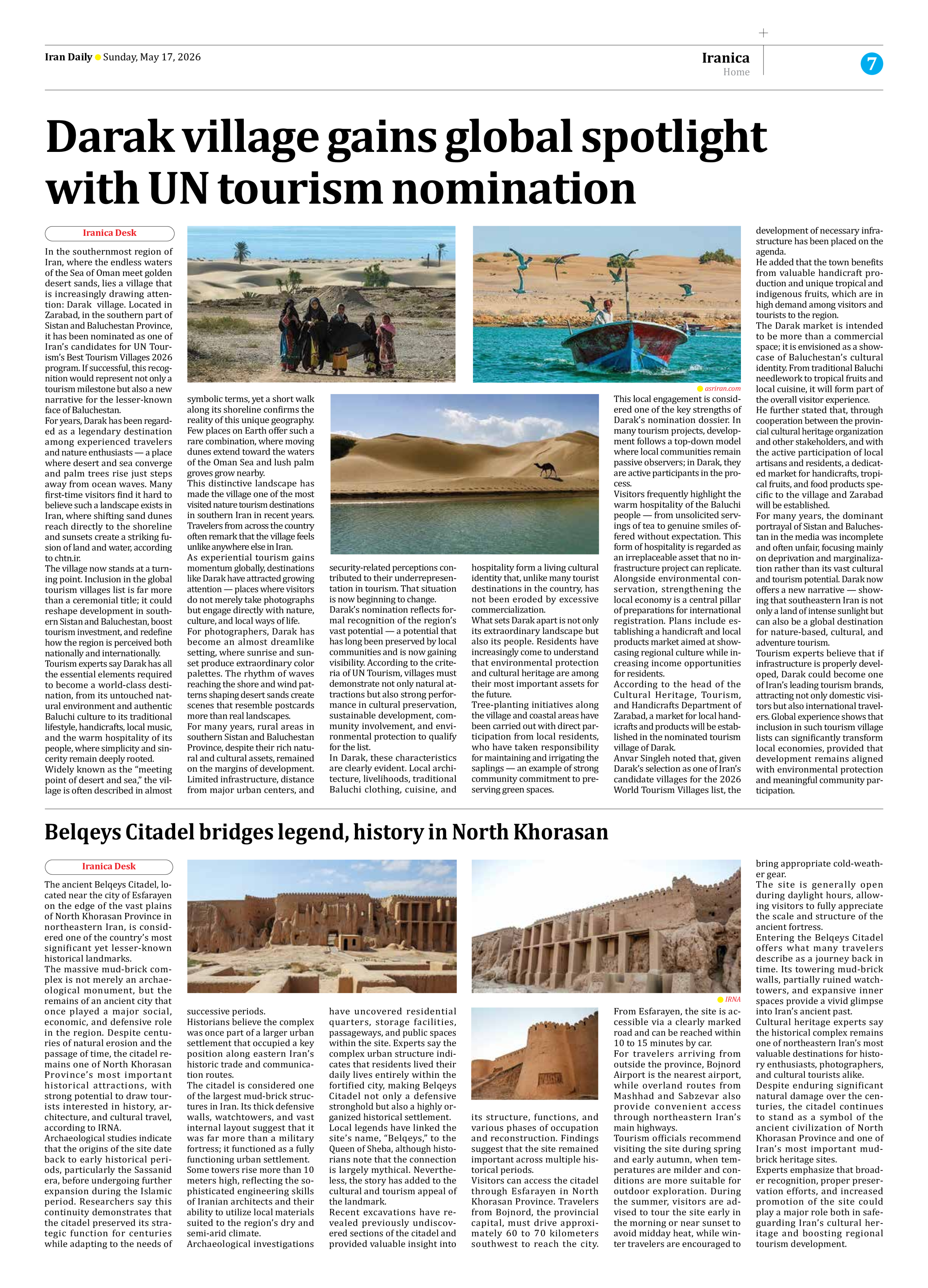
For years, Darak has been regarded as a legendary destination among experienced travelers and nature enthusiasts — a place where desert and sea converge and palm trees rise just steps away from ocean waves. Many first-time visitors find it hard to believe such a landscape exists in Iran, where shifting sand dunes reach directly to the shoreline and sunsets create a striking fusion of land and water, according to chtn.ir.
The village now stands at a turning point. Inclusion in the global tourism villages list is far more than a ceremonial title; it could reshape development in southern Sistan and Baluchestan, boost tourism investment, and redefine how the region is perceived both nationally and internationally.
Tourism experts say Darak has all the essential elements required to become a world-class destination, from its untouched natural environment and authentic Baluchi culture to its traditional lifestyle, handicrafts, local music, and the warm hospitality of its people, where simplicity and sincerity remain deeply rooted.
Widely known as the “meeting point of desert and sea,” the village is often described in almost symbolic terms, yet a short walk along its shoreline confirms the reality of this unique geography. Few places on Earth offer such a rare combination, where moving dunes extend toward the waters of the Oman Sea and lush palm groves grow nearby.
This distinctive landscape has made the village one of the most visited nature tourism destinations in southern Iran in recent years. Travelers from across the country often remark that the village feels unlike anywhere else in Iran.
As experiential tourism gains momentum globally, destinations like Darak have attracted growing attention — places where visitors do not merely take photographs but engage directly with nature, culture, and local ways of life.
For photographers, Darak has become an almost dreamlike setting, where sunrise and sunset produce extraordinary color palettes. The rhythm of waves reaching the shore and wind patterns shaping desert sands create scenes that resemble postcards more than real landscapes.
For many years, rural areas in southern Sistan and Baluchestan Province, despite their rich natural and cultural assets, remained on the margins of development. Limited infrastructure, distance from major urban centers, and security-related perceptions contributed to their underrepresentation in tourism. That situation is now beginning to change.
Darak’s nomination reflects formal recognition of the region’s vast potential — a potential that has long been preserved by local communities and is now gaining visibility. According to the criteria of UN Tourism, villages must demonstrate not only natural attractions but also strong performance in cultural preservation, sustainable development, community involvement, and environmental protection to qualify for the list.
In Darak, these characteristics are clearly evident. Local architecture, livelihoods, traditional Baluchi clothing, cuisine, and hospitality form a living cultural identity that, unlike many tourist destinations in the country, has not been eroded by excessive commercialization.
What sets Darak apart is not only its extraordinary landscape but also its people. Residents have increasingly come to understand that environmental protection and cultural heritage are among their most important assets for the future.
Tree-planting initiatives along the village and coastal areas have been carried out with direct participation from local residents, who have taken responsibility for maintaining and irrigating the saplings — an example of strong community commitment to preserving green spaces.
This local engagement is considered one of the key strengths of Darak’s nomination dossier. In many tourism projects, development follows a top-down model where local communities remain passive observers; in Darak, they are active participants in the process.
Visitors frequently highlight the warm hospitality of the Baluchi people — from unsolicited servings of tea to genuine smiles offered without expectation. This form of hospitality is regarded as an irreplaceable asset that no infrastructure project can replicate.
Alongside environmental conservation, strengthening the local economy is a central pillar of preparations for international registration. Plans include establishing a handicraft and local products market aimed at showcasing regional culture while increasing income opportunities for residents.
According to the head of the Cultural Heritage, Tourism, and Handicrafts Department of Zarabad, a market for local handicrafts and products will be established in the nominated tourism village of Darak.
Anvar Singleh noted that, given Darak’s selection as one of Iran’s candidate villages for the 2026 World Tourism Villages list, the development of necessary infrastructure has been placed on the agenda.
He added that the town benefits from valuable handicraft production and unique tropical and indigenous fruits, which are in high demand among visitors and tourists to the region.
The Darak market is intended to be more than a commercial space; it is envisioned as a showcase of Baluchestan’s cultural identity. From traditional Baluchi needlework to tropical fruits and local cuisine, it will form part of the overall visitor experience.
He further stated that, through cooperation between the provincial cultural heritage organization and other stakeholders, and with the active participation of local artisans and residents, a dedicated market for handicrafts, tropical fruits, and food products specific to the village and Zarabad will be established.
For many years, the dominant portrayal of Sistan and Baluchestan in the media was incomplete and often unfair, focusing mainly on deprivation and marginalization rather than its vast cultural and tourism potential. Darak now offers a new narrative — showing that southeastern Iran is not only a land of intense sunlight but can also be a global destination for nature-based, cultural, and adventure tourism.
Tourism experts believe that if infrastructure is properly developed, Darak could become one of Iran’s leading tourism brands, attracting not only domestic visitors but also international travelers. Global experience shows that inclusion in such tourism village lists can significantly transform local economies, provided that development remains aligned with environmental protection and meaningful community participation.