







South Khorasan’s intangible heritage faces challenge of change
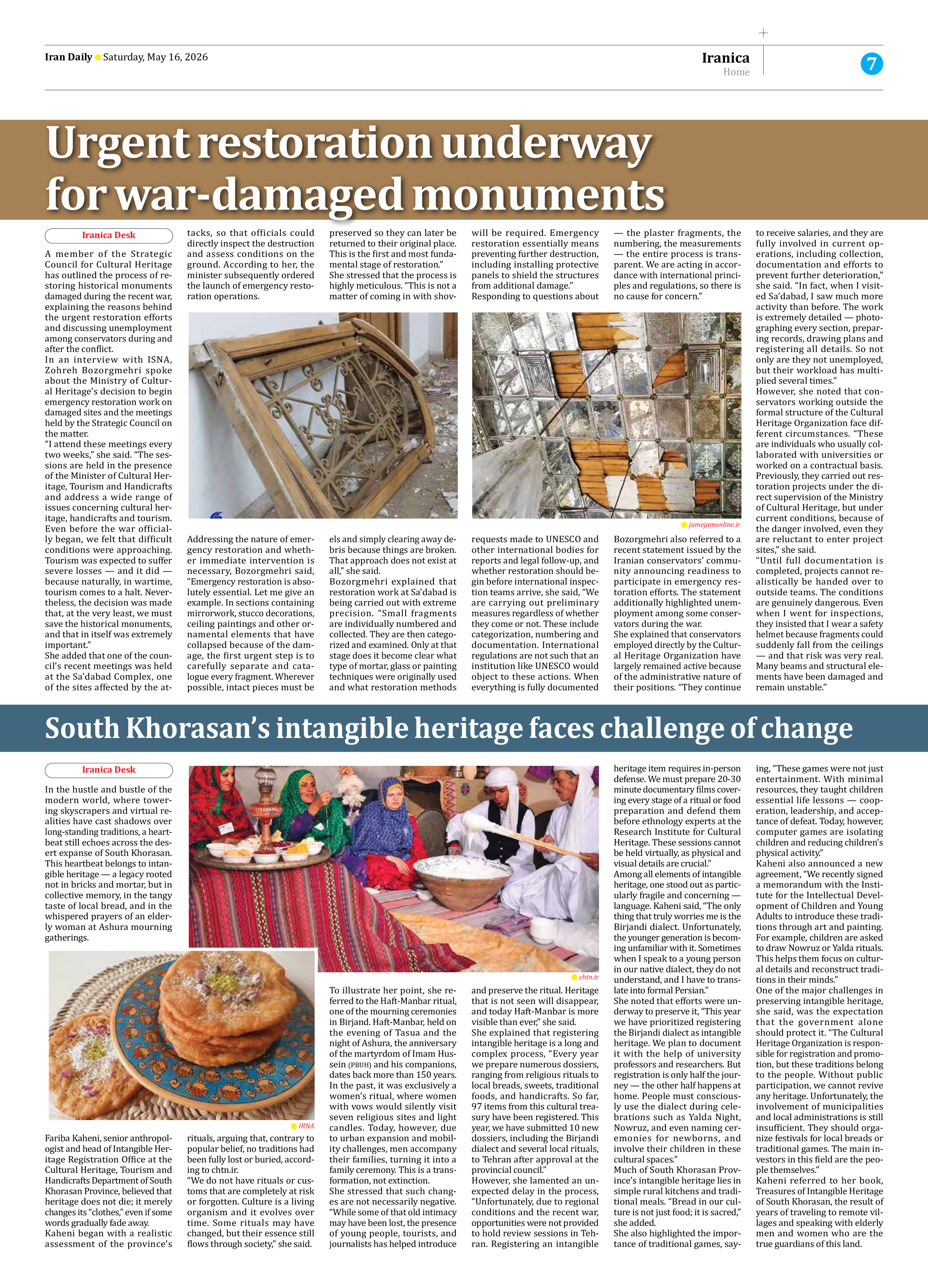
In the hustle and bustle of the modern world, where towering skyscrapers and virtual realities have cast shadows over long-standing traditions, a heartbeat still echoes across the desert expanse of South Khorasan. This heartbeat belongs to intangible heritage — a legacy rooted not in bricks and mortar, but in collective memory, in the tangy taste of local bread, and in the whispered prayers of an elderly woman at Ashura mourning gatherings.
Fariba Kaheni, senior anthropologist and head of Intangible Heritage Registration Office at the Cultural Heritage, Tourism and Handicrafts Department of South Khorasan Province, believed that heritage does not die; it merely changes its “clothes,” even if some words gradually fade away.
Kaheni began with a realistic assessment of the province’s rituals, arguing that, contrary to popular belief, no traditions had been fully lost or buried, according to chtn.ir.
“We do not have rituals or customs that are completely at risk or forgotten. Culture is a living organism and it evolves over time. Some rituals may have changed, but their essence still flows through society,” she said.
To illustrate her point, she referred to the Haft-Manbar ritual, one of the mourning ceremonies in Birjand. Haft-Manbar, held on the evening of Tasua and the night of Ashura, the anniversary of the martyrdom of Imam Hussein (PBUH) and his companions, dates back more than 150 years. In the past, it was exclusively a women’s ritual, where women with vows would silently visit seven religious sites and light candles. Today, however, due to urban expansion and mobility challenges, men accompany their families, turning it into a family ceremony. This is a transformation, not extinction.
She stressed that such changes are not necessarily negative. “While some of that old intimacy may have been lost, the presence of young people, tourists, and journalists has helped introduce and preserve the ritual. Heritage that is not seen will disappear, and today Haft-Manbar is more visible than ever,” she said.
She explained that registering intangible heritage is a long and complex process, “Every year we prepare numerous dossiers, ranging from religious rituals to local breads, sweets, traditional foods, and handicrafts. So far, 97 items from this cultural treasury have been registered. This year, we have submitted 10 new dossiers, including the Birjandi dialect and several local rituals, to Tehran after approval at the provincial council.”
However, she lamented an unexpected delay in the process, “Unfortunately, due to regional conditions and the recent war, opportunities were not provided to hold review sessions in Tehran. Registering an intangible heritage item requires in-person defense. We must prepare 20-30 minute documentary films covering every stage of a ritual or food preparation and defend them before ethnology experts at the Research Institute for Cultural Heritage. These sessions cannot be held virtually, as physical and visual details are crucial.”
Among all elements of intangible heritage, one stood out as particularly fragile and concerning — language. Kaheni said, “The only thing that truly worries me is the Birjandi dialect. Unfortunately, the younger generation is becoming unfamiliar with it. Sometimes when I speak to a young person in our native dialect, they do not understand, and I have to translate into formal Persian.”
She noted that efforts were underway to preserve it, “This year we have prioritized registering the Birjandi dialect as intangible heritage. We plan to document it with the help of university professors and researchers. But registration is only half the journey — the other half happens at home. People must consciously use the dialect during celebrations such as Yalda Night, Nowruz, and even naming ceremonies for newborns, and involve their children in these cultural spaces.”
Much of South Khorasan Province’s intangible heritage lies in simple rural kitchens and traditional meals. “Bread in our culture is not just food; it is sacred,” she added.
She also highlighted the importance of traditional games, saying, “These games were not just entertainment. With minimal resources, they taught children essential life lessons — cooperation, leadership, and acceptance of defeat. Today, however, computer games are isolating children and reducing children’s physical activity.”
Kaheni also announced a new agreement, “We recently signed a memorandum with the Institute for the Intellectual Development of Children and Young Adults to introduce these traditions through art and painting. For example, children are asked to draw Nowruz or Yalda rituals. This helps them focus on cultural details and reconstruct traditions in their minds.”
One of the major challenges in preserving intangible heritage, she said, was the expectation that the government alone should protect it. “The Cultural Heritage Organization is responsible for registration and promotion, but these traditions belong to the people. Without public participation, we cannot revive any heritage. Unfortunately, the involvement of municipalities and local administrations is still insufficient. They should organize festivals for local breads or traditional games. The main investors in this field are the people themselves.”
Kaheni referred to her book, Treasures of Intangible Heritage of South Khorasan, the result of years of traveling to remote villages and speaking with elderly men and women who are the true guardians of this land.