







Urgent restoration underway for war-damaged monuments
A member of the Strategic Council for Cultural Heritage has outlined the process of restoring historical monuments damaged during the recent war, explaining the reasons behind the urgent restoration efforts and discussing unemployment among conservators during and after the conflict.
In an interview with ISNA, Zohreh Bozorgmehri spoke about the Ministry of Cultural Heritage’s decision to begin emergency restoration work on damaged sites and the meetings held by the Strategic Council on the matter.
“I attend these meetings every two weeks,” she said. “The sessions are held in the presence of the Minister of Cultural Heritage, Tourism and Handicrafts and address a wide range of issues concerning cultural heritage, handicrafts and tourism. Even before the war officially began, we felt that difficult conditions were approaching. Tourism was expected to suffer severe losses — and it did — because naturally, in wartime, tourism comes to a halt. Nevertheless, the decision was made that, at the very least, we must save the historical monuments, and that in itself was extremely important.”
She added that one of the council’s recent meetings was held at the Sa’dabad Complex, one of the sites affected by the attacks, so that officials could directly inspect the destruction and assess conditions on the ground. According to her, the minister subsequently ordered the launch of emergency restoration operations.
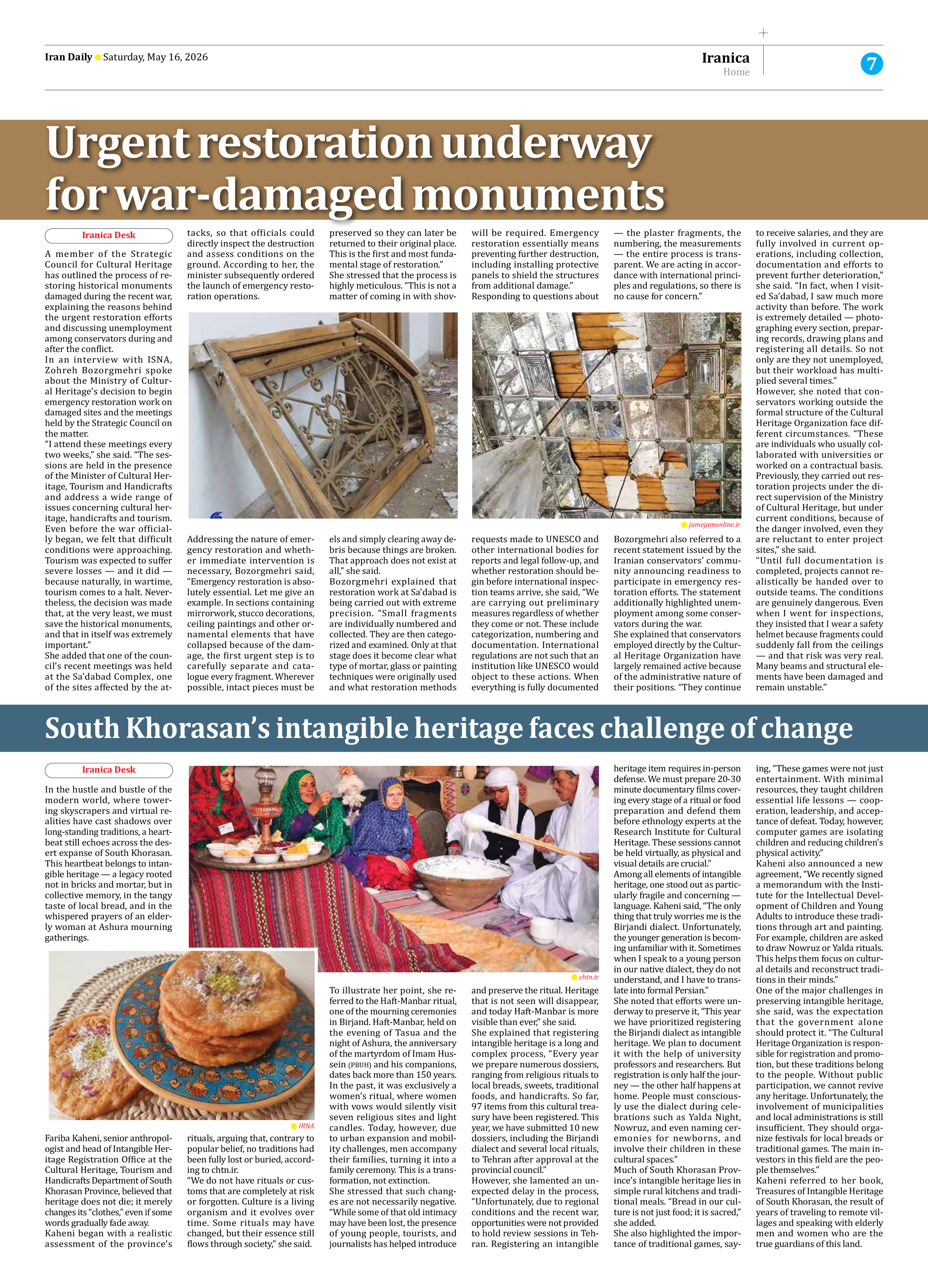
Addressing the nature of emergency restoration and whether immediate intervention is necessary, Bozorgmehri said, “Emergency restoration is absolutely essential. Let me give an example. In sections containing mirrorwork, stucco decorations, ceiling paintings and other ornamental elements that have collapsed because of the damage, the first urgent step is to carefully separate and catalogue every fragment. Wherever possible, intact pieces must be preserved so they can later be returned to their original place. This is the first and most fundamental stage of restoration.”
She stressed that the process is highly meticulous. “This is not a matter of coming in with shovels and simply clearing away debris because things are broken. That approach does not exist at all,” she said.
Bozorgmehri explained that restoration work at Sa’dabad is being carried out with extreme precision. “Small fragments are individually numbered and collected. They are then categorized and examined. Only at that stage does it become clear what type of mortar, glass or painting techniques were originally used and what restoration methods will be required. Emergency restoration essentially means preventing further destruction, including installing protective panels to shield the structures from additional damage.”
Responding to questions about requests made to UNESCO and other international bodies for reports and legal follow-up, and whether restoration should begin before international inspection teams arrive, she said, “We are carrying out preliminary measures regardless of whether they come or not. These include categorization, numbering and documentation. International regulations are not such that an institution like UNESCO would object to these actions. When everything is fully documented — the plaster fragments, the numbering, the measurements — the entire process is transparent. We are acting in accordance with international principles and regulations, so there is no cause for concern.”
Bozorgmehri also referred to a recent statement issued by the Iranian conservators’ community announcing readiness to participate in emergency restoration efforts. The statement additionally highlighted unemployment among some conservators during the war.
She explained that conservators employed directly by the Cultural Heritage Organization have largely remained active because of the administrative nature of their positions. “They continue to receive salaries, and they are fully involved in current operations, including collection, documentation and efforts to prevent further deterioration,” she said. “In fact, when I visited Sa’dabad, I saw much more activity than before. The work is extremely detailed — photographing every section, preparing records, drawing plans and registering all details. So not only are they not unemployed, but their workload has multiplied several times.”
However, she noted that conservators working outside the formal structure of the Cultural Heritage Organization face different circumstances. “These are individuals who usually collaborated with universities or worked on a contractual basis. Previously, they carried out restoration projects under the direct supervision of the Ministry of Cultural Heritage, but under current conditions, because of the danger involved, even they are reluctant to enter project sites,” she said.
“Until full documentation is completed, projects cannot realistically be handed over to outside teams. The conditions are genuinely dangerous. Even when I went for inspections, they insisted that I wear a safety helmet because fragments could suddenly fall from the ceilings — and that risk was very real. Many beams and structural elements have been damaged and remain unstable.”